
 AllSharing business

 24 July, 2025
 Why Vehicle as a Service Is the Key to Sustainable Fleets in 2026
Vehicle as a Service (VaaS) is a subscription model where businesses pay a recurring fee for vehicle access instead of buying a fleet. The provider owns the vehicles and covers maintenance, insurance and replacement.
Owning a car used to make sense. But today, with rising costs, parking hassles, and unpredictable maintenance, vehicle ownership often feels like a heavy burden. What if you didn’t have to own a car to use one, but only when you needed it?
That’s where Vehicle as a Service (VaaS) comes in.
Instead of buying and maintaining a car, VaaS lets users access vehicles on demand through subscriptions, short‑term rentals, or on‑demand services. Think of it as “mobility on tap”: you pay only for what you use, not for what sits idle.
This shift is market‑wide. The global VaaS market, valued at approximately $10.5 billion in 2024, is forecast to grow at an annual rate of 20–21%, reaching $77–81.5 billion by 2034–2035.
Why now? Urban congestion, rising cost of ownership, and growing demand for flexible, and often electric, mobility options are pushing both consumers and businesses to rethink what mobility means.
In the rest of this blog, we’ll dig into what VaaS really means, why it’s becoming a core part of modern mobility, and how businesses and operators can ride this wave.
Key Takeaways:
- VaaS Redefines Ownership: Access vehicles on demand. Pay only for what you use, with no upfront costs or maintenance headaches.
- Market Growth: The VaaS market is set to reach $77.3 billion by 2034, driven by demand for flexibility and sustainability.
- Business Efficiency: VaaS reduces capital costs and simplifies fleet management, making it easier for businesses to scale.
- Environmental Impact: VaaS helps reduce urban congestion and emissions, offering a greener alternative to traditional car ownership.
- EazyRide for Smarter Operations: EazyRide’s fleet management tools optimize routes, reduce downtime, and enhance overall fleet performance.
What Is Vehicle as a Service (VaaS)?
Vehicle-as-a-Service (VaaS) is a mobility model in which you access a vehicle when you need it without owning it. Instead of buying a car and shouldering all the costs and hassles of ownership, you pay for use via subscriptions, short‑term rentals, or on‑demand access.
This could mean renting a car for a weekend, subscribing to a monthly plan, or using a vehicle‑sharing service on demand. Here’s what VaaS could look like in practice:
- Subscription-based services — users pay a recurring fee for vehicle access, insurance, maintenance, and often roadside assistance. Think of it as a “car‑as-a-service membership.”
- Pay-per-use or on‑demand rentals — ideal for occasional users who don’t need a vehicle full-time. You use a car (or other vehicle) when required, and pay only for the time or distance used.
- Fleet and corporate mobility services — companies or operators manage a fleet of vehicles and offer access to customers or employees as needed, rather than selling vehicles. This model supports flexibility, scalability, and asset‑efficient usage.
How fast is VaaS growing today?
According to a recent report, the global VaaS market is projected to grow to $77.3 billion by 2034, at a CAGR of 20.7%. Within that, subscription‑based VaaS is the dominant model, accounting for roughly 63% of market share in 2024.
This growth reflects a broader shift: people and businesses increasingly value access, flexibility, and predictable costs over the burdens of traditional ownership.
Key Drivers Behind the Rise of Vehicle as a Service
Several powerful trends are fueling the shift from traditional car ownership to service‑based mobility. Understanding these drivers helps explain why VaaS is gaining momentum now and why it matters for businesses, fleet operators, and cities.
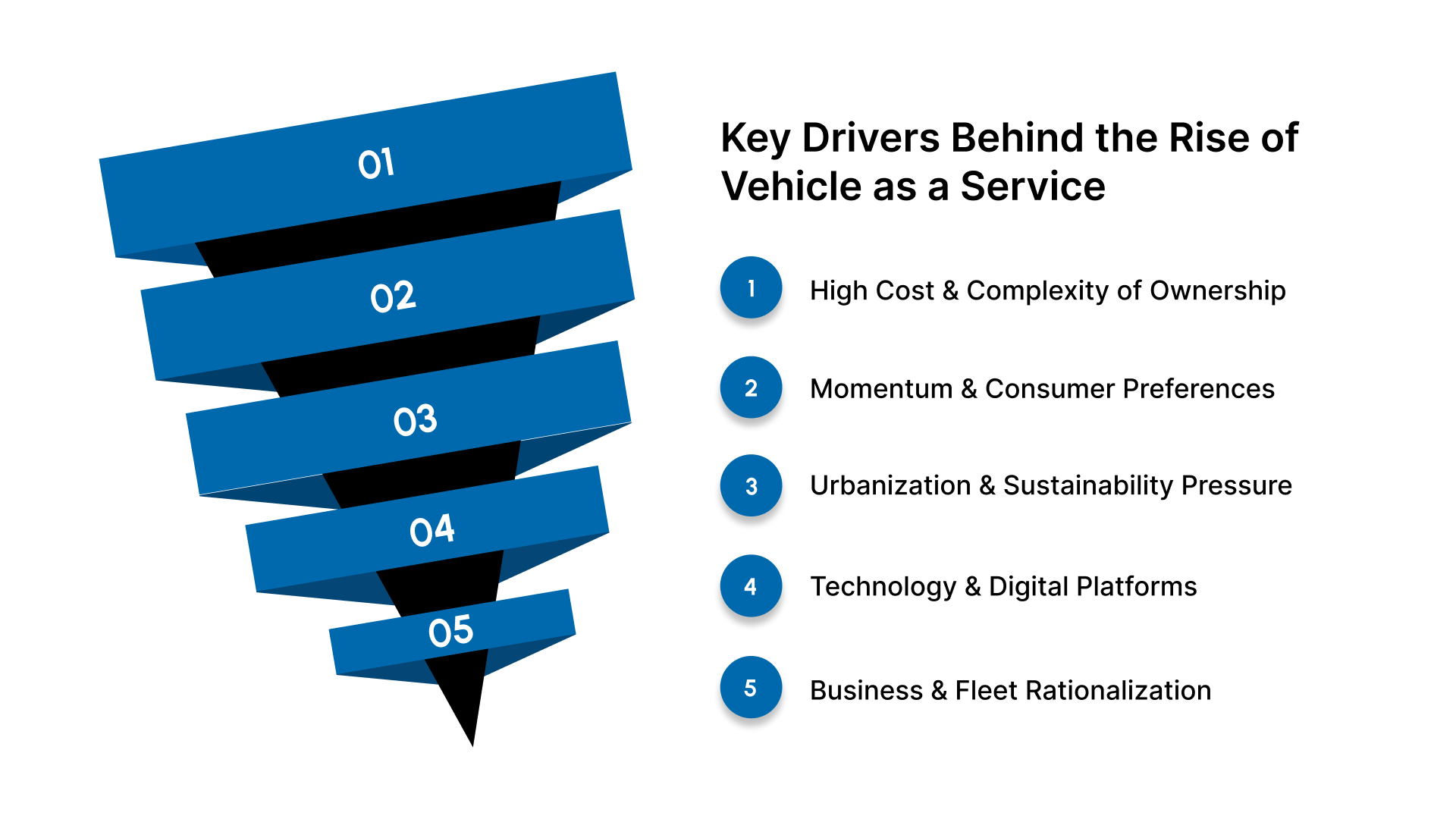
1. High Cost & Complexity of Ownership
The rising cost of owning and maintaining a vehicle (purchase, financing, insurance, maintenance, parking) is driving more people and companies toward flexible alternatives. For many, owning a car makes little sense if they drive infrequently.
VaaS lets users pay only for what they use, radically reducing “idle cost.” This model resonates in dense, parking‑constrained cities where owning a car is more of a liability than a convenience.
2. Momentum & Consumer Preferences
In the broader mobility space, models under Mobility as a Service (MaaS), which includes VaaS, are expanding rapidly. This reflects a generational shift: many consumers now value access over ownership, favor flexibility, and prefer subscription/on‑demand mobility over long‑term ownership commitments.
3. Urbanization & Sustainability Pressure
As cities become more crowded, urban congestion and pollution are rising. This creates pressure on individuals and municipalities to find smarter, cleaner mobility alternatives. VaaS – especially when bundled with EV or shared‑fleet models – helps reduce the number of individual vehicles on roads, easing congestion and emissions.
In urban contexts, shorter trips, unpredictable commuting patterns, and limited parking make flexible mobility more practical than owning a vehicle full‑time. VaaS fits this need by offering vehicles only when required.
4. Technology & Digital Platforms
Advances in digital platforms, mobile apps, telematics, and connected‑vehicle technology make on‑demand access seamless. Users can book, unlock, pay, and return vehicles with a tap. Many VaaS operators now integrate maintenance, insurance, and support into a single package, removing traditional ownership pain points.
For operators, connected‑vehicle data and telematics (which tie into fleet‑management platforms) improve utilization, maintenance scheduling, and vehicle lifecycle management.
5. Business & Fleet Rationalization
For businesses, corporate campuses, residential developers, resorts, or mobility service providers, VaaS enables fleet access without owning or managing vehicles long‑term. This reduces capital expenditure, simplifies maintenance, and offers predictable operational costs.
VaaS aligns with ESG and sustainability goals: operators can deploy EV fleets, reduce emissions per ride, and promote shared use. It’s all attractive to companies under pressure to meet green commitments.
Benefits of Vehicle as a Service (VaaS) for Businesses and Consumers
As cities become more congested, consumers increasingly seek flexible, sustainable mobility solutions. For businesses, VaaS offers an opportunity to reduce operational costs, scale fleets easily, and offer employees or customers flexible transportation options.
For individual consumers, VaaS unlocks a new world of convenience and affordability, where you pay only for the exact mobility services you use, whether for daily commuting or occasional trips.
Let’s get into the top benefits that VaaS brings:
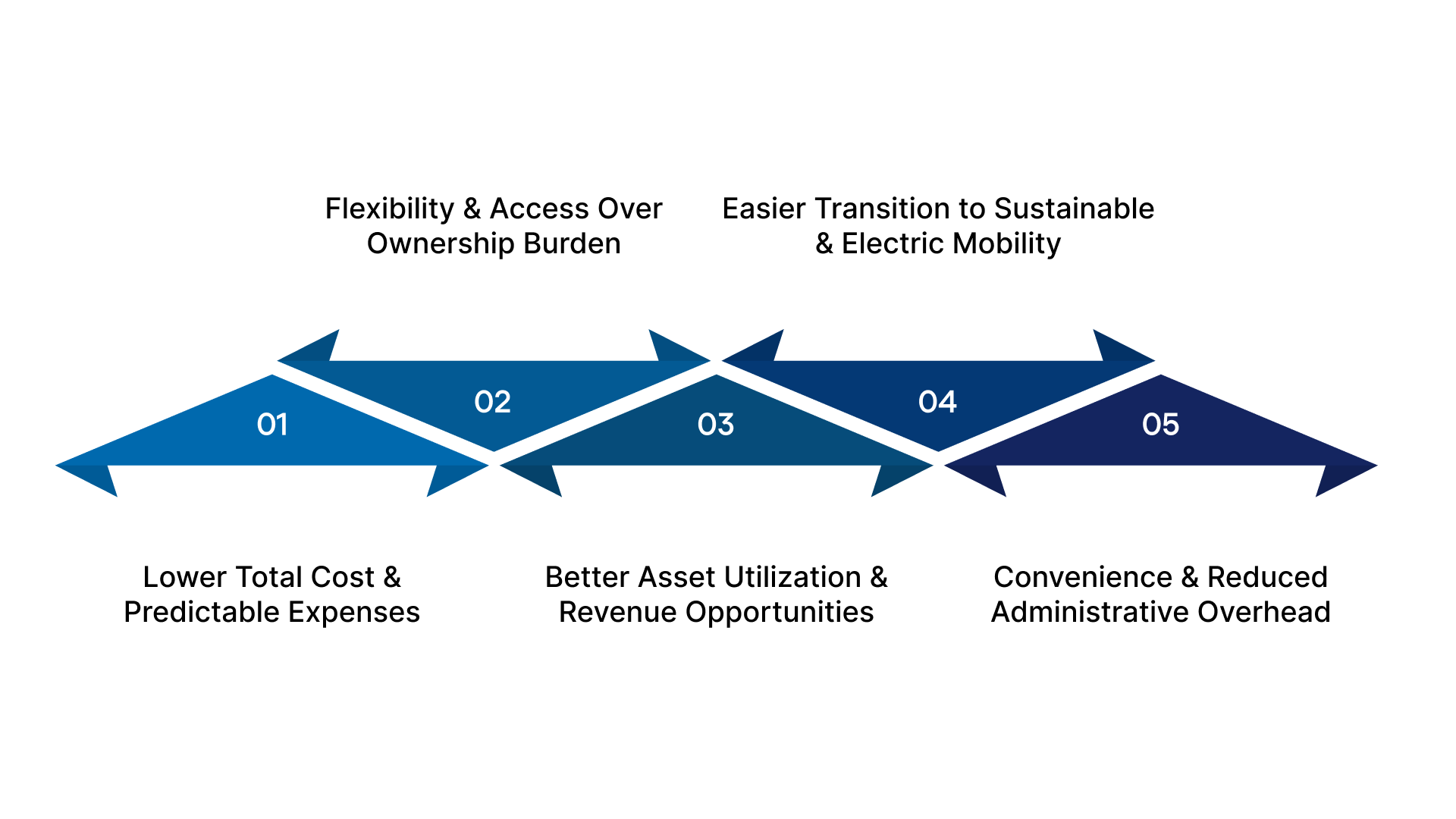
- Lower Total Cost & Predictable ExpensesFor businesses, cost predictability becomes a big advantage: instead of budgeting for uncertain maintenance or repair bills, you get fixed, recurring costs for vehicle access, maintenance, and insurance.
- Flexibility & Access Over Ownership BurdenVaaS gives users or businesses flexibility: you access a vehicle only when you need it without a long‑term commitment. This removes the burden of depreciation, extended financing, and vehicle downtime.
- Better Asset Utilization & Revenue OpportunitiesBecause vehicles remain fleet assets, operators can control lifecycle, maintenance, and remarketing. This maximizes vehicle utilization rather than leaving them idle as with private ownership.
- Easier Transition to Sustainable & Electric MobilityVaaS providers increasingly include electric vehicles (EVs) or eco‑friendly options. This works well for companies or cities targeting sustainability goals: lower emissions, fewer vehicles per capita, and a smaller carbon footprint than traditional vehicle ownership.
- Convenience & Reduced Administrative OverheadSubscriptions or VaaS packages usually bundle maintenance, insurance, roadside assistance, and sometimes even registration/tax. This makes fleet deployment easier for businesses like those expanding quickly or operating mixed fleets, because they don’t have to manage maintenance or logistics in-house.
Suggested Read: The Future of Electric Vehicles
VaaS doesn’t just work in isolation. Let’s see how it integrates into the broader mobility ecosystem to create a more sustainable transportation network.
How Vehicle as a Service (VaaS) Fits Into the Broader Mobility Ecosystem
As cities and mobility needs evolve, VaaS doesn’t operate in isolation. It integrates into a larger mobility ecosystem alongside public transit, micromobility, and shared mobility.
For instance, VaaS fills gaps that public transport or micromobility can’t efficiently serve, like occasional long‑distance trips, weekend getaways, or cargo‑heavy needs.
Additionally, VaaS makes multi-modal commuting smoother: e.g., public transit + on‑demand vehicle for the first/last mile or for specific tasks. This flexibility increases overall mobility and reduces dependency on personal cars.
There are more instances to take into account:
- For fleet operators and mobility startups, VaaS enables asset-light fleet access models. You don’t sell vehicles, you offer them as a service. This makes scaling easier, reduces capital tied up in underused vehicles, and improves utilization over time.
- For users and businesses, VaaS shifts transport from a fixed, upfront-cost mindset (buy a car, pay maintenance) to a flexible, usage-based cost model. You pay for what you need, when you need it.
- Shared and on‑demand vehicle services like VaaS can reduce the total number of privately owned vehicles, easing parking shortages, reducing infrastructure strain, and lowering urban emissions.
- Companies, campuses, resorts, or residential developers can use VaaS as a mobility solution for employees, guests, or residents without investing in their own vehicle fleet. This reduces capital expenditure and maintenance burden while ensuring mobility access.
VaaS works exceptionally well alongside corporate micromobility (e‑bikes, scooters) or shared shuttle services. This gives users options depending on distance, needs, or convenience.
Vehicle‑as‑a‑Service (VaaS) vs. Traditional Vehicle Ownership: A Clear Comparison
When you compare VaaS to traditional car ownership or leasing, the differences go beyond convenience. For many people and businesses, VaaS changes the financial model, the flexibility, and even the environmental footprint of mobility.
Here’s how they stack up and when VaaS truly makes more sense:
| Aspect | VaaS | Traditional Ownership |
|---|---|---|
| Cost Structure | Pay-per-use or subscription, no upfront costs, predictable monthly payments | High upfront costs, ongoing expenses (maintenance, insurance, parking, etc.) |
| Flexibility | On-demand access, vehicle type swaps, no long-term commitment | Fixed vehicle type, ownership responsibility, and less flexibility |
| Depreciation | No depreciation risk — pay only for use | Depreciates over time, loss in value from day 1 |
| Maintenance & Insurance | Included in the service (maintenance, insurance, support) | User is responsible for all maintenance, repairs, and insurance |
| Environmental Impact | Reduced emissions, fewer cars on the road, shared fleet utilization | Higher emissions, more vehicles needed per capita, & underutilization of owned cars |
| Parking & Space Requirements | No need for personal parking — vehicles returned after use | Requires a dedicated parking space, contributes to urban congestion |
| Utilization Efficiency | High — vehicles used by many, reduced idle time | Low — personal vehicles sit unused for long periods, leading to poor asset utilization |
| Sustainability | Supports green mobility with access to electric vehicles and shared services | Typically relies on combustion engine vehicles, which are less sustainable over time |
You can see VaaS offers many advantages, but it isn’t always the clear winner.
In certain circumstances, like high-income users, frequent drivers, long rural commutes, or heavy usage households, traditional ownership or even ownership of a personal automated vehicle could remain more cost‑effective than on‑demand services.
That means VaaS tends to deliver the most value when usage is:
- Intermittent or unpredictable
- Primarily urban or city‑based (less parking/maintenance burden)
- Shared across users or for fleets – maximizing asset utilization
Key Challenges & Considerations for Vehicle‑as‑a‑Service (VaaS)
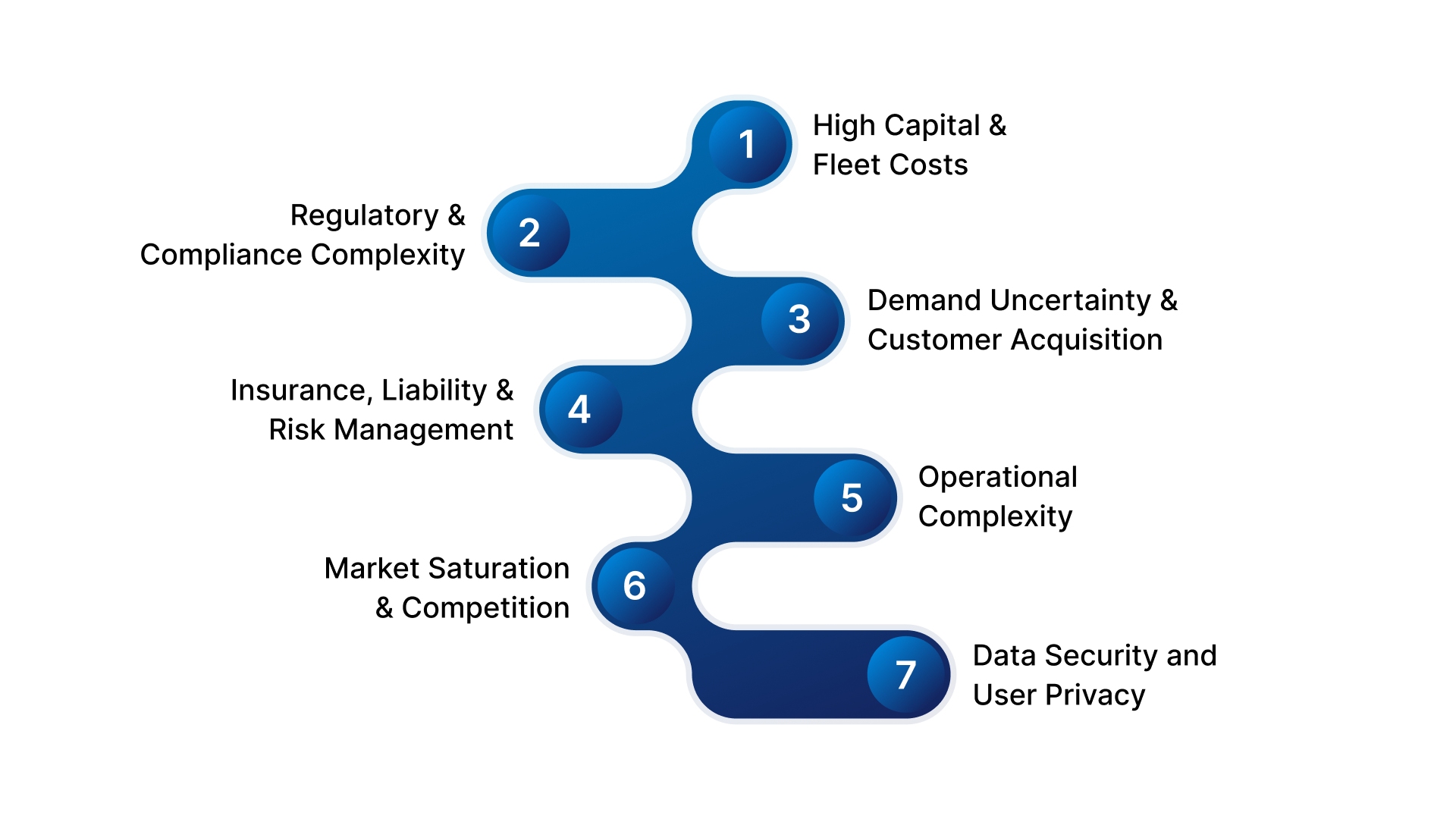
Even though VaaS brings many advantages, it’s not without real challenges. For operators, businesses, or cities considering adoption, being aware of these hurdles is crucial. Planning for them early can make the difference between a successful rollout and a wasted investment.
1. High Capital & Fleet Costs
To offer VaaS at scale, providers need to own or lease a fleet large enough to meet demand on demand. Buying or leasing many vehicles up front requires significant capital.
After purchase, there’s also a continuous cost: maintenance, insurance, registration, refurbishing, and eventual replacement. This burden grows quickly as fleet size increases.
- Possible Mitigation: Use a mix of purchase and lease/subscription financing, or stagger fleet acquisition based on demand forecasts rather than buying a large fleet upfront. Employ robust fleet‑maintenance workflows to minimize repair costs and downtime.
2. Regulatory & Compliance Complexity
VaaS intersects with many regulatory domains, including vehicle registration, insurance, safety standards, emissions norms, and, in some cases, micromobility-specific rules, depending on vehicle type. Regulations often vary across states or municipalities.
- Possible Mitigation: Build compliance and regulation-check processes early. Work with local authorities to understand and meet requirements. Use a modular service model that can adapt to local regulations.
3. Demand Uncertainty & Customer Acquisition
For VaaS to be profitable, the utilization rate must stay high. But demand for on‑demand vehicles can be volatile. It is dependent on location, seasonality, consumer preferences, and alternative mobility options.
- Possible Mitigation: Use data-driven demand forecasting before scaling; start with pilots in high-demand areas; diversify mobility offerings (e.g., combining VaaS with micromobility or fleet‑sharing) to optimize utilization.
4. Insurance, Liability & Risk Management
With shared or on-demand vehicles, users may be less familiar with each vehicle, increasing the risk of accidents, misuse, or damage. That translates to higher insurance premiums, greater liability exposure, and higher costs for providers.
- Possible Mitigation: Implement driver‑monitoring, usage tracking, and safety policies. Maintain well-kept vehicles, offer clear user guidelines, and integrate insurance costs into subscription pricing.
5. Operational Complexity
A shared fleet needs regular maintenance, cleaning, rebalancing (especially if shared across areas), tracking, and possibly rapid replacement cycles to keep vehicles safe and reliable. It’s more complex than owning a single car.
- Possible Mitigation: Use fleet‑management software, maintenance scheduling, and predictive maintenance approaches. Keep spare vehicles to handle demand or downtime. Plan logistics (cleaning, pick-up/drop-off, EV recharging) efficiently.
6. Market Saturation & Competition
As VaaS becomes more popular, competition from car subscriptions, rentals, ride‑hailing, and even traditional ownership intensifies. Price wars, margin pressure, and customer churn become more likely.
- Possible Mitigation: Focus on niche segments like corporate fleets, specialized use cases, premium service, or complement VaaS with additional value (e.g., maintenance, flexibility, EV options). Build a strong brand and customer experience to avoid competing purely on price.
7. Data Security and User Privacy
As VaaS increasingly uses connected vehicle technologies like telematics, tracking, IoT, and innovative apps, there’s increased exposure to cybersecurity risks, data leaks, and misuse of personal/vehicle data.
- Possible Mitigation: Implement robust cybersecurity practices, data privacy policies, and secure backend systems. Consider anonymized usage data, secure authentication, and transparent user consent and data usage policies.
In short, VaaS offers strong potential, but success depends heavily on how well you manage operations, costs, risk, and customer expectations. Getting those pieces right will decide whether VaaS becomes a strategic advantage or a drain on resources.
The Future of Vehicle‑as‑a‑Service (VaaS): What’s Next
The VaaS model is still evolving, and what’s coming could reshape mobility altogether.
The latest market data show that, within the VaaS sector, electric vehicles (EVs) are expected to dominate over the next 5–10 years. In addition, global autonomous vehicle (AV) market estimates suggest high double-digit growth through 2030 and beyond.
When AVs combine with the VaaS model, you get a solid and scalable mobility paradigm: fleets of shared, on-demand, driverless electric vehicles that reduce driver‑related costs and maximize utilization.
That’s not it, there’s more:
- As technology advances – IoT sensors, telematics, fleet‑management software – VaaS operators will get better at predictive maintenance, usage forecasting, dynamic pricing, and optimizing fleet size to demand. This reduces idle time, lowers maintenance costs, and improves overall utilization.
- With data, operators can dynamically match supply to demand, shift vehicles to areas of higher usage, and efficiently manage battery/charging cycles (primarily for EV fleets).
What You Should Watch Out For?
While the future looks promising, success will require careful planning:
- Invest early in EVs and infrastructure (charging, maintenance). Delaying that may leave your fleet outdated.
- Build flexibility into your model because demand patterns, tech developments (like AVs), and regulations may shift rapidly.
- Utilize data-smart fleet management. Simple “own and rent” models will likely become obsolete; the edge will go to those who use predictive analytics and optimize fleet performance.
- Consider partnerships with tech providers, municipalities, or shared mobility platforms rather than going solo. Collaboration may be key to profitability and regulatory compliance.
As VaaS continues to evolve, the right tools will help you stay ahead. See how EazyRide is designed to empower your VaaS operations for maximum efficiency.
How EazyRide Can Empower Your VaaS Operations
VaaS is growing, and fleet operators need more than just basic vehicle tracking. They need a comprehensive platform that provides clear visibility, automation, and easy-to-use tools that can help them scale, optimize, and maintain their fleet efficiently.
That’s where EazyRide comes in.
EazyRide doesn’t just offer data; it empowers operators to act on it, turning complex logistics into simplified operations. Here’s how:
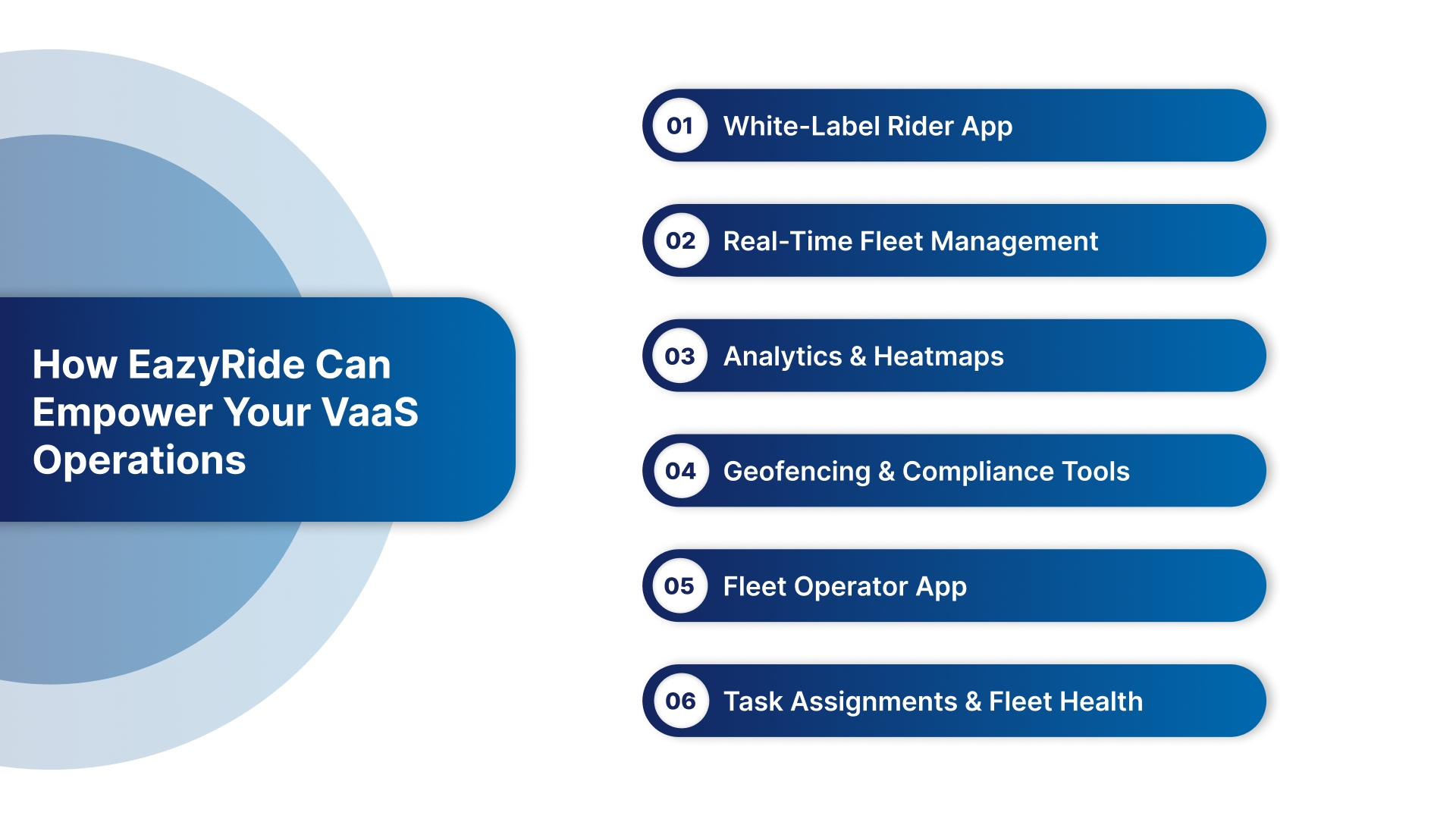
- White-Label Rider App: A fully customizable rider app that reflects your branding, colors, and unique features. Riders experience a seamless interface to unlock, ride, and pay, but everything feels like your business.
- Real-Time Fleet Management: Admin dashboard provides real-time visibility into each vehicle’s location, battery status, usage patterns, and more. Make smarter, faster decisions about fleet deployment & maintenance scheduling.
- Analytics & Heatmaps: Access heatmaps and usage patterns — daily, hourly, or even zone-specific. Highlight areas of high demand, underutilized zones, and emerging trends.
- Geofencing & Compliance Tools: Set up geofences to define allowed ride zones, slow-speed corridors, and parking areas. This ensures your fleet stays compliant with local regulations.
- Fleet Operator App: Your fleet operators have everything they need in one mobile app. From task prioritization to maintenance workflows and even vehicle rebalancing, EazyRide ensures smoother operations across your entire fleet.
- Task Assignments & Fleet Health: Fleet operators can view priority tasks, maintain a regular schedule, and ensure fleet health with minimal effort, reducing downtime and increasing availability.
By automating tasks, providing real-time data, and offering predictive insights, EazyRide helps your VaaS business thrive in an increasingly competitive and data-driven market.
Conclusion
As cities become more crowded, the traditional model of vehicle ownership no longer fits the needs of today’s commuters, businesses, and fleet operators. Vehicle-as-a-Service (VaaS) is a smarter, more sustainable alternative that offers flexibility, cost savings, and scalability – all while reducing congestion and emissions.
With EazyRide, you gain complete control over your fleet’s performance, cost-effectiveness, and scalability, making it easier to meet growing customer demands while reducing operational costs.
Ready to future-proof your mobility operations and discover the full potential of VaaS? Request a demo today and see how EazyRide can help ease your fleet management and elevate your business.
FAQs
Q1. What exactly is “Vehicle as a Service” (VaaS)?
VaaS means you get access to a vehicle (car, scooter, or other) when you need it. You can get it via subscription, on‑demand rental, or usage‑based access instead of owning it long‑term.
Q2. Who benefits most from using VaaS – individuals or businesses?
Both benefit. Individuals save on upfront costs, maintenance, and insurance; businesses (or fleet operators) gain flexibility, easier fleet scaling, and the elimination of the long-term burden of owning and managing vehicles.
Q3. Is VaaS more cost‑effective than owning a car?
Often yes, because VaaS shifts costs from unpredictable maintenance, depreciation, and insurance to fixed or usage-based payments. It reduces total cost and financial risk for users.
Q4. Can VaaS adapt for occasional use rather than daily commuting?
Absolutely. VaaS works well for occasional use. Users pay only when they need a vehicle (weekends, trips, occasional errands), avoiding the costs associated with full-time ownership or underused cars.
Q5. Are there downsides or limitations to VaaS I should be aware of ?
Yes. Demand fluctuations, vehicle availability during peak times, regulatory or maintenance overhead for operators, and dependency on service-level quality can affect reliability and cost-benefit. Well‑managed operations and robust fleet tools help mitigate these risks.


