Bike vs Scooter: Choosing the Best Daily Commuter
As cities become more congested and environmental concerns rise, many commuters are turning to alternative transportation options like bikes and scooters. In 2023, shared micromobility trips in the U.S. and Canada reached an all-time high of 133 million, with scooter ridership accounting for 65 million trips and bike ridership at 68 million trips.
Both offer a more eco-friendly and efficient alternative to driving, but the choice between bike vs scooter depends on several factors, including speed, convenience, cost, and the nature of your daily commute. Understanding the differences between these two popular modes of transportation is key to making the right choice.
In this blog, we’ll compare bikes and scooters, highlighting the factors that matter most to help you determine the best option for your needs.
Key Takeaways
- The choice between bike and scooter depends on your commute distance, terrain, and personal preferences, with each option offering unique advantages.
- Scooters excel in speed and convenience for short urban commutes, while bikes (especially e-bikes) are better suited for longer distances and varied terrains.
- Bikes offer the added benefit of physical exercise, whereas scooters provide a low-effort, quick, and easy mode of transport for daily commuters.
- Cost and maintenance play a significant role in your decision, with traditional bikes being more budget-friendly, but e-bikes and scooters requiring more initial investment and occasional maintenance.
- Both bikes and scooters are eco-friendly alternatives to traditional vehicles, but traditional bikes have a lower environmental impact, while e-scooters and e-bikes still contribute to sustainability efforts.
The Rise of Urban Micromobility
Urban landscapes are evolving rapidly, and so are the ways people move within them. With traffic congestion reaching record levels in cities worldwide, daily commuting has become a major source of stress and lost productivity.
In the U.S., for example, drivers spend an average of 43 hours per year stuck in traffic. California cities top the list of longest commutes, with Los Angeles drivers experiencing travel times up to 50% longer during peak hours. This resulted in an estimated $771 in lost time and productivity per driver. Across the United States, this adds up to over four billion hours lost, with a total economic impact of approximately $74 billion.
This challenge has fueled the growth of micromobility solutions — small, lightweight vehicles like bicycles and scooters designed for short to medium distances. Between 2018 and 2024, the number of shared bike and scooter programs globally surged, with major urban centers embracing these options.
Environmental and social factors also play a key role. Micromobility reduces greenhouse gas emissions, decreases noise pollution, and encourages active lifestyles. Cities are responding with dedicated lanes, parking zones, and incentive programs to support bike and scooter usage. For commuters, this shift isn’t just about convenience — it’s about a sustainable, flexible, and faster alternative to traditional cars and public transit.
Types of Bikes and Scooters
Choosing the right micromobility option goes beyond just picking a bike or a scooter — each category has distinct subtypes, designed for different distances, terrains, and lifestyles. Understanding these options ensures that your choice matches both your commute and personal preferences.
Bikes
1. Traditional Bikes: These are the classic pedal-powered bicycles that have been around for decades. They are simple, durable, and low-maintenance, making them ideal for daily commuting on flat or moderately hilly routes. Traditional bikes are also a good choice for fitness-conscious commuters who want to integrate exercise into their routine. On the downside, long commutes or steep inclines can be physically demanding.
2. E-bikes (Electric Bikes): E-bikes come with an electric motor that provides pedal assistance, reducing the effort needed to cover longer distances or tackle hills. Depending on the model, an e-bike can travel 30–80 km on a single charge, making it a practical alternative to cars for medium-length commutes. They are increasingly popular in cities like Amsterdam and San Francisco, where hilly terrain and traffic congestion make traditional biking challenging. While convenient, e-bikes are heavier than standard bikes and require regular charging, which may be a consideration for some commuters.
3. Hybrid Bikes: Hybrid bikes combine elements of road bikes and mountain bikes, offering a versatile option for mixed commuting conditions. They typically have a comfortable upright riding position, medium-width tires for stability, and gears suitable for both flat streets and light off-road trails. Hybrids are ideal for commuters who traverse varied terrains — for example, moving from suburban roads to city streets or park paths. The trade-off is that hybrids may not be as fast as a road bike or as rugged as a mountain bike, but they strike a practical balance for daily commuting.
Scooters
1. Kick Scooters: Kick scooters are manual, lightweight, and extremely portable. They are often foldable, making them easy to carry into offices, trains, or buses. These scooters are best suited for very short trips or last-mile connectivity, such as moving from a metro station to the workplace. While affordable and low-maintenance, kick scooters require physical effort and are not ideal for long commutes or hilly terrain.
2. Electric Scooter: Electric scooters have surged in popularity due to their ease of use and speed. Powered by rechargeable batteries, they can reach speeds of 15–30 km/h and cover distances up to 40 km per charge, depending on the model. They are perfect for city commuting where traffic congestion is high, and parking is limited. Some high-end models even come with features like suspension for smoother rides, smartphone integration for tracking battery life, and foldable frames for portability.
Common Facts about Bikes and Scooters that People Often Miss Out On
While bikes and scooters are increasingly popular, several practical and surprising facts often go unnoticed. Understanding these can help commuters make smarter choices and optimize their daily travel.
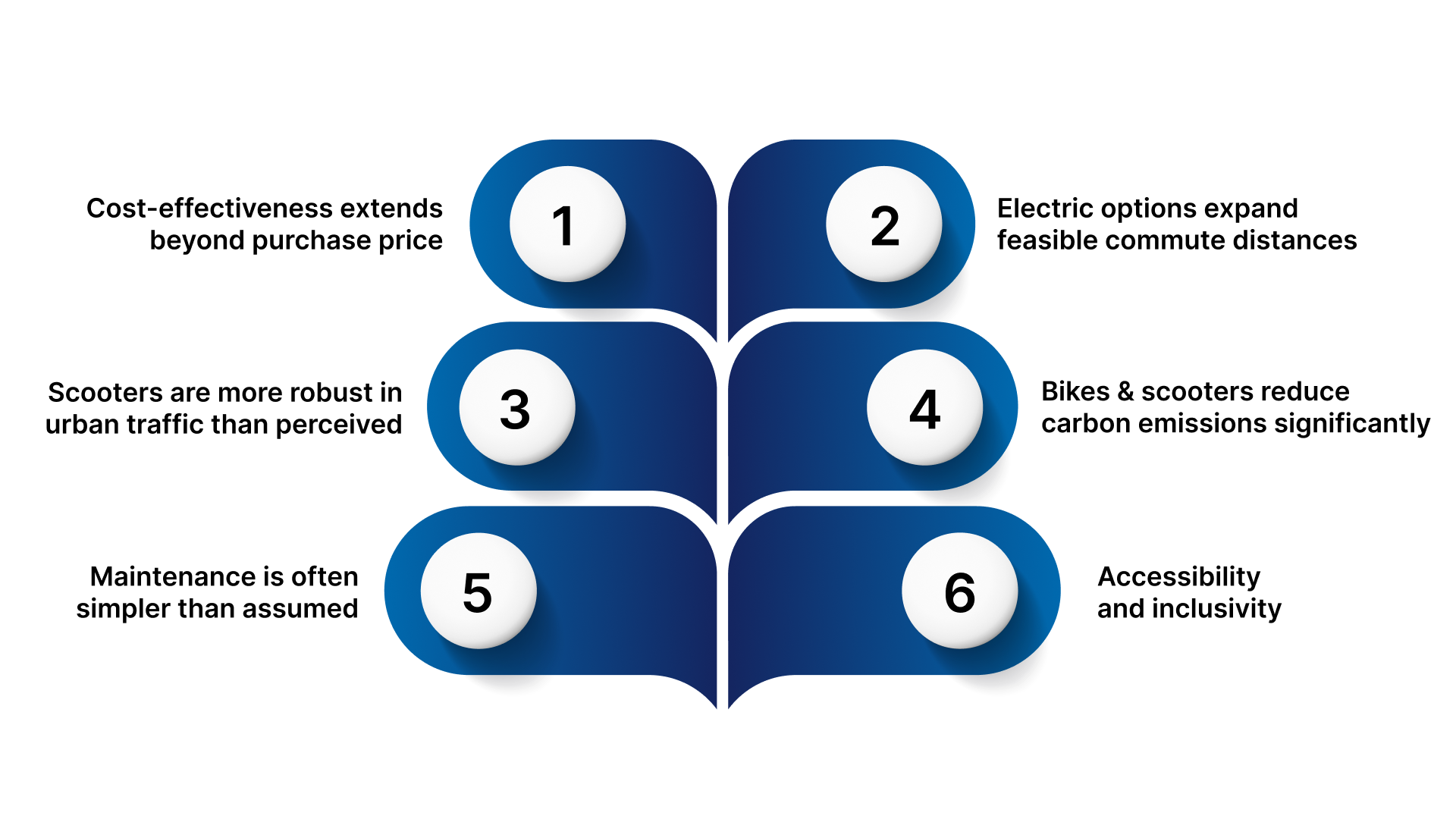
- Cost-effectiveness extends beyond purchase price: Many commuters assume that electric bikes or scooters are expensive to maintain. In reality, studies from 2023 show that the average e-bike costs about $0.03 per mile to operate, including charging and maintenance, compared to $0.58 per mile for a typical car in the U.S. over fuel, insurance, and wear-and-tear costs.
- Electric options expand feasible commute distances: While traditional bikes are ideal for short urban trips, e-bikes allow commuters to cover 3–4 times the distance without additional physical strain. Research indicates the average e-bike trip in the U.S. is around 5.7 miles, making them suitable for longer commutes that might otherwise require a car.
- Scooters are more robust in urban traffic than perceived: Contrary to the belief that scooters are unsafe in congested areas, city trials in 2023 revealed that scooter riders had a lower accident rate per mile than drivers in urban centers like San Francisco and Chicago. The key is adherence to designated lanes and local traffic laws.
- Bikes and scooters reduce carbon emissions significantly: Commuters switching from cars to electric scooters or e-bikes can reduce personal commuting emissions by replacing 57.6% of car trips. This contributes directly to urban air quality improvements, especially in cities struggling with traffic-related pollution.
- Maintenance is often simpler than assumed: Electric scooters and e-bikes require minimal upkeep if used for commuting. Routine checks such as tire pressure, brake function, and battery health are sufficient, reducing the fear of complex or expensive repairs.
- Accessibility and inclusivity: Shared e-bike and scooter programs are increasingly offering adaptive options for riders with physical limitations, ensuring that micromobility solutions are not just eco-friendly but also inclusive.
Criteria for Choosing Between Bike vs. Scooter
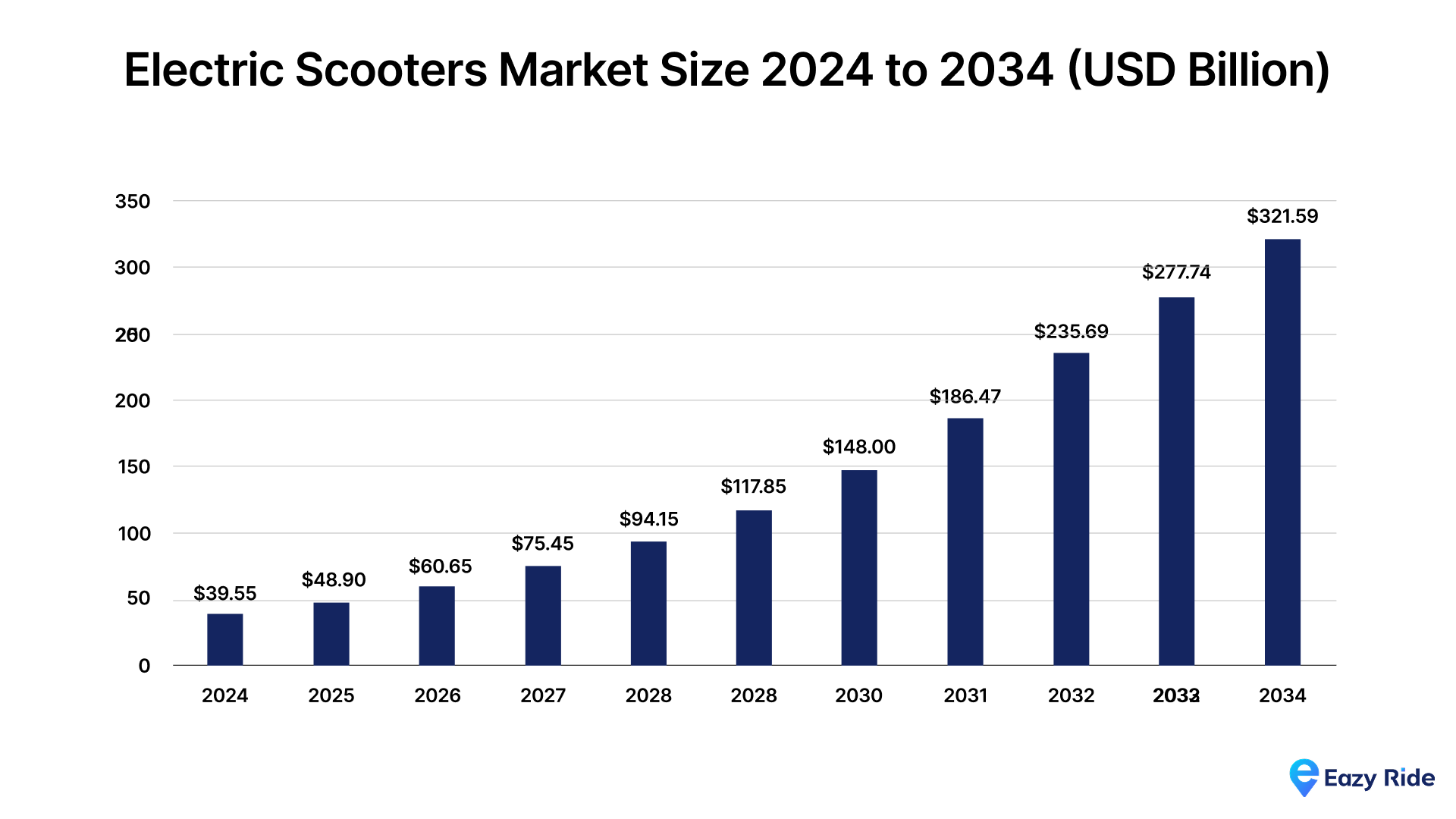
When deciding between a bike vs scooter for your daily commute, it’s important to consider various factors that align with your personal preferences, commuting needs, and lifestyle. Globally, the electric scooter market was valued at USD 39.55 billion in 2024 and is projected to reach USD 321.59 billion by 2034, growing at a CAGR of 23.28.
Both options offer unique advantages, and choosing the right one depends on your priorities. Here’s a comprehensive guide to help you make an informed decision:
1. Commute Distance
- Short Commutes: If you’re commuting short distances (under 5 miles), a scooter can be a great option due to its compact design, ease of use, and speed on city streets.
- Longer Commutes: For longer distances or those involving more varied terrain, a bike, particularly an e-bike, might be the better choice. E-bikes provide additional speed and power to help you cover more ground without excessive physical effort.
Suggested read: Benefits of Sustainable Transportation: How Micro-Mobility Drives Urban Success
2. Effort and Convenience
- Minimal Effort: If you prefer a low-effort commute, a scooter is easier to ride as it requires minimal physical exertion. It’s a good option for those who want a hassle-free ride, especially for people who are not looking to break a sweat.
- Exercise and Activity: Bikes, especially traditional ones, offer a good opportunity for exercise. If you’re looking for a more physically engaging ride, biking provides cardiovascular benefits and is a good option for staying active during your commute.
3. Storage and Portability
- Compactness: Scooters are compact, foldable, and easy to carry, which is perfect for commuters who need to store their vehicle in tight spaces, like public transportation or small apartment buildings.
- Space Needs: Bikes, while still manageable, often require more space for parking and storage. However, if you have a secure place to store your bike, it might be a better fit for those who don’t need portability.
4. Weather Conditions
- Protection from Elements: In wet or colder weather, bikes tend to offer better protection, especially if they have fenders and weather-resistant features. E-scooters, on the other hand, can be less comfortable in these conditions and may be prone to damage from rain or snow.
- Flexibility in All Seasons: Bikes tend to perform better in diverse weather conditions, as they provide more control, especially on slippery roads.
5. Safety and Stability
- Stability: Bikes offer better stability and control, particularly on uneven surfaces or in emergency situations. They also tend to be safer on faster routes.
- Handling and Maneuverability: Scooters are easier to handle in crowded urban environments, and their smaller size makes them more maneuverable in tight spaces. However, they might not offer the same level of safety or control as bikes, particularly in busy or high-speed traffic.
Choosing between a bike vs scooter ultimately comes down to your specific commuting needs and preferences.
Now that we’ve explored the core factors, it’s time to look into specific aspects such as speed, ease of use, cost, and comfort that can further help guide your decision.
Bike vs Scooter: Choosing the Best Daily Commuter
When it comes to daily commuting, choosing the right mode of transportation can make a huge difference in your time, comfort, and overall efficiency. With the rise of shared mobility solutions and eco-friendly options, commuters are increasingly faced with a choice: bike vs scooter. Both are excellent alternatives to traditional cars, but which one is the best for your daily needs?
In this blog, we’ll dive into the key differences between bikes and scooters, helping you make an informed decision based on your lifestyle, commuting distance, and convenience.
1. Speed and Efficiency: Which Gets You There Faster?
One of the biggest factors to consider when choosing between a bike and a scooter is speed.
- Bikes: While traditional bikes generally require more effort, electric bikes (e-bikes) offer an excellent balance between speed and convenience. E-bikes typically reach speeds of 20-28 mph (32-45 km/h), making them an excellent option for longer commutes or hilly areas. However, even traditional bikes can be faster than walking and are perfect for short to medium distances.
- Scooters: Electric scooters are often faster than regular bikes in urban environments, with average speeds ranging from 15-20 mph (24-32 km/h). The speed is especially beneficial in crowded city environments where you might face heavy traffic, and they are perfect for short, quick rides. For quick in-and-out city commuting, a scooter might be your best bet.
Verdict: If you have a longer commute, especially one involving varying terrain, e-bikes might be the better choice for speed. For quick trips within the city, scooters provide great efficiency.
2. Ease of Use: Which is More Convenient for You?
Convenience is a key factor in deciding between bike vs scooter.
- Bikes: Riding a bike does require some physical effort, especially when pedaling. However, electric bikes make the process easier by providing motor assistance, which reduces the amount of effort required, especially on inclines. Bikes also tend to require more space for parking and may not be as easy to maneuver through tight spaces.
- Scooters: Scooters are lightweight and require minimal physical effort, making them ideal for people who want to commute with ease. Most scooters are foldable, making them easier to store and carry compared to bikes. Their compact design makes them ideal for crowded city environments and public transportation, as you can easily fold and carry them on the bus or train.
Verdict: For effortless use and portability, scooters take the lead. If you want an easy-to-ride, quick, and efficient option, a scooter is your go-to.
3. Cost and Maintenance: Which is More Budget-Friendly?
When considering the cost of your daily commute, both bike vs scooter come with their own financial considerations.
- Bikes: Traditional bikes are often more affordable upfront, with prices starting as low as $100 for basic models. E-bikes, however, can range anywhere from $500 to $3,000 depending on the model and features. Maintenance costs for bikes generally include tire replacements, chain maintenance, and occasional repairs. E-bikes may have additional costs, such as battery replacements, but overall, maintenance for both types is reasonable.
- Scooters: Electric scooters tend to be more expensive initially, with prices ranging from $300 to $1,500, depending on the features. Scooters may require less maintenance compared to bikes, but parts such as wheels, brakes, and batteries may need replacement over time. On average, the cost of maintenance for scooters is generally lower than for e-bikes.
Verdict: If you’re on a budget and looking for something with low upfront costs, a traditional bike is a great option. However, for those looking for convenience with less maintenance, a scooter may offer a better long-term investment.
Also read: How Telematics Navigation Optimizes Modern Fleet Operations?
4. Environmental Impact: Which is More Eco-Friendly?
Both bikes and scooters are eco-friendly alternatives to cars, but when it comes to their environmental impact, they each have unique considerations.
- Bikes: Bikes are one of the most sustainable modes of transport. They require no fuel, emit no emissions, and have minimal environmental impact overall. E-bikes, while still relatively green, require electricity to charge, but they still generate far fewer emissions compared to cars.
- Scooters: Electric scooters, like e-bikes, run on batteries and require electricity to charge. While they are more eco-friendly than cars, their environmental impact depends on the energy source used to charge them. However, they still offer a significant reduction in carbon emissions compared to traditional gasoline-powered vehicles.
Verdict: Both options are environmentally friendly, but traditional bikes are the most eco-conscious choice. Electric bikes and scooters provide great alternatives but have a slightly higher environmental footprint due to their battery requirements.
5. Comfort and Terrain: Which One Handles Different Environments Better?
Consider where you’ll be commuting when deciding between bike vs scooter. Different types of terrain can greatly affect your experience.
- Bikes: Bikes handle a wide range of terrains, from smooth city roads to more challenging paths like hills and trails. If your commute includes hills or longer distances, an e-bike will give you the extra support needed to comfortably tackle various terrain types.
- Scooters: Scooters are best suited for smooth, paved roads. While they can handle small bumps and uneven surfaces, they may not be as comfortable or efficient for longer rides or more challenging terrains. If you have a relatively smooth commute, a scooter is ideal, but it may struggle with rougher roads.
Verdict: If your commute involves a lot of different terrains or longer distances, a bike (especially an e-bike) is the better choice. For urban, flat roads, a scooter excels in comfort and convenience.
Here’s a table for a quick overview of the differences:
| Factor | Bike | Scooter |
|---|---|---|
| Speed | Traditional bikes: 10-15 mph. E-bikes: 20-28 mph. | 15-20 mph on average. |
| Effort Required | Requires pedaling (unless e-bike). | Minimal effort, especially with electric scooters. |
| Convenience | More space needed for parking. Requires more physical effort. | Lightweight, foldable, easy to store and transport. |
| Cost | Traditional bikes: $100-$500. E-bikes: $500-$3,000. | Electric scooters: $300-$1,500. |
| Maintenance | Bikes: Regular maintenance on tires, chains, and brakes. E-bikes: Additional costs for battery replacement. | Lower maintenance, but parts like wheels, brakes, and batteries may need replacements. |
| Environmental Impact | No emissions. E-bikes require charging but still eco-friendly. | Electric scooters have minimal emissions but depend on electricity source. |
| Terrain Handling | Great for varied terrains, including hills and trails (e-bikes perform better on hilly terrain). | Best on smooth, paved roads. Struggles on uneven surfaces or rough terrains. |
| Comfort | Comfortable for longer distances and rougher terrain. | More comfortable for short, flat, urban commutes. |
| Suitability for Commutes | Ideal for longer distances, hilly areas, and diverse terrain. | Best for short city commutes and quick, flat routes. |
| Space and Portability | Larger, requires a dedicated parking space. | Foldable, compact, easy to carry, and store. |
| Health Benefits | Provides great cardiovascular exercise and promotes physical activity. | Minimal physical activity is involved. More about convenience. |
With that in mind, let’s explore how you can streamline your bike or scooter rental business and offer a seamless customer experience with the right fleet management solution.
Ready to Launch Your Bike or Scooter Rental Business?
Choosing between bike vs scooter for your rental fleet is just the beginning. To succeed in the shared mobility space, you need a powerful platform that manages your fleet with ease, ensuring optimal performance, safety, and customer satisfaction.
EazyRide offers the perfect solution with its all-in-one fleet management platform tailored to bike and scooter rental businesses. With real-time tracking, predictive maintenance, driver behavior monitoring, and seamless booking integration, EazyRide helps you scale your rental business effortlessly.
Key features for bike and scooter rental businesses:
- Real-Time Fleet Tracking: Track the exact location, availability, and condition of every vehicle in your fleet. This allows operators to quickly respond to customer requests, prevent vehicle misuse, and strategically manage fleet distribution during peak hours.
- Predictive Maintenance Alerts: Receive proactive notifications for vehicle servicing, battery replacement, or potential mechanical issues. This minimizes unexpected breakdowns, reduces downtime, and ensures customers always have access to fully functional vehicles
- Customizable Booking System: Offer a fully branded, user-friendly booking platform that lets customers select vehicles, schedule rides, and pay effortlessly. Customization options also allow businesses to implement loyalty programs, promotions, or specialized rental packages.
- Driver Safety and Behavior Monitoring: Monitor riding behavior such as speed, braking patterns, and adherence to traffic rules. Use these insights to improve rider safety, provide feedback or incentives for responsible behavior, and lower accident-related costs.
- Geofencing Capabilities: Define operational zones or restricted areas for your vehicles using geofencing technology. This ensures scooters and bikes stay within approved areas, protects assets from theft or misuse, and helps comply with city-specific regulations.
- Advanced Analytics Dashboard: Access detailed metrics on vehicle usage, trip patterns, revenue, and customer preferences. Data-driven insights support smarter fleet allocation, pricing strategies, and operational planning to maximize profitability.
- Automated Billing and Invoicing: Simplify payment operations with automatic invoicing and recurring billing options. This reduces administrative overhead, minimizes human errors, and provides customers with a transparent, reliable billing experience.
- Flexible Rental Models: Operate station-based, free-floating, or hybrid rental models depending on city layout, demand, and user preference. Flexibility in rental structures allows businesses to adapt quickly to market conditions and customer needs.
- Seamless Integration with Third-Party Apps: Connect your fleet with popular navigation, payment gateways, and customer engagement apps. This improves user convenience, broadens reach through familiar platforms, and creates a more connected and efficient mobility ecosystem.
Ready to take your bike or scooter rental business to the next level? Let EazyRide’s comprehensive solutions help you manage and grow your fleet while providing exceptional experiences for your customers.
Conclusion
Choosing between a bike vs scooter ultimately depends on your commuting needs, distance, and personal preferences. If you need speed, flexibility, and convenience for short urban trips, a scooter is a great option. However, if you’re tackling longer distances, hills, or diverse terrains, a bike (especially an e-bike) is likely the better choice for you.
No matter which option you choose, both bikes and scooters offer a sustainable, efficient alternative to traditional commuting. If you’re looking for an easy way to scale your shared mobility service, consider using a platform like EazyRide to manage your fleet of bikes or scooters and provide seamless experiences for your customers.
Ready to scale your bike or scooter fleet? Explore how EazyRide can help you launch and manage your own shared mobility business effortlessly.
Start managing your fleet with EazyRide today!
FAQs
1. How do I decide if a bike or scooter is more suitable for my lifestyle?
To determine whether a bike or scooter fits your lifestyle, consider factors like how much time you spend commuting, your activity level, and the type of areas you frequent. Bikes are better for individuals who enjoy outdoor exercise and have longer commutes, while scooters are ideal for those seeking convenience and a quicker, lower-effort mode of transport for short trips.
2. What are the storage requirements for bikes and scooters in apartment buildings?
Storage in apartment buildings can be a challenge, especially in limited spaces. Bikes can be stored in bike racks or locked to fixed points, but scooters are more portable. Many electric scooters are foldable, making them easy to store inside apartments or in designated spaces like bike racks. It’s essential to keep them in secure, dry areas to avoid damage or theft.
3. Can I use a bike or scooter for both commuting and recreational purposes?
Yes, both bikes and scooters can serve dual purposes. Bikes, particularly hybrid models, are great for both commuting and leisurely rides. E-scooters, while primarily designed for short-distance commuting, can also be fun for recreational rides on smooth paths. If you plan to use them for both, choose models that provide comfort, durability, and versatility for varying uses.
4. How can I ensure my scooter or bike remains in good working condition over time?
Regular maintenance is key to keeping your bike or scooter in top condition. For bikes, check tire pressure, clean and oil the chain, and inspect brakes regularly. For scooters, check the battery life, ensure the wheels and brakes are intact, and keep the motor clean and functioning. Storing them in dry, sheltered areas and performing routine checks will extend their lifespan.
5. What is the best way to recharge an electric scooter or e-bike for daily use?
To ensure your electric scooter or e-bike is always ready for daily use, charge it in a safe, dry place and avoid overcharging. Most e-scooters and e-bikes have built-in charging management systems to protect the battery. Aim to recharge your vehicle after each use to maintain optimal battery health and performance, especially if you’re using it for regular commutes.