
 AllAnalytics and research

 23 December, 2025
 Scooter Fleet Business Guide for U.S. Operators Scaling in 2026
If you’re looking into the scooter fleet business, you’re not really choosing scooters. You’re selecting a daily operations model.
Because the hard part isn’t deployment, it’s everything after scooters that die mid-day because charging wasn’t planned, or vehicles piling up in low-demand spots while hot zones go empty, and much more.
That’s where most fleets lose money, not in the launch. In the weeks after, when the work becomes repetitive, the system gaps show up.
This guide is for U.S. operators and founders who want to scale without turning the business into a constant cycle of dispatching and damage control. We’ll cover what actually drives profitability: utilization, uptime, charging efficiency, compliance controls, and the software stack that ties it together.
Key Takeaways
- Profitability Depends on Operations: Focus on utilization, uptime, and cost control to drive profitability, not just fleet size.
- Scaling Needs Systems: Use real-time management, charging workflows, and geofencing to maintain control as you grow.
- Track the Right KPIs: Monitor fleet uptime, charging turnaround, and compliance rates to make informed, profitable decisions.
- Choose the Right Fleet Model: Select between free-floating, station-based, or hybrid models based on your operational needs.
- EazyRide Powers Efficient Scaling: EazyRide’s platform provides tools to track, manage, and scale your fleet without losing control.
What a Scooter Fleet Business Really Looks Like in 2026
Shared micromobility is no longer a niche experiment. In North America alone, shared bikes and scooters collectively accounted for over 225 million trips in 2024, marking a 31% increase over the previous year and the second record-setting year in a row. This surge underscores rising consumer adoption of scooters for short trips and daily errands.
Scooters remain one of the dominant vehicle types in shared systems. In North America, they account for nearly half of all shared micromobility deployments, with usage patterns often matching or exceeding those of other vehicle types in key urban markets.
The broader U.S. bike and scooter rental market is expanding rapidly:
- In 2023, the bike and scooter rental segment generated USD 1.45 billion in revenue, and is forecast to reach USD 4.35 billion by 2030 – a 17% CAGR.
- Within the overall micro-mobility market, the U.S. segment alone is expected to grow from roughly USD 5.26 billion in 2024 to over USD 14 billion by 2030, driven strongly by electric kick scooters.
These figures place scooters at the intersection of rapid ridership growth and meaningful revenue opportunity, especially for operators who can optimize for utilization and cost control from the outset.
For U.S. scooter fleet founders and operators, these trends tell you three things:
- Demand Is Real, Not Experimental. Shared scooters have moved beyond the pilot phase into sustained consumer use across cities, with ridership growing each year.
- Fleet Scale Matters. With nearly hundreds of systems deployed across the U.S., scaling operators must manage multiple zones, pricing strategies, and operational workflows, not just deployments.
- Revenue Is Growing Fast. The rental and shared fleet market is expected to more than double in size by 2030 if current trends continue.
This isn’t a side hustle model. It’s a commercial mobility business with measurable demand and meaningful revenue at scale, if you build the right operational foundations first.
Before You Scale – Is Your Scooter Fleet Actually Profitable?
Before you add more scooters, more zones, or more staff, you need one answer: is your current fleet making money per deployed scooter, or just generating trips? Because in a scooter fleet business, scale doesn’t fix weak unit economics. It amplifies them.
Here’s a grounded benchmark to sanity-check demand. U.S./North America industry-level data shows e-scooter utilization averaged about 1.4 trips per scooter per day (2023). If your fleet is consistently below that, you likely have an operations, pricing, or deployment issue.
If you’re above it, your next question becomes: Are you keeping scooters available and ride-ready enough to capitalize on that demand?
The 3 Numbers That Determine Profitability
If you track nothing else, track these:
- Trips per scooter per day: This is your demand-and-deployment score. Even modest improvements here move revenue without buying more hardware.
- Fleet uptime (how many scooters are actually ride-ready): A scooter that’s dead, damaged, missing, or “waiting for service” is not part of your fleet. It’s idle inventory. This is where charging and maintenance processes decide whether you’re profitable.
- Cost per active scooter per day: This is the silent killer for early fleets: labor for charging/rebalancing, repairs, warehouse handling, and retrieval. When these costs rise faster than trips, break-even slips even if ridership looks healthy.
Scooter demand is real, but only operators with strong uptime and deployment discipline consistently capture it.
Common Challenges That Kill Scooter Fleet Businesses Early
A scooter fleet business usually doesn’t fail because nobody rides. It fails because operations can’t keep scooters ride-ready where demand is. And the U.S. demand is real: shared micromobility hit 225M+ trips in North America in 2024 (bikes + scooters), up 31% year over year.
That kind of growth rewards operators who can maintain high uptime. It punishes fleets that lose availability due to charging delays, bad parking, or compliance issues.
Here are the failure points that show up early (and get worse with scale):
1. Charging & Rebalancing
As fleets grow, the “overnight reset” becomes a logistics operation: collecting low-battery scooters, charging them at hubs, and redeploying them into demand zones. Rebalancing and charging are crucial operational challenges tied directly to service levels and performance.
If you don’t have clear workflows and tooling here, you’ll see the same pattern:
- Morning demand spikes with empty hot zones
- Scooters are sitting charged but not deployed
- Teams are wasting time on inefficient routes
2. Uptime Collapses
Early fleets tend to underestimate how quickly minor issues accumulate: brake wear, tire wear, loose stems, battery health, and vandalism damage. When maintenance isn’t tracked and prioritized, scooters don’t just “need repair.” They disappear from your usable fleet, and your unit economics degrade.
This is where operators get tricked: trips might still look good overall, but active fleet size shrinks, and revenue per deployed scooter drops.
3. Parking & Compliance Problems
In the U.S., cities often regulate speed and where devices can operate or park. NACTO’s shared micromobility guidelines, for example, recommend e-scooter motor assist speeds no greater than 15 mph, and cities frequently require speed reductions in certain areas.
If you can’t enforce rules via geofencing and operational controls, you end up managing compliance manually, which is slow, inconsistent, and risky at scale.
4. Lack of Visibility
Once you run more than a small fleet, you need to know, right now, what’s deployed, what’s idle, what’s low-battery, and what’s out of service. Without centralized visibility, you make expensive decisions late:
- Rebalancing based on yesterday’s patterns
- Maintenance based on complaints instead of fleet health
- Deployments based on guesswork
5. Multi-Zone Growth
Scaling isn’t just “more scooters.” It’s more zones, more rules, more variability. The operators who scale reliably build a real scooter-sharing operations-center mindset, centralized control, clear tasking, and performance tracking, before they expand.
Also Read: A Comprehensive Guide to Scooter Types for Mobility Businesses
Once you’ve identified these early hurdles, it’s time to pick the right fleet model. Let’s explore the options that will shape how you deploy, manage, and grow your business.
Choosing the Right Scooter Fleet Model
In a scooter fleet business, your model determines your level of complexity. It determines how you charge, where you deploy, what you’re legally allowed to do, and how much “ops overhead” you’ll carry every day.
In the U.S., that choice matters even more because most e-scooter programs are designed to be dockless. It also means you’re not building in a vacuum. As of June 30, 2025, the U.S. Department of Transportation’s Bureau of Transportation Statistics reports e-scooters were operating in 132 U.S. cities.
That’s a lot of markets with different rules and operating realities. So picking the model that matches your context is a profitable decision.
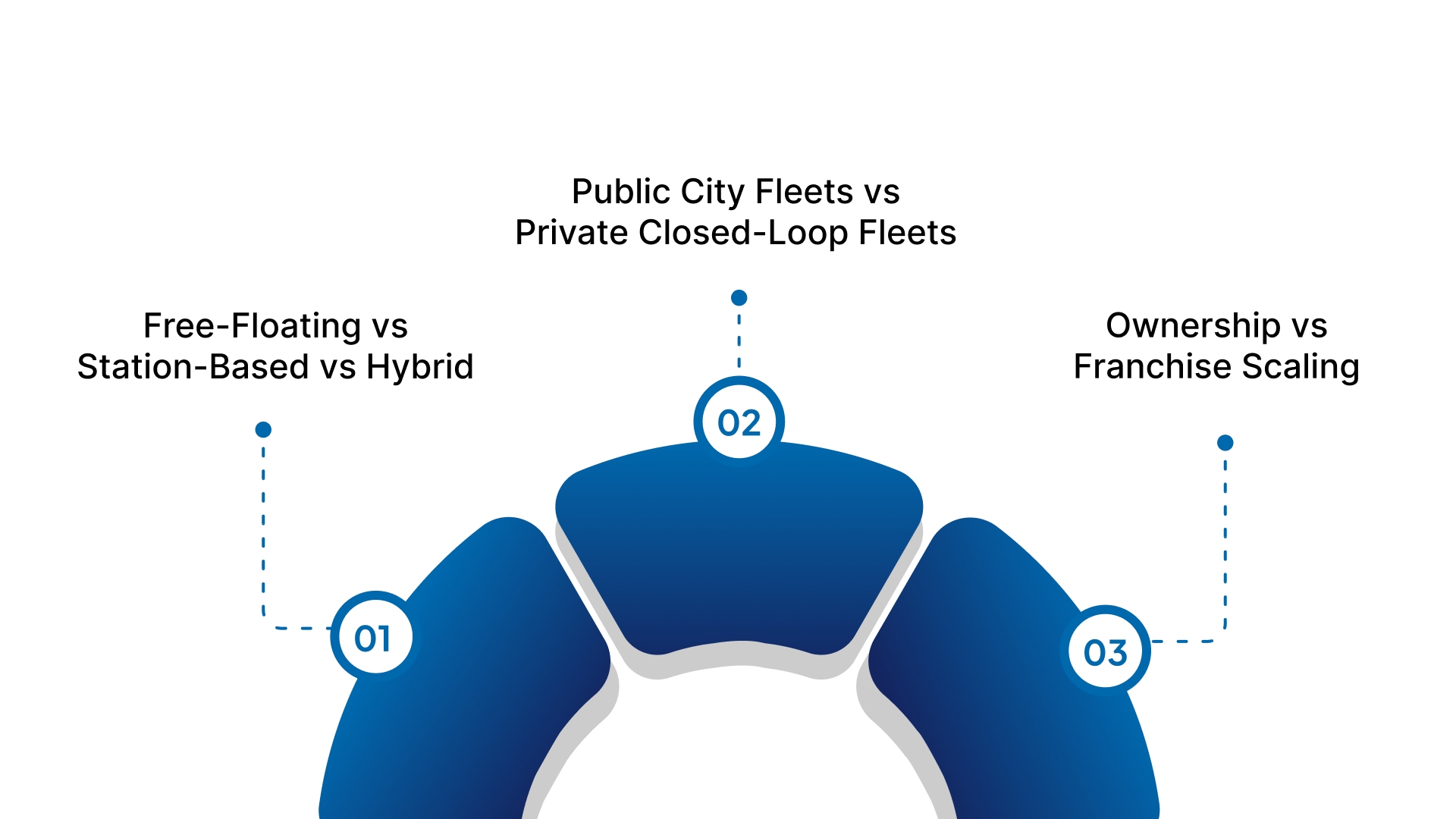
1) Free-Floating vs Station-Based vs Hybrid
Free-floating (dockless) is what most people associate with e-scooters in U.S. cities: users pick up and drop off within allowed areas. It’s flexible and can scale fast, but it puts pressure on:
- Rebalancing and charging logistics
- Parking compliance
- Zone enforcement
Station-based works best when you want tighter control over parking and availability (common in private properties). It’s easier to manage, but riders have less flexibility, and your stations become part of the operational workload.
Hybrid models combine both: designated hubs plus flexible parking zones. These models blend structure with flexibility.
In practice, a hybrid often works well when a city or property wants order (hubs) without killing convenience (flex parking zones).
2) Public City Fleets vs Private Closed-Loop Fleets
Public city fleets can deliver volume, but you’ll deal with:
- Permitting
- Compliance requirements
- Changing boundaries and speed rules
- Higher operational variance
Private/closed-loop fleets (campuses, resorts, residential communities) typically have:
- More predictable demand
- Tighter zones
- Simpler enforcement
- Clearer deployment routines
If you’re early-stage and want fewer variables, closed-loop fleets often give you a cleaner path to operational maturity before expanding.
3) Ownership vs Franchise Scaling
If your goal is expansion across locations, you’ll eventually choose between:
- Ownership scaling: you control everything, but capital and ops workload rise quickly.
- Franchise scaling: you grow faster by enabling local operators under a shared brand and systems layer.
This is where a scooter-sharing franchise dashboard becomes an absolute requirement. In this, multiple franchisees operate under a single backend dashboard, each with their own branded rider apps and dashboards.
Whether you use a franchise approach or not, the key takeaway is the same: scaling beyond one market demands centralized visibility and standardized operations.

What Software a Scooter Fleet Business Actually Needs
In a scooter fleet business, the software you use makes the difference between a fleet you can control and a fleet you’re constantly chasing.
That matters in the U.S. because this is a regulated, multi-market reality. If you’re scaling across zones (or planning to), you need a system that can handle changes in rules, demand, and operations without turning every day into manual dispatch.
Here’s the software stack that actually moves the needle.
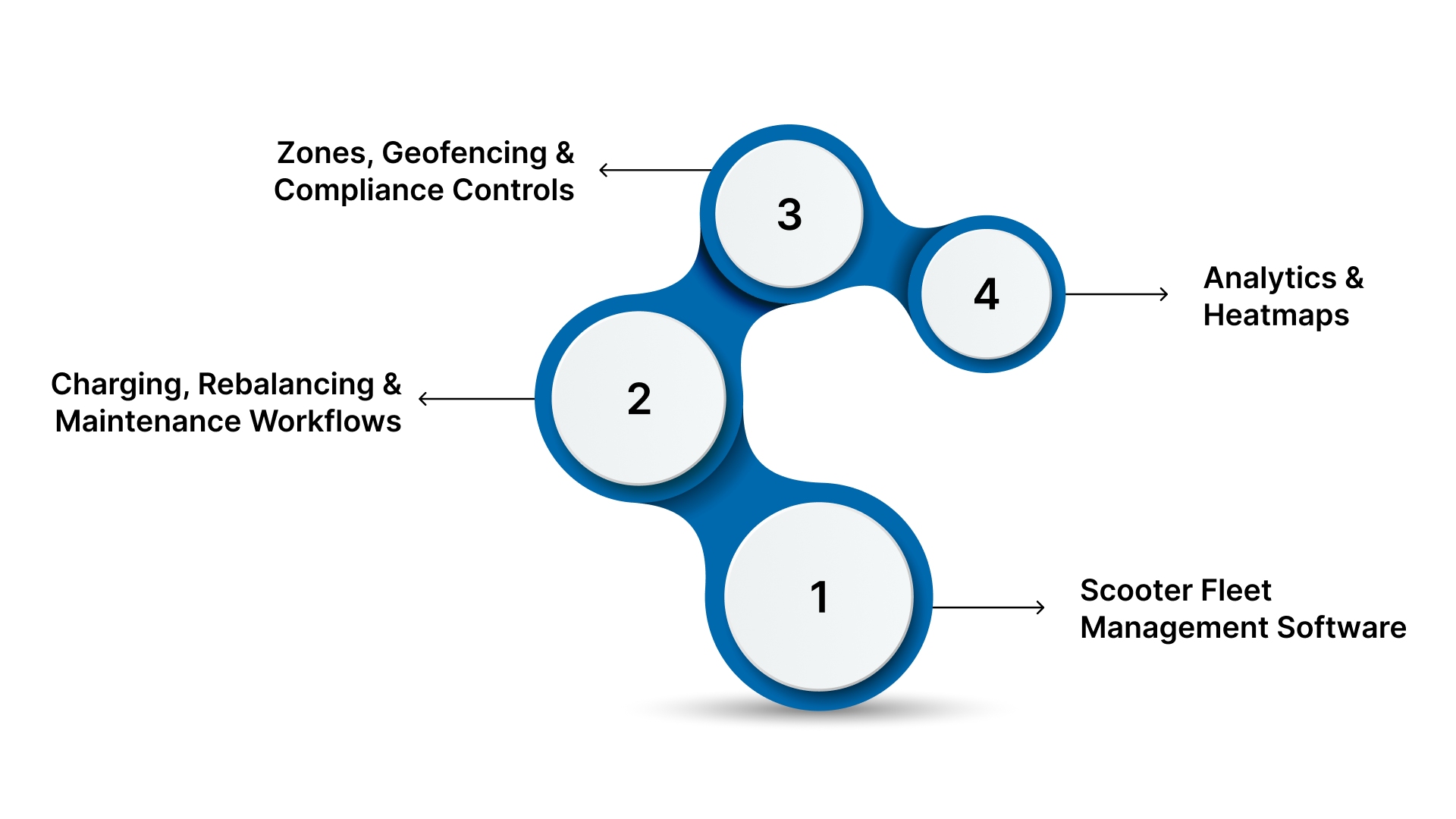
1. Scooter Fleet Management Software
This is your core layer. Without it, you can’t answer basic operator questions fast enough to act. At minimum, your scooter fleet management software (or e-scooter fleet management software) should give you:
- Real-time fleet status (available, in-use, low battery, out of service)
- Live location + trip history
- Vehicle health signals you can use operationally
Your profitability lives inside small decisions, where to deploy next, what to pull for service, and what’s idle too long. A strong fleet dashboard turns those into real-time calls instead of guesswork.
2. Charging, Rebalancing & Maintenance Workflows
This is the part most new operators underestimate. Rebalancing and charging are the core operational challenges in shared e-scooter systems. If your tools don’t support this, your fleet size becomes irrelevant because a chunk of scooters will always be unavailable.
What you need:
- Task assignment and routing for field teams
- Maintenance workflows (log issues, track status, prioritize fixes)
- Clear accountability (who did what, when, and what’s still pending)
This is also where a genuine scooter sharing operations center starts to form: one view of work, one queue of tasks, one source of truth.
3. Zones, Geofencing & Compliance Controls
U.S. cities often require operating boundaries, speed limits, and parking rules, and they expect operators to enforce them. Geofencing is a practical way to define “zones” with different operating rules, such as slow zones and parking requirements.
So your software should let you:
- Set allowed/no-go zones
- Create slow-speed corridors
- Define parking/drop rules
- Adapt quickly when a city changes requirements
This is not just compliance. It’s operational efficiency: rules you can enforce in software reduce manual interventions and costly surprises.
4. Analytics & Heatmaps
If you can’t see patterns, you can’t scale. You need analytics that show:
- Demand by hour and zone
- Idle hotspots
- Scooters that underperform consistently
- Operational KPIs like uptime and trips per scooter
This is how you decide whether to add scooters, shift zones, or change pricing without guessing.
Also Read: 9 Great Electric Scooters for Micro-Mobility Operators in 2025
Now that we’ve covered the essential software tools, let’s take a closer look at what your operations center should look like to keep everything running efficiently.
Inside a Modern Scooter Sharing Operations Center
For a scooter fleet business, the operations center is your command hub, the one place that lets you track everything in real-time without constant firefighting. This is where all your operational data comes together:
- Scooter availability
- Fleet health
- Geofencing compliance
- Rebalancing progress
- Maintenance status
If you’re scaling across multiple zones, this isn’t just a dashboard. It’s a living view of your fleet’s health, helping operators make quick decisions based on data.
So, what do you need in your operations center?
- Real-time fleet tracking: Whether it’s for rebalancing, maintenance, or compliance, you should know what’s deployed, what’s idle, and what’s out of service.
- Task assignment for on-ground teams: Assign rebalancing, charging, and maintenance tasks based on current demand and fleet health.
- Geofencing and compliance monitoring: Track whether scooters are parked in the correct zones and if speed limits or no-go areas are being respected.
In the U.S., cities like San Francisco and Washington, D.C. have begun mandating more stringent requirements for fleet visibility, including real-time geo-fencing to prevent scooters from being used outside designated areas.
KPIs Every Scooter Fleet Operator Should Track
In a scooter fleet business, you cannot manage what you don’t measure. The difference between a fleet that grows profitably and one that barely stays afloat often comes down to a handful of key metrics that operators actually use, not vanity numbers.
Here are the most critical KPIs for U.S. scooter fleet operators:
| KPI | What It Measures | Why It Matters for Your Business |
|---|---|---|
| Rides per Scooter per Day | The average number of trips a scooter completes each day. | Measures demand and fleet utilization. The higher this number, the more profitable your fleet. |
| Fleet Uptime | The percentage of time scooters are ride-ready and available for use. | A higher uptime translates directly to higher revenue and fewer idle scooters. |
| Charging Turnaround Time | The average time taken to charge scooters and get them back on the road. | Faster charging = higher utilization, reducing downtime and improving ROI. |
| Cost Per Active Scooter Per Day | The operational cost to maintain one scooter per day, including labor, transport, maintenance, etc. | Controls overhead. If costs exceed daily revenue, profits are at risk. |
| Maintenance Turnaround Time (TAT) | The time taken to perform repairs and get scooters back in use. | Faster repairs mean more scooters in service and higher fleet availability. |
| Compliance Incident Rate | Frequency of violations of local regulations, such as parking or speed limits. | High rates lead to fines, operational restrictions, and potential contract losses. |
Consistently tracking these KPIs allows you to make data-driven decisions that lead to higher profitability, better fleet uptime, and smoother scaling.
However, the right tools can help automate all these processes. Here’s how EazyRide can help you with everything.
How EazyRide Helps You Run & Scale a Scooter Fleet Business
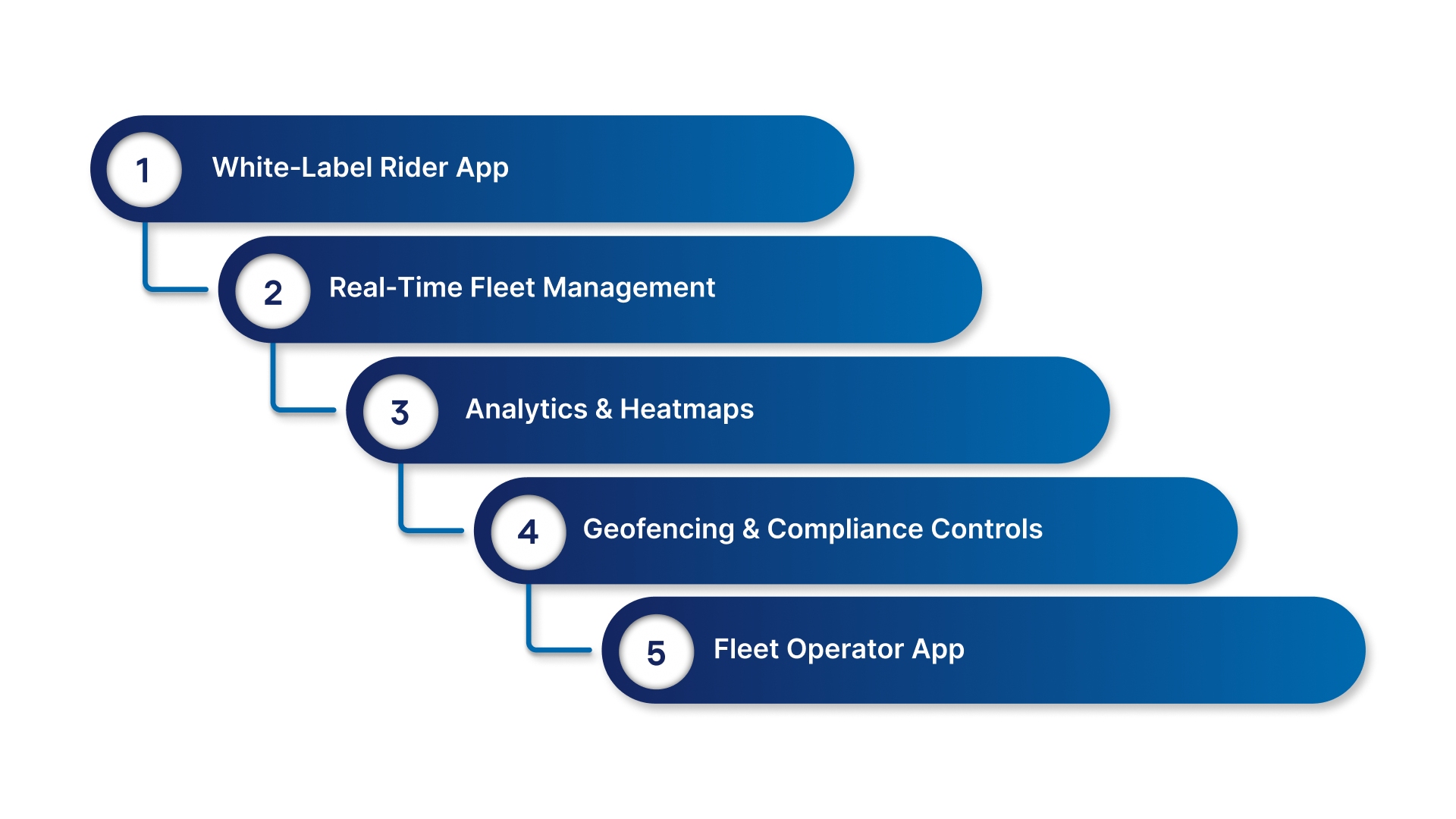
When you’re scaling a scooter fleet business, platforms like EazyRide give you the integrated tools operators actually use to manage demand, field teams, zones, and customer experience without piecing together disparate tools.
Here’s how eazyride supports every part of this business:
- White‑Label Rider App: A prebuilt, customizable mobile app lets riders find & unlock scooters, book and pay seamlessly, and access trip history and promotions
- Real‑Time Fleet Management: The admin dashboard shows live scooter status (location, availability, battery levels, and recent trips). This real‑time visibility lets you make quick operational decisions rather than react after delays and complaints.
- Analytics & Heatmaps: Operators need insights. Hourly and zone‑based analytics show where scooters are most used, where they sit idle longest, and patterns that justify redeployment or pricing changes
- Geofencing & Compliance Controls: Let’s you define allowed and restricted areas, set geofenced speed limits, and enforce parking/drop‑off policies. This helps you stay compliant without manual enforcement.
- Fleet Operator App: Your charging, maintenance, and rebalancing crews need task assignments and status updates. A dedicated operator app helps you: assign daily tasks, track completion status, reduce downtime, and turnaround times.
With a complete operational platform like Eazyride, you spend time managing the business rather than building tools, while your competitors scale ahead.
Conclusion
Starting and scaling a scooter fleet business in the U.S. is more than just putting scooters on the streets. It’s about building systems that control charging, maintenance, compliance, and utilization across multiple zones.
Operators who take control of these aspects with the right tools, such as operational platform, can move beyond basic deployments to run a profitable, efficient, and scalable fleet. EazyRide helps optimize operations, reduce downtime, and scale efficiently, without the headaches of manual processes.
Ready to take control of your scooter fleet business? Schedule a demo and see how EazyRide helps operators manage demand, reduce downtime, and scale profitably.
FAQs
1. Is a scooter fleet business profitable in the U.S.?
Profitability depends on utilization, uptime, and cost control. U.S. fleets that maintain high availability, fast charging cycles, and strategic deployments often reach break‑even faster than ad‑hoc operations.
2. How many scooters do I need to start a scooter fleet business?
You can launch profitably with as few as 30–50 scooters in targeted zones to test demand, then expand based on data. Starting with a focused area improves utilization and reduces operational overhead.
3. What software do I need for scooter fleet management?
Operators need real‑time fleet tracking, task assignment for charging/maintenance, geofencing controls, and performance analytics, capabilities found in dedicated scooter fleet management software, not basic GPS tools.
4. How do scooter operators handle charging and rebalancing?
Successful fleets use structured workflows that assign charging and rebalancing tasks daily, often combined with route optimization and performance dashboards to minimize downtime and travel costs.
5. What’s the difference between free‑floating and station‑based scooter models?
Free‑floating lets users park anywhere in a zone, offering flexibility but increasing rebalancing complexity. Station‑based restrictions on parking at hubs reduce operational chaos but limit user convenience.


