
 AllAnalytics and research

 26 December, 2025
 ATOM Mobility vs EazyRide: Best CRM Tools Comparison for 2026
Most shared mobility operators don’t struggle with vehicles; they struggle with visibility. Rider data sits in one place, bookings in another, support issues somewhere else, making it harder to drive repeat usage or fix problems fast.
As operations expand across fleets and locations, these gaps grow wider. This gap is becoming more visible as the global shared mobility market size is expected to reach USD 274.99 billion by 2032.
Growth at this scale demands platforms that connect rider activity, operations, and decision-making in one system. That’s where CRM capabilities inside mobility platforms start to matter as operational and engagement engines.
In this blog, we will discuss how ATOM Mobility and EazyRide differ in their approach to CRM tools, rider management, and operational control, and which platform aligns better with different mobility business models.
Overview
- Mobility platforms connect rider behavior, trip history, and payments to generate actionable insights for engagement, retention, and operational efficiency.
- EazyRide focuses on operational rider management and fleet workflows, utilizing integrations for engagement, rather than providing a dedicated full CRM dashboard.
- ATOM Mobility provides a CRM with lifecycle tracking, in-app messaging, and analytics, supporting growth across multiple vehicle types and locations.
- EazyRide uses promo codes and discounts within operational workflows, whereas ATOM Mobility includes built-in loyalty and referral campaigns for deeper rider engagement.
- Mobility CRM impact is measured through retention, active rider volume, incentive effectiveness, support resolution speed, and revenue per rider.
What CRM Means in Mobility Software?
In mobility software, CRM goes beyond storing rider details or contact information. It connects trip history, payment behavior, usage frequency, and in-app interactions to help operators understand how customers actually use their vehicles.
A mobility-focused CRM supports actions like targeting frequent riders with loyalty rewards. It identifies churn risk based on drop-offs in usage and resolves support issues with full ride context.
Also Read: Electric Vehicle as a Service: Future Trends and Challenges
Why Traditional CRMs Fall Short for Mobility Operators?
Most traditional CRMs were built for businesses that sell once and follow up later. Mobility businesses operate very differently. Value is created through repeated rides, real-time availability, and location-specific usage. When CRMs are not designed around these dynamics, operators end up forcing mobility data into structures that were never meant to support it.
That mismatch shows up clearly in day-to-day operations:
- Customer records are not tied to individual rides, routes, or vehicle usage
- Location context, like pickup zones, service areas, or geofencing, cannot trigger engagement
- Segmentation is limited to static fields instead of behavior across time and trips
- Usage drop-offs and churn signals are not surfaced without heavy customization
- Support teams lack a single view combining trips, payments, and rider history
What does Mobility CRM include in 2026?
Mobility CRM has grown into a core operational layer rather than a separate customer database. In 2026, it will work directly with live ride data to inform how operators engage, retain, and grow their rider base. The focus shifts from managing contacts to understanding usage patterns and rider intent.
A modern mobility CRM typically brings together:
- Rider profile management that updates automatically with every trip
- Complete usage and payment history linked to specific rides and time windows
- In-app communication aligned with ride moments and service events
- Built-in retention tools such as loyalty rewards and referral flows
- Engagement decisions driven by real usage data rather than assumptions
With the fundamentals of mobility CRM defined, the real difference lies in execution. The next section breaks down how EazyRide and ATOM Mobility translate these principles into platform-level CRM capabilities.
Platform Overview: EazyRide vs ATOM Mobility
Both EazyRide and ATOM Mobility position themselves as white-label mobility platforms, but they are built with different operator priorities in mind. The distinction becomes clearer when you look at how each platform structures CRM around growth, fleet scale, and day-to-day operations.
1. EazyRide at a Glance
EazyRide is designed with a stronger emphasis on operational control, particularly for rental and dispatcher-led mobility models. Rider information is primarily used to enable booking, vehicle assignment, and driver coordination rather than standalone engagement workflows.
At a platform level, this translates into:
- White-label micro-mobility platform founded in 2021
- Core focus on vehicle rentals, dispatching, and fleet utilization
- Rider management embedded within operational and rental workflows
- Driver and dispatcher applications are central to day-to-day execution
- Suited for rental-first setups and franchise-style mobility operations
2. ATOM Mobility at a Glance
ATOM Mobility presents itself as a broad mobility infrastructure rather than a single-use solution. Its platform combines fleet control, rider data, and engagement tools within a unified dashboard intended to support growing mobility operations.
Key characteristics include:
- White-label mobility platform founded in 2018
- Support for multiple vehicle types across shared mobility and rentals
- Central dashboard that includes rider management, payments, and communication tools
- CRM functionality connected to trip history, pricing rules, and usage data
- Positioned for operators managing growth across cities or vehicle categories
These platform differences directly influence how each handles customer data and engagement. To understand that impact, let’s compare their CRM features side by side.
CRM Feature Comparison: Side-by-Side Breakdown
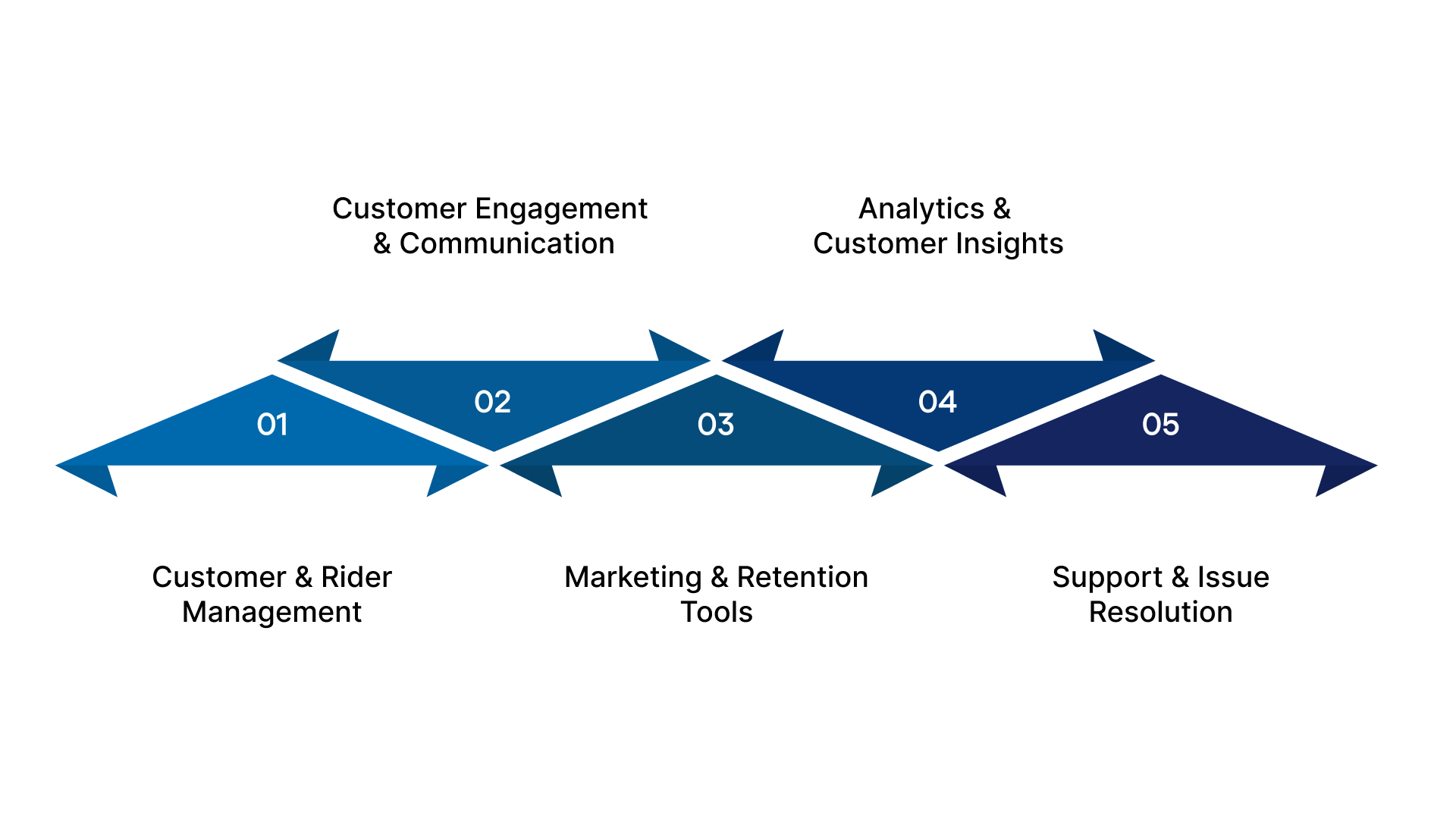
CRM in mobility shapes rider experience, operational efficiency, and growth. Here’s how EazyRide and ATOM Mobility implement these capabilities in practice.
1. Customer & Rider Management
Effective rider management underpins smooth operations. EazyRide focuses on operational data, capturing essential booking and payment information, while ATOM Mobility extends this to lifecycle tracking and growth-oriented segmentation.
- EazyRide: Rider profiles with booking history, payment data, and operational notes; primarily supports dispatch and rental workflows
- ATOM Mobility: Dedicated CRM dashboard showing rider lifecycle, trip frequency, and engagement history; allows segmentation for personalized communication
2. Customer Engagement & Communication
Communication drives retention, but approaches differ. EazyRide enables messaging through integrated tools and promotions, whereas ATOM Mobility centralizes engagement directly inside the CRM for targeted interactions.
- EazyRide: Promo codes and automated messaging via integrations like OneSignal, Twilio, and Mailgun
- ATOM Mobility: In-app messaging, push notifications, loyalty program alerts, and referral invitations accessible from the dashboard
3. Marketing & Retention Tools
Retention tools vary in sophistication. EazyRide uses pricing and promotional campaigns to encourage repeat rides, while ATOM Mobility provides built-in loyalty and referral programs embedded in the CRM.
- EazyRide: Relies on dynamic pricing, discounts, and promo codes; no native loyalty engine
- ATOM Mobility: Native loyalty programs and referral campaigns designed to increase repeat usage
4. Analytics & Customer Insights
Analytics shape operational and growth decisions. EazyRide provides insights to optimize fleet and revenue, whereas ATOM Mobility offers deeper, rider-focused analytics to guide marketing and engagement.
- EazyRide: Reports on revenue, bookings, and fleet utilization; insights primarily operational
- ATOM Mobility: Advanced analytics with heatmaps, engagement tracking, and ride pattern visualization for informed marketing and retention decisions
5. Support & Issue Resolution
Support is embedded differently in each platform. EazyRide integrates issue management into operational workflows. Meanwhile, ATOM Mobility supports customer support integrations that can be connected with rider and trip data, enabling faster and more context-aware resolution.
- EazyRide: Incident reporting, inspections, and work orders integrated into operations; support is operations-driven
- ATOM Mobility: Issue reporting tied to specific riders and trips, enabling faster and more personalized resolution
With these CRM features in mind, let’s break down EazyRide and ATOM Mobility side by side in a detailed comparison table to visualize differences and strengths clearly.
Also Read: Bike vs Scooter: Choosing the Best Daily Commuter
CRM Comparison Table
To summarize the differences between EazyRide and ATOM Mobility, this table highlights key CRM capabilities, engagement tools, analytics, integration flexibility, and ideal operator profiles.
| Feature Category | EazyRide | ATOM Mobility |
|---|---|---|
| CRM Positioning | Operational CRM focused on rider profiles, booking, and payment data | Dedicated CRM dashboard with lifecycle visibility and segmentation |
| Engagement Tools | Promo codes, messaging via OneSignal, Twilio, Mailgun | In-app messaging, push notifications, loyalty programs, referrals |
| Analytics Depth | Revenue, bookings, fleet performance reports | Advanced analytics, heatmaps, engagement tracking, demand insights |
| Extensibility via APIs | Supports integrations for communications and analytics, but does not publicly document open API support for CRM workflows. | Extensive API access for integrations across multiple mobility services |
| Best-fit Operator Type | Rental-first and franchise-style businesses | Growth-stage operators expanding multi-vehicle or multi-location fleets |
With the key differences clearly mapped, you can now evaluate which platform aligns best with your operational priorities. It will help you decide whether EazyRide or ATOM Mobility meets your required goals.
Which Platform Fits Your CRM Needs?
Selecting the right mobility CRM depends on your business model, operational priorities, and growth strategy. Both EazyRide and ATOM Mobility serve fleet-based businesses, but their CRM approaches cater to distinct operator needs.
- Choose EazyRide if: Your focus is on operational efficiency and rental management. CRM functionality is embedded within fleet workflows, covering rider profiles, booking histories, and payment tracking. This makes it ideal for location-based or franchise rental businesses that prioritize fleet control over deep customer engagement, or for teams using external tools for marketing and retention.
- Choose ATOM Mobility if: Your growth depends on understanding and engaging riders directly. Its built-in CRM and engagement tools let you track behavior, incentivize loyalty, and drive repeat usage. The platform excels for operators managing multiple vehicle types or expanding across cities, where centralized customer insights and marketing automation are important.
By aligning platform choice with your CRM priorities, you ensure that your technology not only supports daily operations but also drives long-term growth and rider satisfaction.
Key Metrics to Evaluate CRM Success in Mobility
Choosing a CRM is only part of the equation; measuring its impact is what matters more. Tracking the right metrics helps you understand whether your platform is improving rider engagement, operational efficiency, and revenue. Key metrics to consider include:
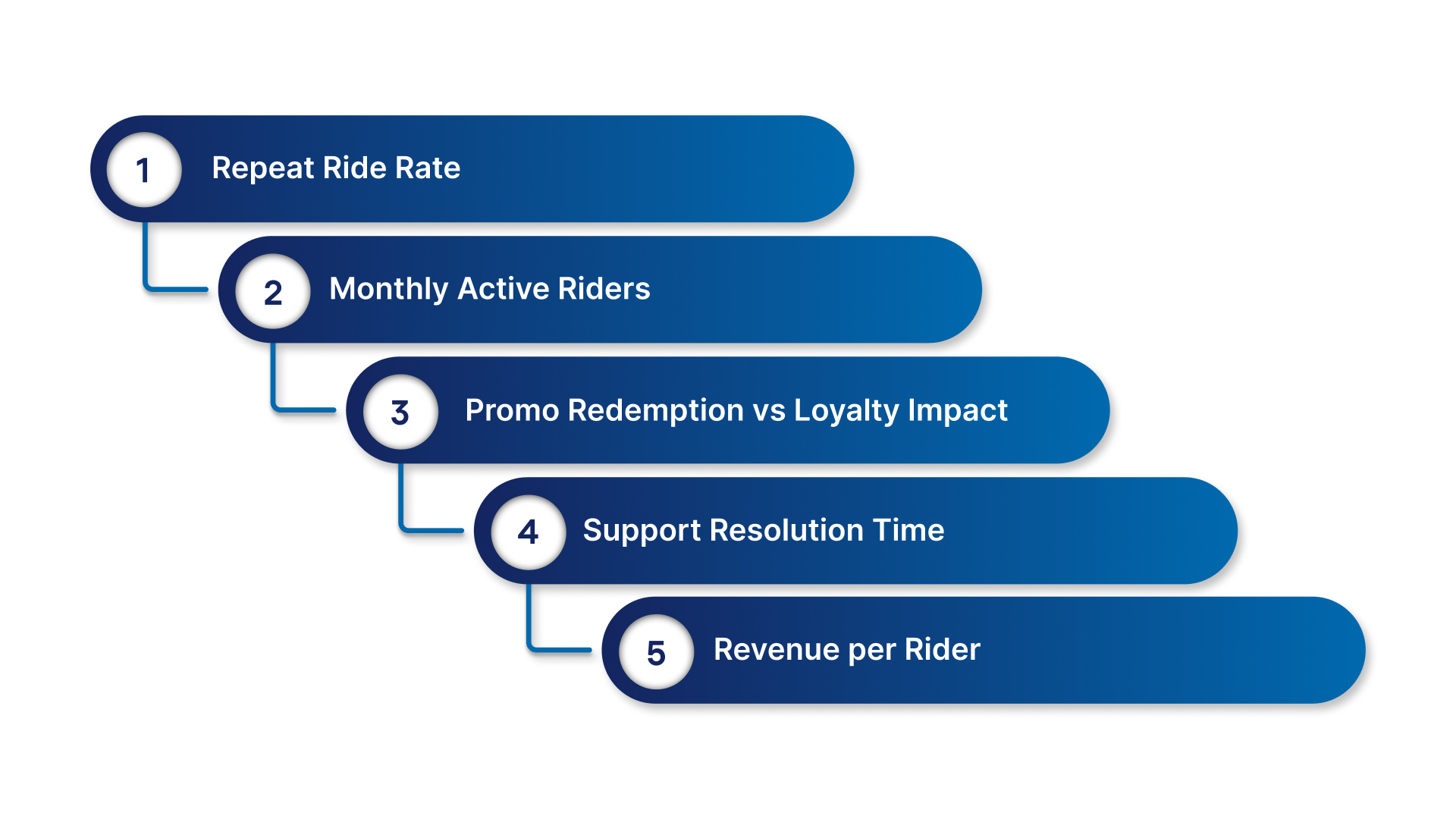
- Repeat Ride Rate: Measures how often riders return, reflecting engagement and retention. EazyRide influences repeat usage through operational reliability, pricing controls, and promo campaigns tied directly to booking and rental workflows, while ATOM Mobility emphasizes loyalty and referral programs.
- Monthly Active Riders (MAR): Tracks the total engaged rider base. EazyRide provides clear visibility into active riders across locations and fleets using real booking and usage data, whereas ATOM Mobility layers behavioral segmentation for engagement-focused use cases.
- Promo Redemption vs Loyalty Impact: Compares the effectiveness of discounts or loyalty incentives. EazyRide focuses on promo codes and pricing flexibility integrated into operations, enabling quick demand activation, while ATOM Mobility relies on native loyalty programs for retention tracking.
- Support Resolution Time: Measures how quickly rider issues are resolved. EazyRide excels here by embedding incident reporting, inspections, and work orders directly into fleet operations. It reduces delays caused by disconnected support systems.
- Revenue per Rider: Calculates monetization efficiency per user. EazyRide ties revenue directly to rentals, bookings, and fleet utilization metrics, giving operators a clear view of operational profitability. Meanwhile, ATOM Mobility correlates revenue with engagement analytics.
Focusing on these metrics ensures your CRM investment translates into tangible growth, better rider experiences, and smarter operational decisions. It must directly connect platform capabilities to business outcomes.
Also Read: Fleet Tracking System Reviews 2025: Best GPS Platforms Rated
Conclusion
Choosing the right CRM platform for your mobility business depends on whether your priority is rider engagement or operational efficiency. ATOM Mobility and EazyRide both offer robust tools, but they serve different operator needs. ATOM focuses on integrated CRM, marketing, and retention, while EazyRide emphasizes fleet management, rentals, and operational workflows. Assessing your growth strategy and business model is essential for making the best choice.
EazyRide is ideal for operators seeking simplified fleet control and rental management without building software from scratch. Its operational capabilities, including rider profiles, booking histories, payment tracking, and real-time dashboards, help location-based or franchise rental businesses scale efficiently while keeping daily operations seamless.
FAQs
1. What is the main difference between ATOM Mobility and EazyRide in terms of CRM capabilities?
ATOM Mobility provides a dedicated CRM with rider lifecycle management, engagement tools, and loyalty programs. EazyRide focuses on operational CRM, tracking rider profiles, booking history, and payments primarily within fleet and rental workflows.
2. Can EazyRide’s CRM handle marketing and retention strategies, or is it mainly operational?
EazyRide’s CRM is primarily operational, supporting rider profiles, booking data, and basic promo campaigns. Marketing and retention rely on integrations with tools like OneSignal, Twilio, or Mailgun rather than built-in loyalty or referral programs.
3. Which platform is better suited for managing fleet operations across multiple rental locations or hubs?
EazyRide is well-suited for managing fleet operations across multiple rental locations or hubs. It centralizes bookings, vehicle assignment, inspections, and incident workflows within operational dashboards.
4. How do ATOM Mobility and EazyRide integrate customer engagement tools with fleet management?
ATOM Mobility links engagement directly to rider profiles, trips, and analytics for targeted campaigns. EazyRide connects promotions, messaging, and incident reporting to operational workflows, allowing fleet management teams to maintain efficiency while reaching riders


