
 AllAnalytics and research

 7 August, 2026
 Bike vs Scooter: What Your Rental Fleet Should Run in 2026
If your commute runs under five miles on flat city streets, a scooter almost always wins. If it’s longer, hits hills, or you actually want the exercise, a bike wins. Most “bike vs scooter” guides bury that answer under 1,500 words of hedging. Here it is up front, then the detail behind it.
Both are cheap, clean, and faster than crawling through traffic. In 2023, shared micromobility trips in the U.S. and Canada hit an all-time high of 133 million, split almost evenly between 68 million bike trips and 65 million scooter trips. That near-even split tells you something: neither one “wins” outright. The right pick depends on your route, your body, and what you’re carrying.
This guide compares them on the eight things that actually change your daily ride, including a few factors most comparisons skip entirely: road vibration, riding in work clothes, and the learning curve.
Key Takeaways
- Scooters win short, flat, low-effort city commutes under five miles.
- E-bikes handle longer routes and steep hills without sweat.
- E-bikes run near $0.03 per mile; cars near $0.58.
- Bikes build fitness; scooters fold flat for easy carrying.
Bike vs Scooter at a Glance
Before the section-by-section breakdown, here’s the whole decision in one table.
| Factor | Bike (incl. e-bike) | Scooter (electric) |
|---|---|---|
| Speed | Traditional 10-15 mph; e-bike 20-28 mph | 15-20 mph average |
| Effort | Pedaling, unless an e-bike | Minimal, throttle only |
| Range per charge | E-bike 30-80 km | Up to ~40 km |
| Cost to buy | Bikes $100-$500; e-bikes $500-$3,000 | $300-$1,500 |
| Cost per mile | ~$0.03 (e-bike) | Comparable, low |
| Comfort on rough roads | Bigger wheels absorb bumps | Small wheels feel every crack |
| Stability | High, easy to balance | Lower, twitchy at speed |
| Carrying and storage | Bulky, needs a rack | Folds, fits trains and offices |
| In work clothes | Awkward in tight or formal wear | Easy, you just stand |
| Learning curve | Most adults already know how | New riders adapt in minutes |
| Exercise | Real cardio benefit | Almost none |
| Best for | Longer, hilly, varied routes | Short, flat, quick city hops |
Now the detail behind each row.
Speed and Range: Which Gets You There Faster?
For pure top speed inside a city, it’s closer than people think. Electric scooters average 15-20 mph, which is plenty for weaving through congested downtown blocks where cars barely move. E-bikes push higher, roughly 20-28 mph, and they hold that speed better over distance and up hills.
Range is where they separate. A scooter gives you up to about 40 km per charge. An e-bike stretches to 30–80 km depending on the model and how hard the motor works. If your one-way trip is two miles, either is overkill. If it’s seven miles with a climb, the e-bike gets you there without a dead battery halfway.
Short version: scooters are quick off the line for short hops; e-bikes hold speed over real distance.
Suggested read: Benefits of Sustainable Transportation: How Micro-Mobility Drives Urban Success
Cost Per Mile: The Number That Surprises People
Sticker price is the wrong thing to compare. Running cost is what hits your wallet every day, and here micromobility crushes a car.
The average e-bike costs about $0.03 per mile to run, counting charging and maintenance. A typical U.S. car costs around $0.58 per mile once you fold in fuel, insurance, and wear. That’s not a rounding difference. Over a 3,000-mile commuting year, you’re comparing roughly $90 against roughly $1,740.
Scooters land in similar territory to e-bikes on running cost, with lower upfront prices ($300–$1,500) than most e-bikes. Traditional bikes are the cheapest of all to buy and own, since there’s no battery to charge or replace.
Short version: any of these is a fraction of car cost. Pick on fit, not on running cost, because they’re all cheap to run.
The Factors Most Comparisons Skip
Speed and cost are easy to look up. These four decide whether you actually enjoy the ride, and almost every other guide leaves them out.
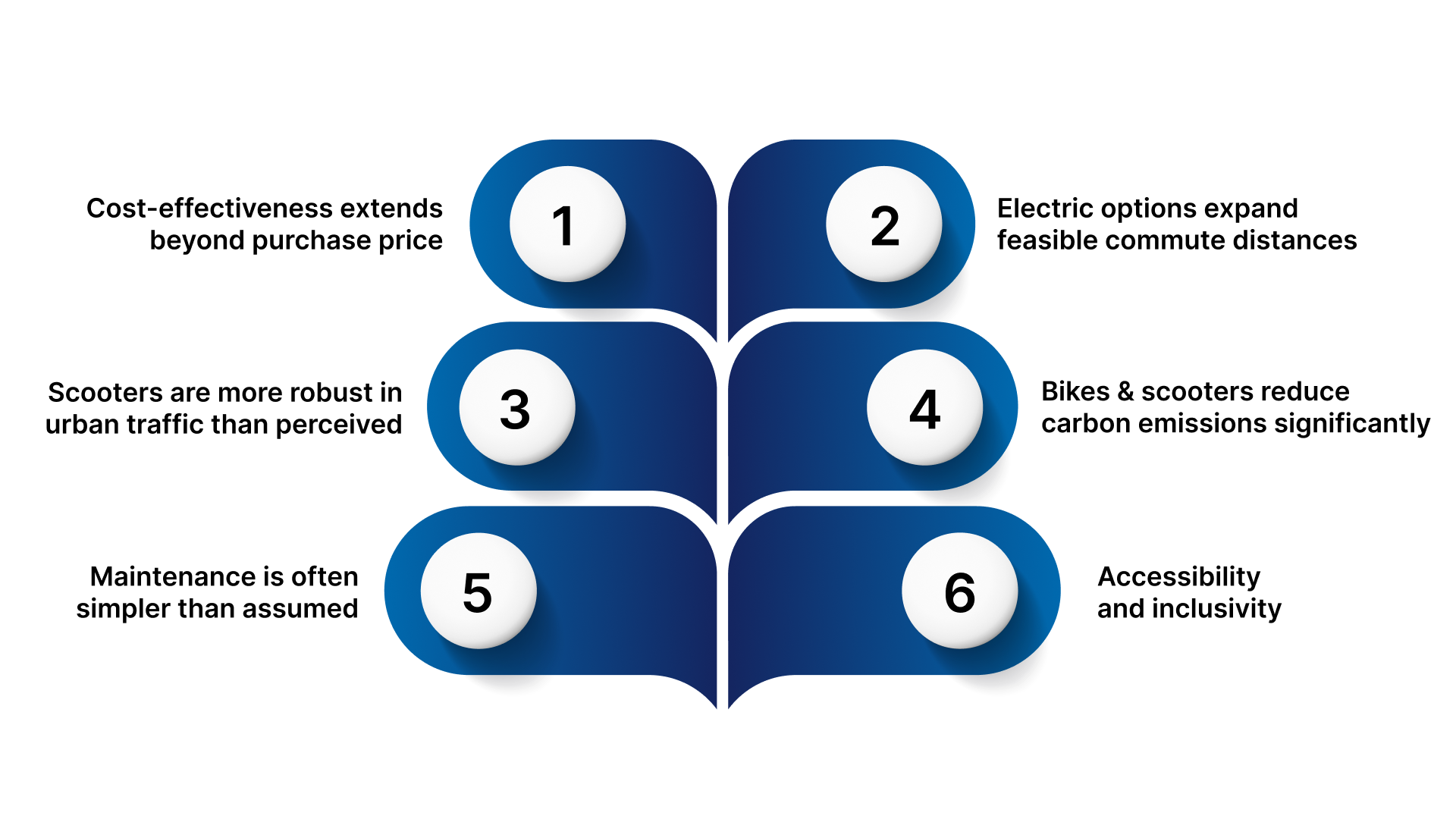
- Road vibration and comfort: This is the biggest hidden gap. Bikes roll on large wheels that soak up cracks, cobbles, and curb transitions. Scooters ride on small wheels, so every seam in the pavement travels straight up into your hands and feet. On smooth asphalt, a scooter is a joy. On a battered downtown street, an hour on one leaves your wrists buzzing. If your route is rough, that alone can settle it.
- Stability: A bike keeps you upright through its own geometry, which is why you can glance at a turn or signal with one hand. A scooter asks you to balance on a narrow deck with a higher center of gravity, so it feels twitchy at speed and on loose surfaces. New riders master a scooter in minutes, but a bike gives you more margin when something goes wrong.
- Riding in work clothes: Rarely mentioned, felt daily. On a scooter you stand upright and barely move your legs, so a suit, a skirt, or dress shoes survive the trip. Pedaling a bike in tight or formal clothing is genuinely awkward, and you may arrive warm. If you can’t shower or change at work, the scooter is the low-friction choice.
- Learning curve: Most adults already know how to ride a bike, so there’s no curve at all. Scooters are new to many people, but the curve is short. Ten minutes in a quiet lot and most riders feel confident. Neither is a real barrier. But if you haven’t been on a bike in twenty years, a scooter may feel easier from day one.
Carrying, Storage, and What You Haul
Where the vehicle lives when you’re not riding it matters as much as the ride itself.
Scooters fold in seconds and weigh under 30 pounds on most models, so they slide under a desk, onto a train, or into a studio apartment. That last-mile flexibility — ride to the station, fold, hop the train — is their signature strength.
Bikes need real space and usually a rack or a locked point outside. The trade-off is capacity. A bike takes panniers, a basket, or a rear rack, so it can haul groceries, a laptop bag, and a change of clothes. A scooter can manage a backpack and not much more. If your commute doubles as an errand run, the bike carries the day.
Short version: scooters win storage and portability; bikes win cargo capacity.
Weather, Terrain, and Safety
Bikes handle bad conditions better. Larger wheels, fenders, and a stable stance give you more control on wet or slick roads, and they shrug off gravel and small bumps that stop a scooter cold. Scooters are happiest on dry, smooth, paved routes and lose composure on rain-slick or uneven ground.
On safety, scooters get an unfair reputation. City trials in 2023 found scooter riders had a lower per-mile accident rate than drivers in dense centers like San Francisco and Chicago. The catch is discipline: stay in bike lanes, obey local speed limits, and skip the sidewalk. Bikes still offer more control at speed and in emergencies thanks to that stability advantage, but a scooter ridden sensibly is not the hazard the headlines suggest.
Both also beat a car on emissions. Commuters swapping car trips for an e-bike or scooter can replace up to 57.6% of their car mileage, a direct win for city air quality.
Also read: How Telematics Navigation Optimizes Modern Fleet Operations?
So, Which One Should You Pick?
Run your real commute through three questions.
- How far, and how hilly? Under five flat miles, lean scooter. Longer or hilly, lean e-bike.
- Do you want exercise or to arrive fresh? Bikes give cardio. Scooters keep you in your work clothes.
- Where does it sleep, and what do you carry? Tight space or a train transfer favors a scooter. Cargo and secure parking favor a bike.
There’s no universal winner, which is exactly why cities keep both. Match the tool to your route and you’ll ride more and drive less.
Running a Bike or Scooter Fleet? The Math Changes
If you’re not choosing a commute vehicle but launching a rental fleet, the decision flips. You don’t pick one, you offer both and let demand decide. A commuter chooses based on their route. An operator wins by covering every route.
That’s where the choice stops being about hardware and becomes about software. Managing mixed vehicle types, live tracking, zone rules, and billing across a city is the hard part, not the scooters themselves. EazyRide runs e-scooters, e-bikes, and mopeds from one admin account, with real-time geofencing that pushes no-parking and speed zones to every vehicle instantly, no firmware update required. Operators using that geofencing report up to 40% fewer parking violations than manual enforcement.
If you’re weighing a launch, our guide to starting a scooter rental business walks through fleet sizing and city ops, and the sharing scooter software development cost breakdown compares building your own stack against a white-label launch. On the product side, a branded white-label rider app handles bookings and payments, while the field operator app keeps your street team rebalancing and charging without a second tool.
For teams running both vehicle types, EazyRide’s shared bike and scooter management solutions put every asset on one map. Running 50-plus vehicles on a platform that can’t handle multiple vehicle types is worth a 30-minute look at scooter fleet management software built for exactly that.
FAQs
1. Is a scooter or bike better for commuting?
Scooters win short, flat city trips under five miles. Bikes and e-bikes suit longer routes, hills, and commuters who also want built-in daily exercise on the ride.
2. How much does an e-bike cost per mile?
About $0.03 per mile including charging and upkeep, versus roughly $0.58 per mile for a typical U.S. car. That car figure covers fuel, insurance, and wear.
3. Are scooters safe in city traffic?
Yes, when you stick to bike lanes and local speed rules. City trials found scooter riders had lower per-mile accident rates than drivers in dense downtown areas.
4. Can I carry a scooter onto a train?
Yes. Most electric scooters fold in seconds and weigh under 30 pounds, so they slot onto trains and buses and into small offices and apartments easily.
5. Which needs less maintenance, a bike or scooter?
Both stay low-maintenance for commuting. Scooters need battery, brake, and wheel checks; bikes need tire, chain, and brake care. Neither comes close to a car’s running costs.


