
 AllMicro Mobility Model

 26 June, 2025
 How to Build Electric Scooter Rental App and Launch Your Own Fleet
You want to build an electric scooter rental app. You may already have a few scooters in a storage room, or you are planning a pilot for your city, campus, or tourism business. You picture a map, a QR scanner, a payment page, and riders cruising.
But the second you start estimating costs & timelines, you realize you are not just building an app. You are creating a business system that must track vehicles, manage IoT data, handle charging and repairs, stay compliant with local rules, and stay profitable day after day.
The real question is not “How do I build the app?”
It is “How soon can my fleet break even?”
If your scooters are going to generate revenue, the app needs to do far more than unlock a ride. It needs to help you hit the numbers that matter, keep operations tight, and make your fleet usable, safe, and reliable every single day.
This guide walks you through how to build electric scooter rental app the right way. You will learn what Lime gets right, what most new operators overlook, and how to create a system that is profitable, scalable, and fast to launch.
Key Takeaways:
- Profitability = System + App: A profitable fleet requires efficient operations, not just a good app.
- Real-Time Data Drives Revenue: Fleet tracking, battery monitoring, and location management directly impact earnings.
- Start Small, Scale Smart: Begin with 40–60 scooters to test demand before scaling up.
- Tech Must Support Operations: IoT, geofencing, and analytics are essential for smooth, compliant operations.
- Skip Custom Development Costs: Use a ready-made platform like EazyRide for faster launch and lower risk.
What It Takes for a Scooter Sharing App to Be Profitable?
If you move forward, you’re not just building an app but a business. And in micromobility, the numbers matter more than features. Before you plan code or UI, you must ask: Will my fleet actually earn enough to justify investment?
First, have a glance at some of these figures:
- Shared micromobility (bikes + e-scooters) in the U.S. and Canada saw 130 million total trips in 2022, a 35× increase since 2010.
- The typical cost for a one-way dockless e-scooter ride in 2023 across many U.S. cities was around USD 6.00.
- The broader bike & scooter rental market (global benchmark) is projected to grow roughly at a CAGR of 15–16% through 2030–2032.
- Experts estimate that per-ride gross profit margins for scooter-sharing operators (after direct costs) can reach 27–30%.
There’s clear demand. People are using shared scooters regularly and are willing to pay for them. Growth trends suggest rising adoption, which means early entry can pay off.
But demand alone isn’t enough: you must design operations (fleet size, utilization, maintenance) to capture profit.
What a Profitable Fleet Looks Like?
To make things concrete, here is a sample “back-of-the-envelope” model for a U.S. city / mid-size fleet, under reasonable assumptions, along with the figures we discussed:
| KPI / Metric | Conservative Estimate* | Why it Matters |
|---|---|---|
| Daily rides per scooter | 2.5 – 4 rides | At USD 6/trip → ~USD 15–24/day per scooter |
| Gross daily revenue per scooter | USD 15 – 24 | Determines top-line revenue |
| Fleet utilization rate (active vs idle time) | ≥ 85–90% uptime | Idle scooters earn nothing; high uptime reduces losses & maximizes returns |
| Gross margin (after direct ride costs) | 27–30% of ride revenue | Helps cover fixed costs (maintenance, charging, redistributions) |
| Break-even time for a typical scooter | ~9–14 months (for a well-run fleet) | Based on initial scooter + setup cost vs consistent ride revenue and margin |
*Note: These estimates assume moderate-to-strong demand, efficient operations, and reasonable maintenance costs.
So, even though the demand and numbers look good, many operators fail because they underestimate the complexity behind the numbers.
- Low utilization kills margins. If rides per scooter drop below ~2 per day due to poor placement, bad demand forecasting, or seasonality, revenue shrinks and overhead eats profits.
- Maintenance & field logistics are heavy. Battery charging, hardware wear, redistributing scooters, repairs, if not properly managed, they consume time and money.
- Regulation, compliance, and city fees. Cities often impose permit fees or taxes on shared mobility services.
- Ride-fee sensitivity among users. The ride cost (USD 6/trip) means riders weigh cost vs convenience; high pricing or low service quality will limit repeat use.
- Seasonality/usage fluctuations. Many scooter fleets see usage drop in off-peak seasons or poor weather. Founders must plan for leaner months.
Also Read: A Comprehensive Guide to Scooter Types for Mobility Businesses
What This Means for You Before You Build the App?
Before starting development, a few critical questions must be answered with data and realistic assumptions:
- What is the expected ride demand in your target city (daily riders, commutes, tourism)?
- What utilization rate per scooter can you realistically achieve (are scooters visible, accessible, and properly distributed)?
- What are your fixed & variable costs (vehicles, charging, maintenance, staff, compliance)?
- Given those numbers, how long until break-even or profitability (and what’s the margin)?
- Do you have an operational plan for maintenance, charging, redistribution, and idle management, but not just the front-end app?
If you cannot answer these confidently, building an app becomes a high-risk investment.
The next section will break down exactly what your app must do to support a profitable, efficient business.
What You Need to Build an Electric Scooter Rental App
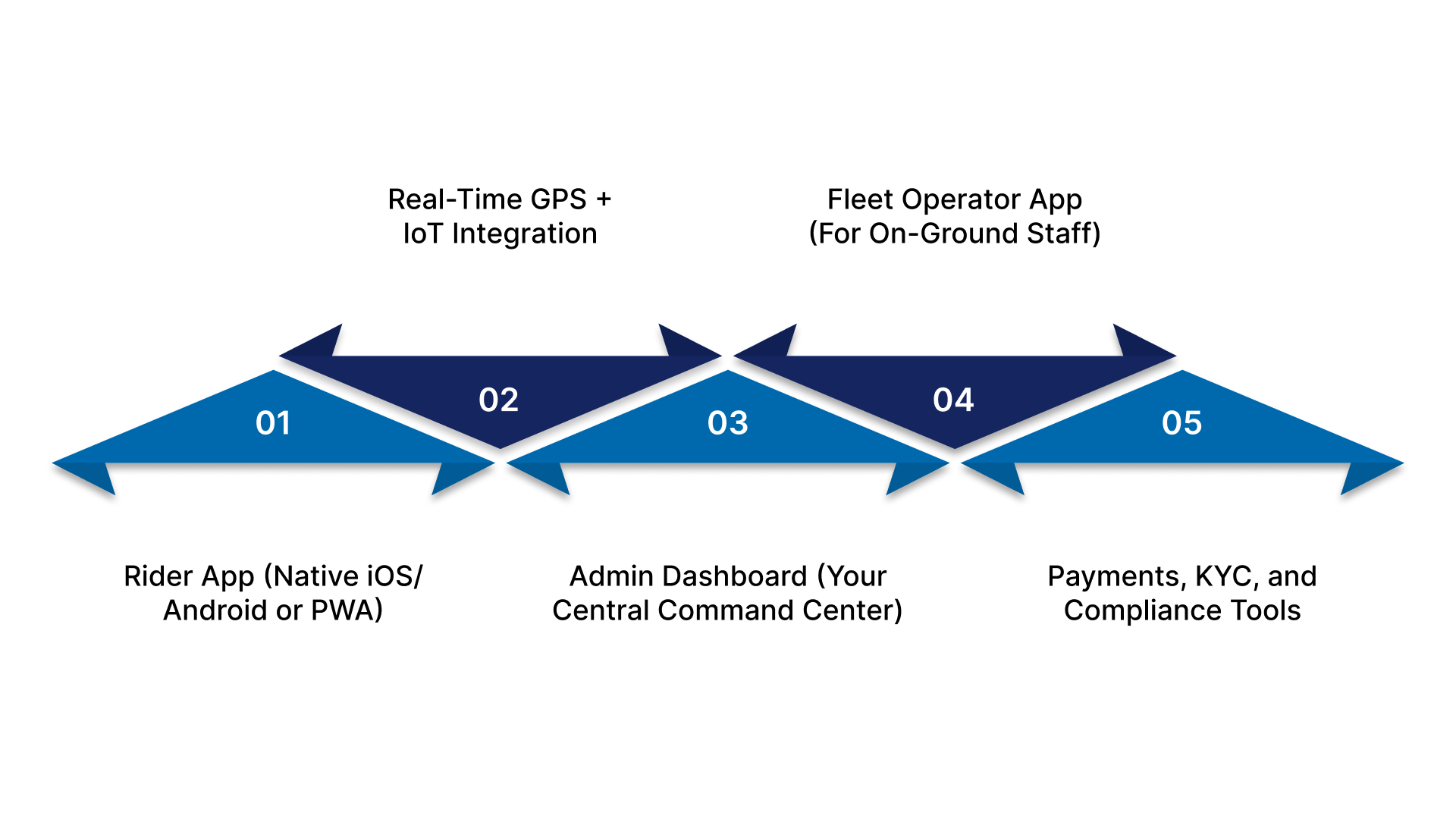
If you want your fleet to break even and scale, the tech must support your operations, compliance, and customer experience at every moment. A scooter rental app is a connected system made of five core components.
Below is a clear breakdown of each piece:
1. Rider App (Native iOS/Android or PWA)
Your rider app is the storefront of your entire business. It drives visibility, trust, and revenue. If users cannot find a scooter, unlock it fast, or trust the payment flow, ride volume drops.
It must include:
- Map with live scooter locations
- QR code unlock
- Wallet, payments, promo codes
- Safety checklist
- Ride summary
- Support and reporting tools
2. Real-Time GPS + IoT Integration
This is the core of your fleet. You cannot manage operational compliance without accurate IoT data. Your scooters must constantly connect with your system to send:
- live GPS location
- battery percentage
- lock/unlock status
- errors and maintenance codes
- trip start/end
Also Read: How IoT-Enabled Devices Power Smarter Mobility?
3. Admin Dashboard (Your Central Command Center)
Your dashboard tells you whether your fleet is healthy, profitable, compliant, or underperforming. It’s not about “nice charts” but how you keep uptime high and predictable.
Here are the key metrics the dashboard must track:
- Utilization rate
- Daily revenue per scooter
- Idle zones
- Battery distribution map
- Maintenance status
- Heatmaps
- Demand patterns (by hour/day/location)
- Geofencing boundaries
- Rider behavior and trip heat
4. Fleet Operator App (For On-Ground Staff)
This is the most overlooked part of a scooter business. If your field team cannot quickly find low-battery scooters, identify damaged vehicles, or redeploy during peak hours, you lose rides.
Here’s what the operator app must include
- Navigation to scooters needing pickup or charging
- Condition reports and photos
- Maintenance task assignments
- Battery swap or charging routes
- Redeployment suggestions
- Daily checklist
5. Payments, KYC, and Compliance Tools
For U.S. operators, compliance and payment systems are crucial from day one. Here are some must-have tools:
- Stripe, Adyen, or PayPal integration
- Age verification (for insurance + city requirements)
- ADA-sensitive zone definitions
- Local city permit tagging (if required)
- Remote lock enforcement for no-ride zones
Additionally, cities like Portland, Chicago, and LA require:
- speed-limited zones
- mandatory end-of-ride photo verification
- slow/stop zones around crowded public areas
If your app cannot enforce these rules, you risk suspensions or penalties.
Skipping or weakening any one component delays break-even. This is why founders who try to build an app “feature by feature” end up months behind schedule and thousands over budget.
Must Read: The Ultimate Guide to E-Scooter App Development
How to Create an E-Scooter Sharing App Like Lime: Step-by-Step
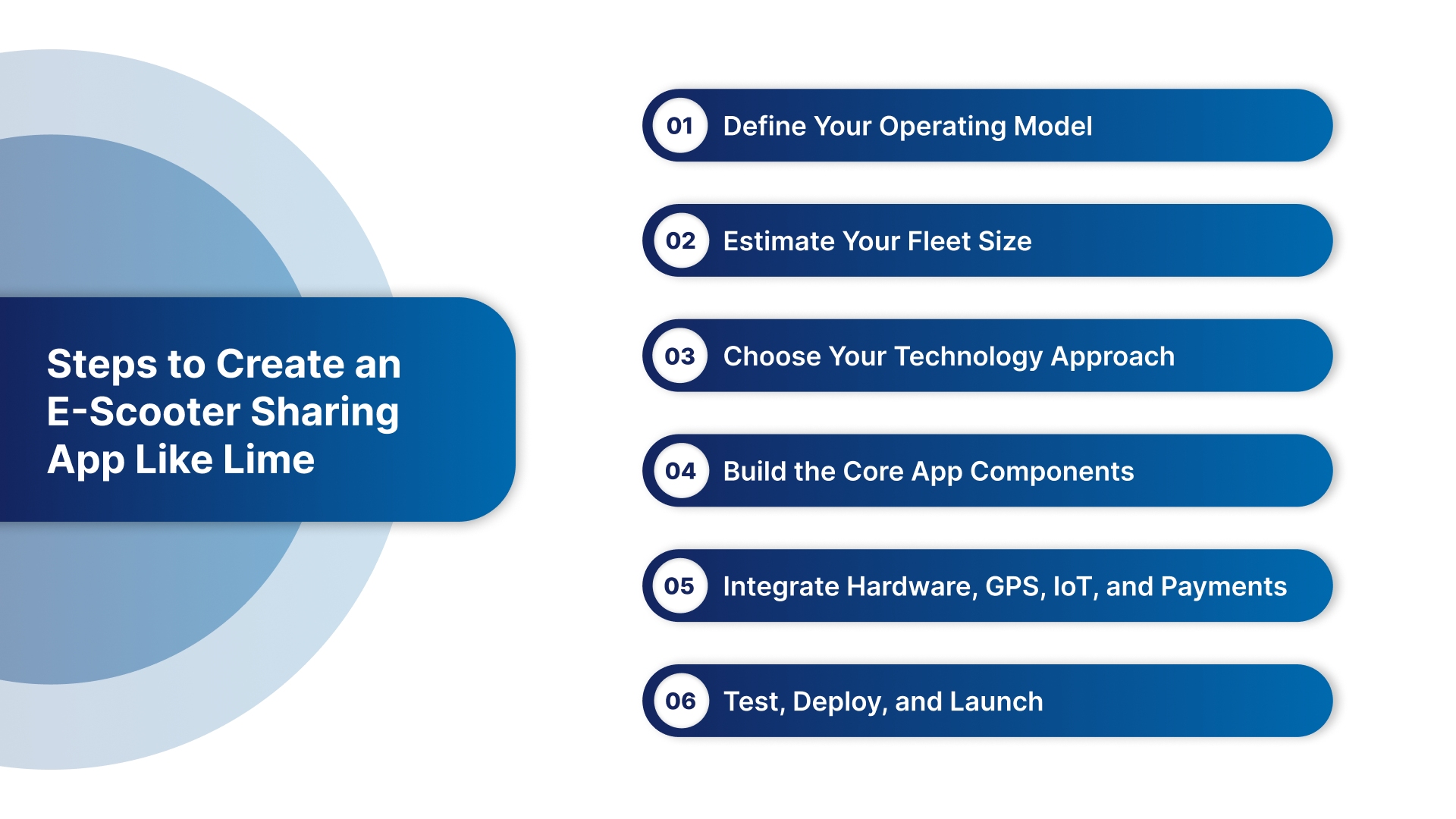
Building an app like Lime is not just a technical project. It’s a sequence of business decisions that determine whether your fleet reaches profitability or burns through cash. These steps are structured exactly the way a U.S. mobility founder thinks: market → model → budget → tech → operations → launch.
Step 1: Define Your Operating Model
Your operating model determines cost, hardware, staffing, and app features. Choose early to align your app with real-world needs. Here are some standard models to go with:
- Dockless (Most Popular): Best for cities, campuses, tourism zones. Requires strong IoT and geofencing.
- Docked: Higher upfront cost but lower operational chaos. Ideal for controlled spaces.
- Hybrid: Mix of drop zones + racks. Good for mid-size U.S. cities with moderate regulation.
- Campus-Only / Private Property: Universities, business parks, resorts. Lower compliance friction and easier to scale.
Step 2: Estimate Your Fleet Size
Your budget sets the scope of development and the number of scooters you can deploy. A typical U.S. starter fleet you can consider is:
- Small pilot: 40–60 scooters
- Mid-size operation: 150–300 scooters
- Tourism-heavy zones: 80–120 scooters
- Campus/University: 60–150 scooters
If your target is a 10–14 month break-even window, your fleet must consistently hit:
- 3+ rides per scooter per day
- Low downtime
- Stable maintenance and charging workflows
This is why founders often consider ready-made scooter rental PWA solutions, as they significantly reduce upfront risk.
Also Read: Electric Scooter Mileage: What Fleets Need to Know
Step 3: Choose Your Technology Approach
This is where most founders overspend. You have three realistic options:
| Options | Features |
|---|---|
| Build from Scratch |
|
| Scooter Rental PWA Solution |
|
| White-Label Platform (Like EazyRide) |
|
Step 4: Build the Core App Components
Each component must support operations, compliance, and profitability – not just look good.
- Rider App: Fast unlock, map visibility, secure payments. Slow or confusing unlock flows reduce ride conversions.
- Admin Dashboard: Must track revenue per scooter, utilization, heatmaps, no-ride zones, idle scooters, and more.
- Operator App: For charging, repairs, redeployment, and route planning. This tool directly impacts your operational cost.
- IoT + GPS Integration: Your app must communicate with scooter hardware without delay. Accuracy affects fines, safety, and ride experience.
- Compliance Tools: City rules require speed zones, parking zones, and ADA-friendly paths. Your app must enforce these, or you risk penalties.
Step 5: Integrate Hardware, GPS, IoT, and Payments
Cities like Chicago, San Francisco, and Portland require specific upload intervals (e.g., real-time or every 30–60 seconds). If your IoT cannot update quickly enough, you risk operational issues or compliance violations.
You must ensure:
- Your IoT module supports Bluetooth + GPS
- Lock mechanism works with your app
- Battery data syncs in real-time
- Payments (Stripe/PayPal) are consistent and secure
- Geofences update automatically when zones change
- Photo verification supports city rules
Step 6: Test, Deploy, and Launch
Before going live, run controlled tests with 5–10 scooters. Follow this pre-launch checklist to avoid missing any steps:
- Full ride testing
- GPS drift checks
- Payment flow verification
- Zone control testing
- Operator routes
- Charging workflows
- In-app support and incident reporting
Common Mistakes While Building E-Scooter Rental App And How to Avoid Them
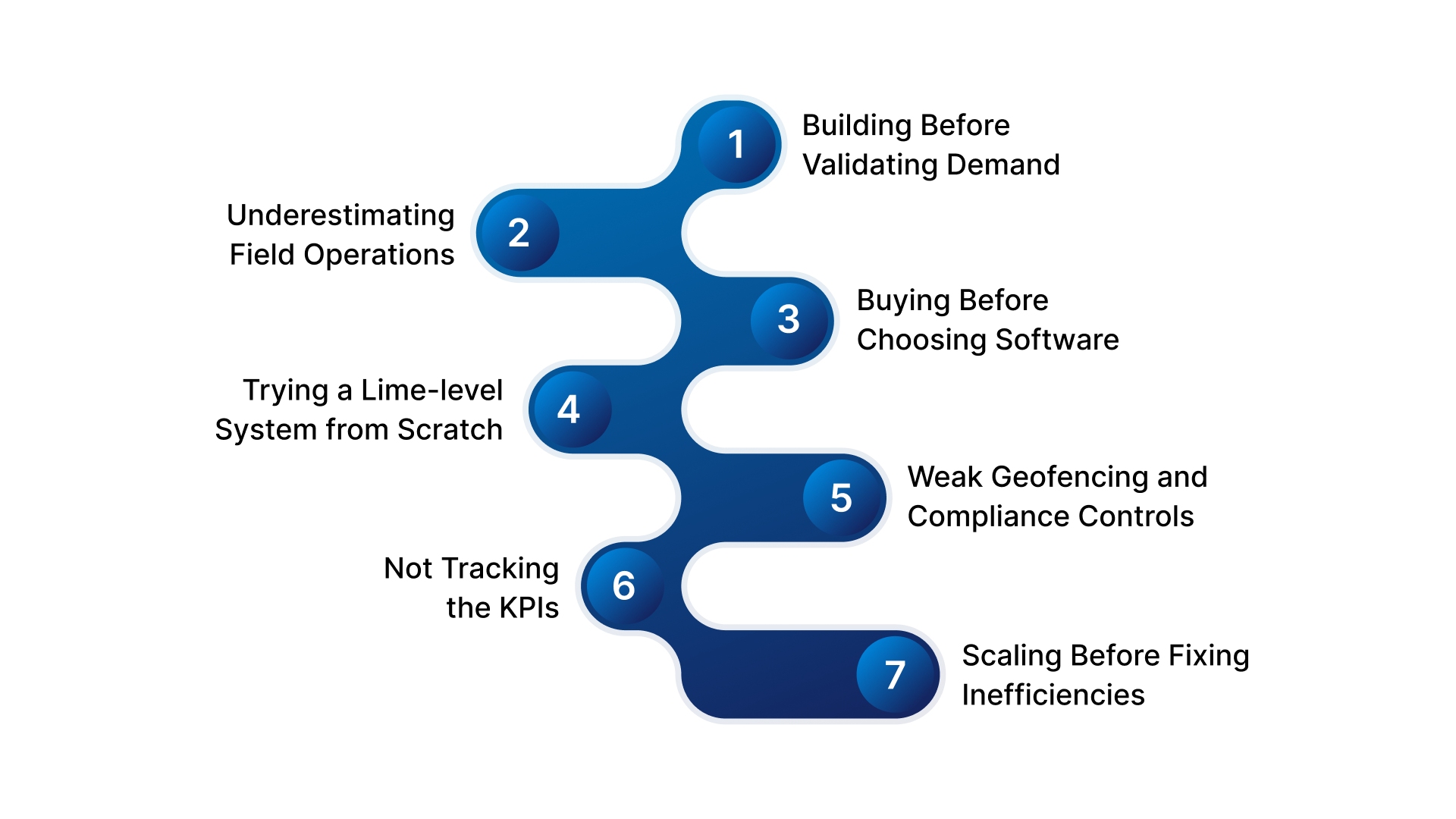
Most scooter-sharing pilots fail not because the idea is bad, but because the execution misses a few critical details. Here are the most common mistakes founders make, followed by the practical way to avoid each one:
1. Building Before Validating Demand
Many founders assume riders will appear once the app launches. That’s rarely true. Run a small test first:
- Run a mini demand test with 5–10 scooters in a high-traffic zone
- Track actual daily rides per scooter (your benchmark is 3+ rides/day)
- Use heatmaps or simple footfall observation to check peak-hour activity
- Study competition and local mobility trends
A small test shows you whether the location can support a fleet long before you invest in development.
2. Underestimating Field Operations
The #1 profit killer is downtime. Scooters sitting uncharged or unrepaired lose money every hour.
- Set up a predictable charging workflow (swap or bring-back)
- Define a repair cycle so each damaged unit is fixed within 24–48 hours
- Train field staff to report issues through an operator app
- Use heatmaps to plan redeployment routes
Treat operations as seriously as software. This is where your margins are made or lost.
3. Buying Before Choosing Software
Different scooters use different IoT modules, GPS chips, and firmware. If your app and vehicles don’t sync well, nothing works smoothly.
- Choose your software first
- Confirm which IoT modules your platform supports
- Ensure compatibility with GPS reporting intervals required by U.S. cities
- Test lock/unlock speed and battery accuracy before bulk purchasing
Your hardware should match your software infrastructure, not the other way around.
Also Read: 10 Key Benefits of GPS Fleet Tracking Software for Your Business
3. Trying a Lime-level System from Scratch
Custom development feels flexible, but it drains budget and time quickly. Compare the cost and time of a custom build vs. ready-made platforms.
- Use a white-label solution if you want to launch quickly
- Reserve custom features for later, after you confirm demand
- Avoid trying to build admin dashboards, operator tools, and IoT integrations yourself in the first version
Start lean. Build custom only once the business model is validated.
4. Weak Geofencing and Compliance Controls
U.S. cities require strict parking rules, slow zones, and MDS data reporting. Poor geofencing leads to fines or program shutdowns.
- Use highly accurate GPS and fast IoT refresh rates
- Add required zone types: slow, no-ride, parking-only
- Include end-of-ride photo verification if mandated
- Test geofence boundaries around parks, campuses, and busy areas
- Automate compliance alerts inside your dashboard
Cities take compliance seriously. Your tech must enforce rules automatically.
5. Not Tracking the KPIs
Founders often focus on app downloads instead of the numbers that matter. Track KPIs from day one:
- utilization rate
- rides per scooter per day
- average revenue per scooter
- cost per ride
- charging cycle efficiency
- downtime per scooter
- incident rate
Make decisions based on metrics, not assumptions. This shortens the time to profitability.
6. Scaling Before Fixing Inefficiencies
Launching 200 scooters when your processes only support 40 leads to chaos and wasted money. Start small.
- Start with a 40–60 scooter pilot
- Fix repair cycles, charging plans, and redeployment workflows
- Identify your most profitable zones
- Expand only once you see predictable patterns in ride demand
- Scale in controlled batches (20–40 units at a time)
How EazyRide Helps You Launch Faster and Avoid Costly Mistakes?
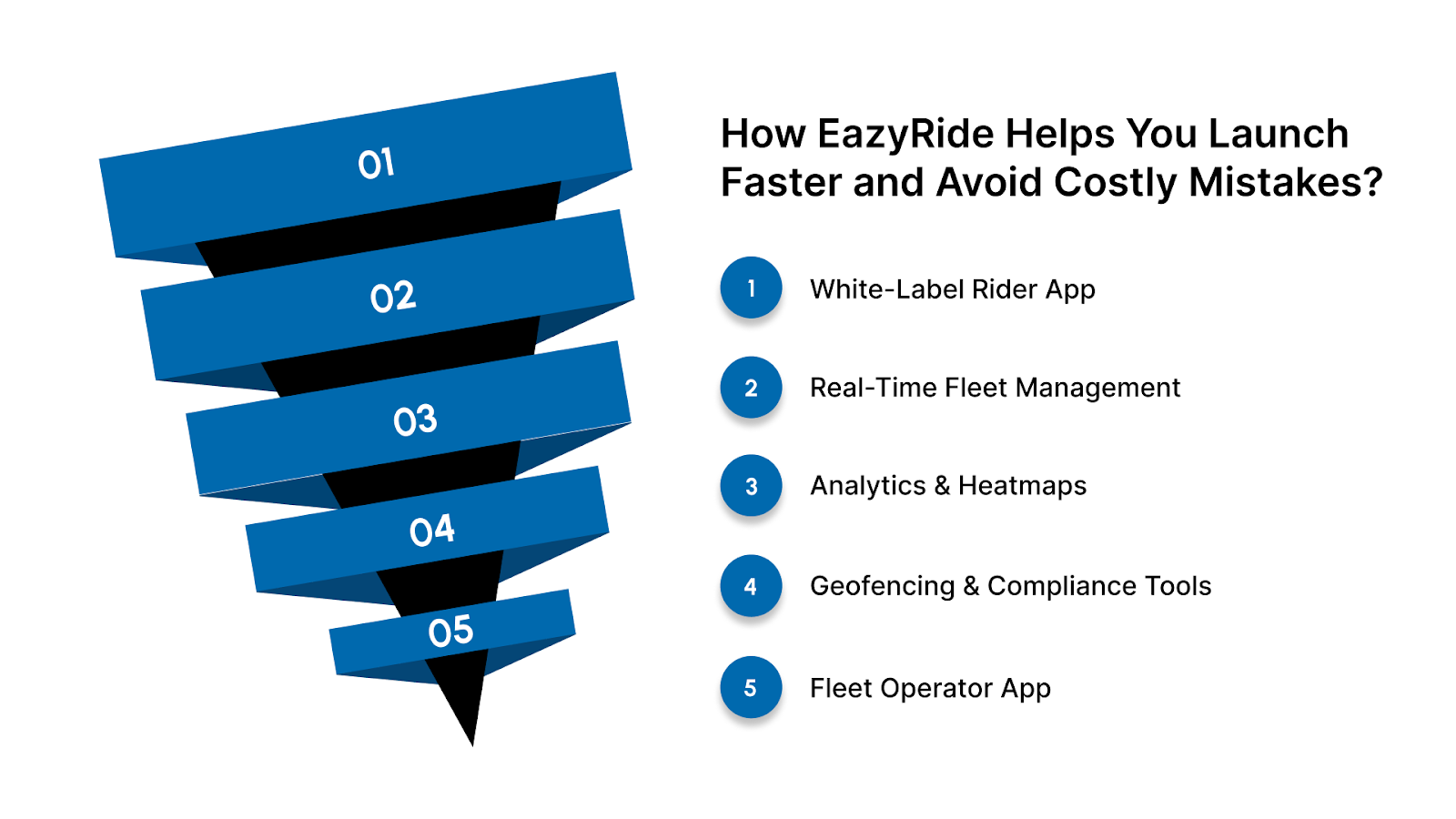
At this point, you understand what it takes to build a scooter-sharing app and what usually goes wrong. Now here is the practical part: how EazyRide helps you avoid those mistakes and launch with the systems already in place.
No hype. Just clear business benefits tied directly to the founder’s needs.
- White-Label Rider App: Can fully customize with your branding. You can offer a seamless, professional experience for customers while keeping your business’s identity front and center.
- Real-Time Fleet Management: Admin dashboard provides real-time data on all your scooters, tracking battery levels, location, and usage patterns. Optimize fleet deployment and maximize scooter usage.
- Analytics & Heatmaps: Detailed analytics that help you understand customer behavior, peak demand times, and revenue patterns. You can improve fleet efficiency, increase customer satisfaction, and drive higher revenue.
- Geofencing & Compliance Tools: Ensure that your scooters stay within allowed operational areas, helping you stay compliant with local regulations. You can minimize regulatory risk, ensure safe riding, and guarantee compliance.
- Fleet Operator App: Simplifies daily operations for your on-the-ground team. From rebalancing scooters to managing maintenance schedules, this app centralizes all tasks in one place.
When these tools work together, you get a branded rider experience with high uptime and stable revenue. EazyRide removes the friction that typically delays break-even and complicates early-stage growth.
Final Thoughts
Launching an electric scooter sharing service is not just about building an app. It is about creating a system that delivers predictable rides, efficient operations, and steady revenue.
If you approach this business with clear numbers, a tight operational plan, and the right software stack, breaking even in under a year becomes realistic. What slows most founders down is not demand, but the time and money wasted on building all these components from scratch.
EazyRide simply provides the foundation serious operators need. Your branding, your fleet, your city – supported by the tools that keep uptime high, riders satisfied, and operations under control.
Don’t just take words. Schedule a demo with us and see how these tools can get your fleet live in weeks!
FAQs
Q1: How long does it take to build a scooter‑sharing app like Lime or Bird from scratch?
Typically, building a full-featured app (rider + admin + operator + IoT integration) from scratch takes 6–12 months, assuming you have a dedicated development team and handle hardware integration correctly.
Q2: What are the typical development costs to launch a scooter rental app in the U.S.?
For a custom build, expect around USD 100,000–150,000 depending on features and platforms. Using a ready or white‑label platform significantly reduces costs and time to launch.
Q3: What are the must‑have features for a scooter-sharing app to work reliably?
Essential features include a live scooter‑location map, QR unlock, payment processing, real‑time GPS/IoT tracking, geofencing, maintenance & operator tools, and a strong admin dashboard. Without them, operations quickly fail.
Q4: Can I start with a small fleet, or do I need large numbers to make scooter sharing viable?
You can absolutely start small. Many fleets begin with 40–60 scooters and test demand. If utilization, maintenance, and deployment are efficient, you can grow from there. Scaling gradually reduces risk. (Derived from typical rollout strategies in the industry.)
Q5: Why do many scooter‑sharing startups fail even with a good app?
Because success depends not only on the app but also on operations – poor maintenance, a bad redeployment strategy, weak IoT integration, or a lack of data/tracking usually kill profitability long before the software fails.


