
 AllAnalytics and research

 19 June, 2025
 IoT Fleet Management: How IoT Fleet Tracking Solutions Enhance Efficiency
Fleet management comes with its fair share of challenges, like rising costs, inefficiencies, and the constant need for better tracking and performance. If you’re managing a fleet, you know the struggle: keeping everything running smoothly, staying on top of maintenance, and making sure vehicles are where they need to be on time.
But what if there was a smarter way to handle it all?
That’s where IoT fleet management steps in. With IoT-enabled fleet vehicle tracking solutions, you can track your vehicles in real time, reduce operational costs, and improve efficiency.
But again, how fast will your fleet see results with IoT? Well, you could break even in less than a year. With real-time insights and predictive maintenance, the return is faster than you might think.
This blog breaks down how IoT is revolutionizing fleet management, from better tracking to modern route optimization. Ready to make your fleet smarter and more efficient? Let’s dive in.
Key Takeaways:
- Real-Time Tracking: IoT provides live data on vehicle location, fuel usage, and driver behavior, enabling immediate, informed decisions.
- Predictive Maintenance: Avoid costly breakdowns by tracking vehicle health and scheduling maintenance before issues occur.
- Route Optimization: Reduce fuel consumption and improve delivery efficiency with real-time route adjustments.
- Integrated Solution: EazyRide’s platform offers custom branding, real-time management, and detailed analytics to boost fleet efficiency.
- Quick ROI: Expect cost reductions in fuel and maintenance within a year of implementing IoT.
The Hidden Costs of Traditional Fleet Management
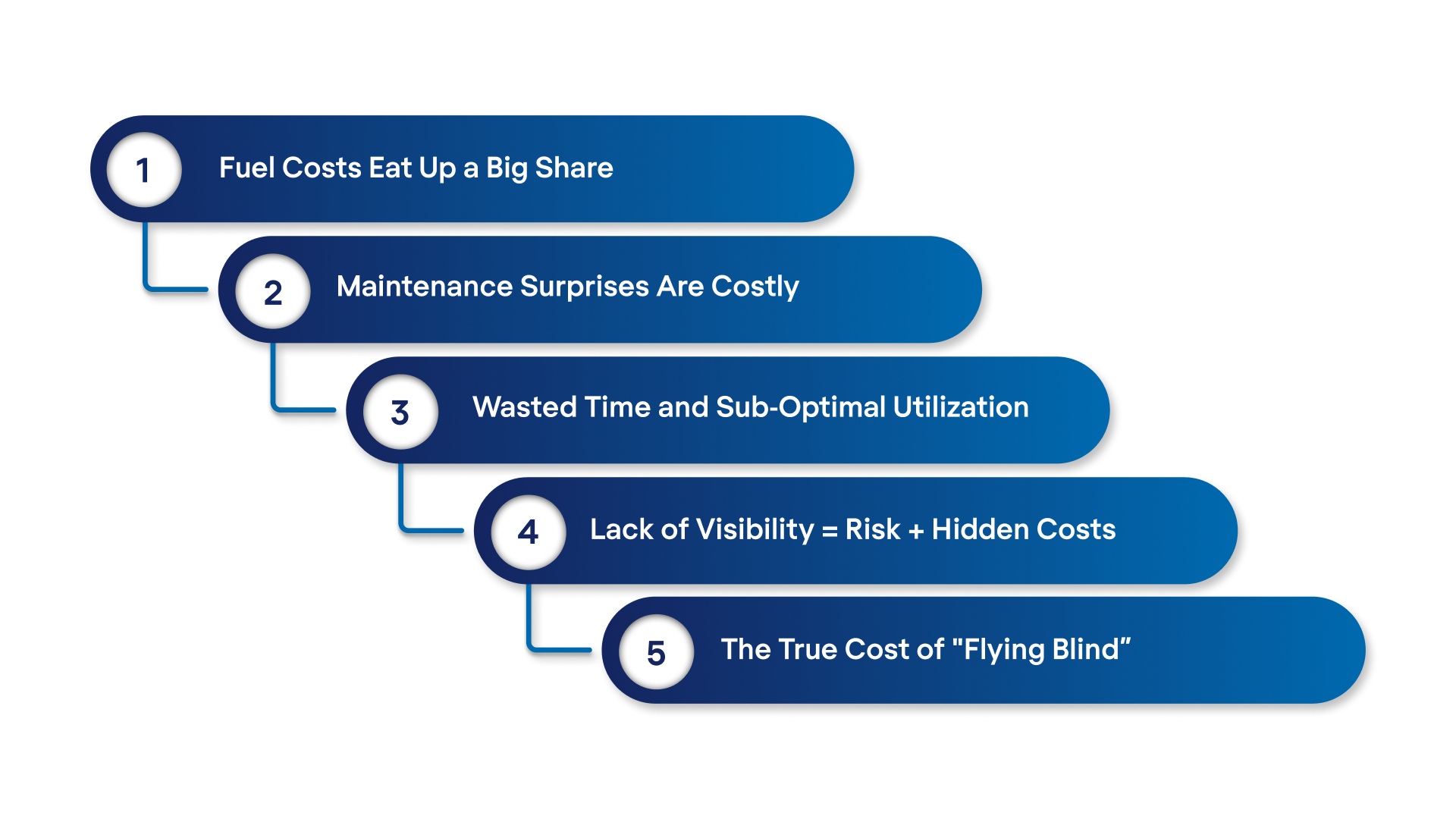
Traditional fleet management hides inefficiencies. When you run a fleet without smart tracking or analytics, you don’t always see the money slipping away. Over time, it adds up and hurts your profitability, scalability, and reliability. As you grow, these hidden costs often grow faster than your revenue.
Here’s where the real pain lies:
Fuel Costs Eat Up a Big Share
Without visibility into routes, idling, or driver behavior, you end up overspending on fuel. In fact, fleets with telematics or tracking often report fuel consumption reductions of 20-30%.
So, cutting almost a third off your fuel bill just by optimizing driving and routing? That’s not a small change.
Maintenance Surprises Are Costly
Maintenance (plus repair costs) can represent a major portion of total fleet expenses. And worse, unplanned breakdowns or emergency repairs can cost 3–5 times as much as scheduled preventive maintenance.
This unpredictability hurts both your cash flow and your reliability as a service provider.
Wasted Time and Sub‑Optimal Utilization
Without real-time tracking, you lack clear insights into which vehicles are active, idle, underused, or overused. That means you might be paying for assets that sit unused.
Worse: delayed dispatching, inefficient scheduling, and unclear assignment – all eat into productivity and lower asset utilization.
Lack of Visibility = Risk + Hidden Costs
Without data, you’re “flying blind.” Driver behavior (speeding, harsh braking, long idle times), inefficient routes, unauthorized usage — all go unchecked. There’s also a safety and compliance risk.
Accidents, breakdowns, or misuse of vehicles can add insurance costs, downtime, and repairs – all of which could have been mitigated with better data and control.
The True Cost of “Flying Blind”
When you add up fuel wasted, unexpected maintenance, underused vehicles, and unmanaged driver behavior, the hidden cost can be 15–25% of potential revenue that slips away due to inefficiencies.
That’s not a small leak but a hole in your profit margin.
If you don’t know what’s going wrong, you can’t fix it. This is why many modern fleets are shifting to IoT / telematics / GPS‑enabled tracking systems.
What Exactly is IoT Fleet Management?
At its core, IoT fleet management utilizes connected devices, sensors, and data analytics to enhance the efficiency, performance, and safety of fleet operations. Simply put, it’s a way to turn your vehicles into smart assets that provide valuable real-time insights.
Here’s how it works:
1. IoT Sensors and GPS Tracking
IoT fleet management relies on GPS-enabled devices and IoT sensors installed in each vehicle.
- These sensors track real-time data, including location, speed, fuel consumption, engine health, and driver behavior.
- By feeding this data back to a central dashboard, fleet managers gain a full picture of their fleet’s operations, down to the minute details of every vehicle’s movement.
2. Telematics Data Collection
Telematics refers to the technology that collects and transmits vehicle data to a centralized platform.
- IoT fleet management uses telematics to monitor vehicle health, including engine diagnostics, battery levels, tire pressure, and fuel efficiency.
- This allows managers to keep an eye on both preventive maintenance (catching minor issues before they turn into expensive repairs) and operational performance (e.g., tracking how efficiently each vehicle is being used).
Also Read: How Telematics Empowers SMEs in Micro-Mobility
3. Data Analytics and Actionable Insights
The real value of IoT lies in data analytics.
- The sensors and telematics systems collect vast amounts of data that would be impossible for a human to track manually. With IoT, this data is transformed into actionable insights.
- For example, if one vehicle is using excessive fuel, IoT analytics can highlight that it’s idling too often or taking inefficient routes. A simple solution could be to adjust the driver’s behavior or optimize the route.
By harnessing this data, fleet managers can make real-time decisions to reduce costs, improve performance, and avoid problems before they escalate.
How Does IoT Fleet Management Benefit Your Business?
Adopting IoT technology transforms how you manage your fleet. It’s no longer about reacting to issues; it’s about proactively managing operations and reducing risk.
Here are some of the excellent perks you must not miss:
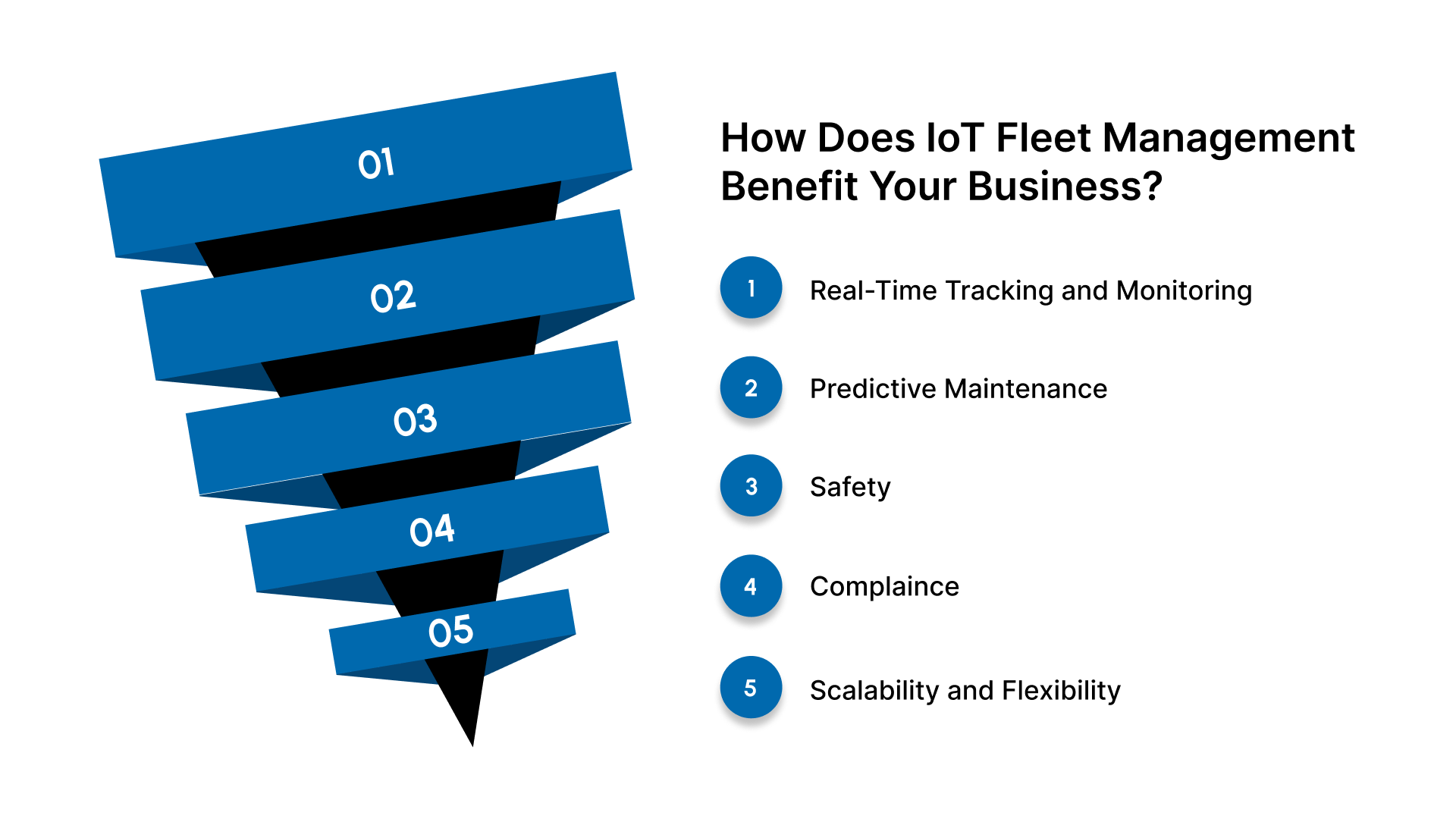
Real-Time Tracking and Monitoring
Traditional fleet management systems often rely on manual checks or phone calls to track a vehicle’s status. With IoT, everything is tracked automatically and in real time. This means fleet managers know exactly where each vehicle is at all times and can reroute them if necessary to save time or fuel.
Predictive Maintenance
By continuously monitoring the health of your vehicles, IoT systems can predict when a part is likely to fail or when maintenance is due. This prevents unexpected breakdowns and keeps the fleet running smoothly.
Safety
IoT systems can monitor driver behavior in real-time, alerting managers when speed limits are exceeded or when unsafe driving patterns emerge, such as harsh braking or acceleration. This helps enforce safer driving, reducing accidents and potential liability.
Complaince
Most importantly, IoT systems help ensure compliance with local regulations by tracking things like driver working hours, emissions levels, and vehicle inspections.
Scalability and Flexibility
As your fleet grows, IoT systems can scale with it. Whether you have 5 vehicles or 500, IoT-enabled management platforms provide the same level of detailed insight and control. The system can handle additional vehicles, new routes, or expanded operations with ease, making it perfect for business growth.
All in all, it’s not just a technology; it’s a business transformation tool.
Suggested Read: How IoT-Enabled Devices Power Smarter Mobility?
These are broad but powerful benefits. To get a closer look, let’s read a case study that has successfully implemented this in its business.
A Real Case Study of Successful Fleet Transformation with IOT
If you manage a fleet of any size, you don’t need to be a massive global company to benefit from IoT. Whether you have 20 vehicles or 2,000, the same principles apply. But don’t just take words for it.
Below is a concrete example of a company that deployed IoT fleet management and transformed its operations.
How DEF Logistics (North America) Utilized IoT for Fleet Transformation
DEF Logistics manages a large commercial fleet (2,400+ vehicles) across North America, handling deliveries and logistics operations. Like many traditional fleets before IoT, they struggled with:
- Lack of real-time visibility over where each vehicle was
- High fuel and maintenance costs due to inefficient routing and reactive maintenance
- Delays, unpredictable delivery times, and sub‑optimal fleet utilization
Solution: Telematics + IoT-Based Fleet Tracking
DEF Logistics rolled out a comprehensive telematics implementation: IoT and GPS tracking devices, real-time monitoring dashboards, and analytics for predictive maintenance, driver behavior, and route optimization. Read the full DEF Logistics telematics case study
After the deployment:
- They saw significant improvements in efficiency, safety, and profitability.
- Real-time monitoring and data-driven decisions helped cut down idle time, improve routing, and reduce unnecessary fuel spend.
- Predictive maintenance reduced unplanned breakdowns and lowered maintenance costs, improving fleet uptime and reliability.
- The shift from reactive to proactive management gave better control over operations, even across a vast fleet.
This concrete example demonstrates the kind of results you can expect.
IoT Fleet Management Is the Future of Fleet Operations
As fleets grow in size and complexity, sticking with manual or legacy methods becomes a liability. IoT‑powered fleet management is becoming essential.
The global IoT fleet management market was valued at about USD 7.03 billion in 2023 and is projected to grow to USD 20.6 billion by 2030, at a CAGR of around 17 % This growth signals two things for you:
- Competitors are likely already evaluating or adopting IoT, and
- IoT platforms will become more feature-rich and affordable.
It’s a window you don’t want to miss.
Also, because of cloud‑based architecture and modular IoT devices, expansion means adding more units – not rebuilding operations from scratch. This makes IoT especially valuable for businesses planning growth.
Are You Prepared For the Next Wave?
The future of mobility is shifting, and fleets are part of it. IoT systems will form the backbone of:
- Electric vehicle (EV) fleet management — monitoring battery health, optimizing charging schedules, and managing performance.
- Smart logistics & predictive analytics — using historical and real-time data to forecast demand, maintenance, and route optimization, enabling leaner, more efficient operations.
- Regulatory readiness & sustainability compliance — with rising environmental and safety standards, IoT gives you the data and tools to stay ahead.
If you wait too long, fleets that adopt IoT, especially EV‑ready, data‑driven fleets, will likely get a competitive edge in efficiency, cost, compliance, and scale.
Also Read: IoT’s Contribution to Environmental Sustainability
EazyRide’s IoT Fleet Management Solution: Your One-Stop Platform
Managing a fleet is complex, but it doesn’t have to be. With EazyRide’s IoT fleet management solution, you get a fully integrated platform that optimizes every aspect of your fleet.
Here’s how we can help:
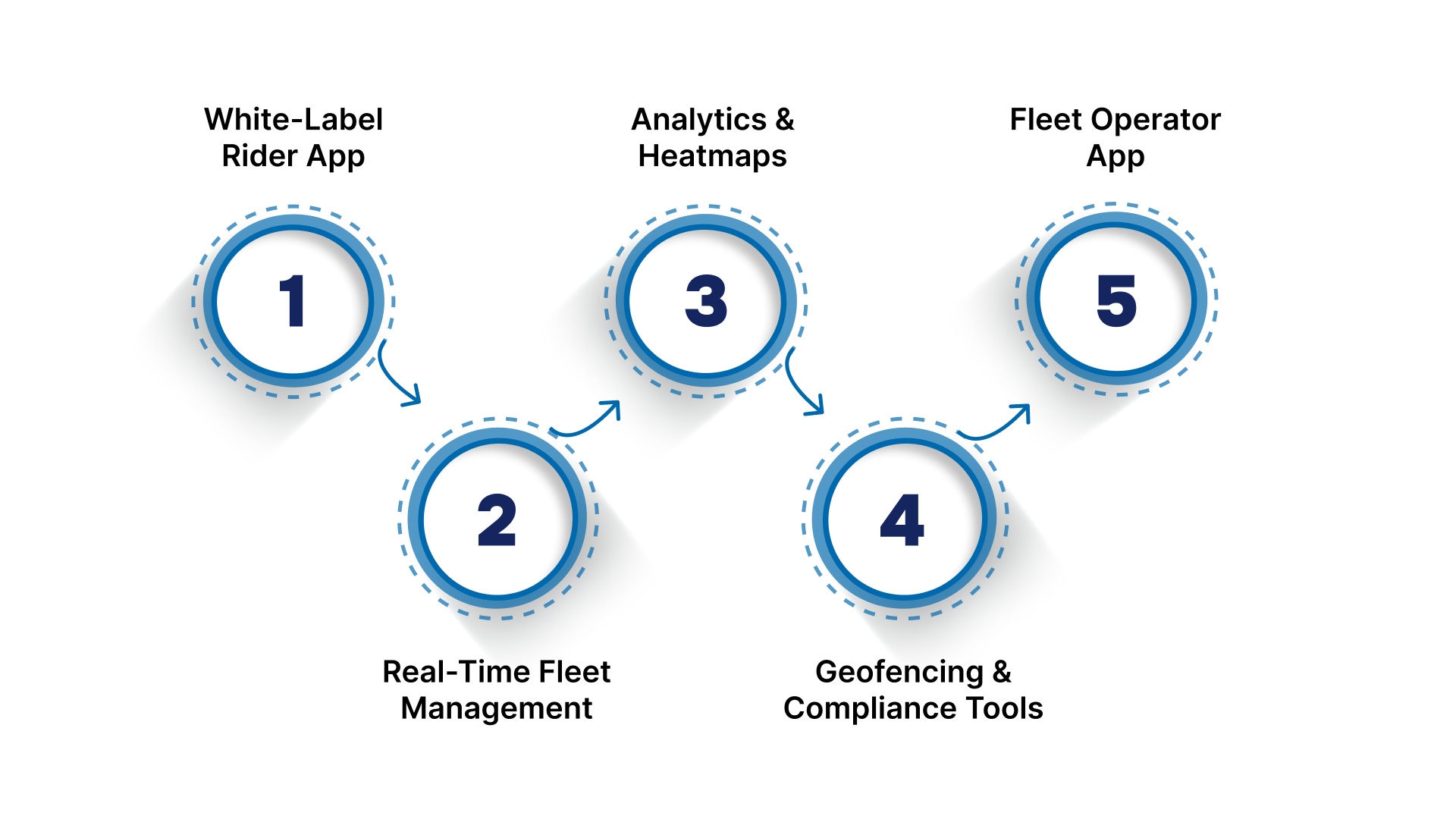
- White-Label Rider App: Allows you to brand the app with your company’s identity, offering your customers a professional, consistent experience while keeping your brand front and center.
- Real-Time Fleet Management: Admin Dashboard provides real-time data on all vehicles in your fleet. Track battery levels, location, and usage patterns to understand where your fleet is most active and how it’s performing.
- Analytics & Heatmaps: Allows you to dive deep into customer behavior, peak demand times, and revenue patterns, and make informed decisions.
- Geofencing & Compliance Tools: Create virtual boundaries that ensure your vehicles stay within authorized areas. Enforce safe riding areas and prevent vehicles from going where they shouldn’t.
- Fleet Operator App: Manage daily tasks for your on-the-ground team easier than ever. Whether it’s rebalancing vehicles, scheduling maintenance, or monitoring vehicle health, the app centralizes all functions in a single intuitive platform.
EazyRide’s comprehensive suite of features provides you with everything you need to run a smarter, more efficient fleet.
Final Thoughts
Fleet management doesn’t have to be a constant battle with inefficiency and rising costs. IoT fleet management offers a clear path to smarter, data-driven operations. By embracing IoT now, you not only save on fuel, maintenance, and operational costs but also set your fleet up for future growth.
With EazyRide, you get real-time insights, predictive maintenance, and complete control over your fleet’s performance, all from a single platform. It’s time to stop reacting and start proactively managing your fleet.
Book a demo with us today and see how our IoT-powered platform can transform your fleet management.
Frequently Asked Questions
Q1: What exactly does “IoT fleet management” mean? How is it different from regular GPS tracking?
IoT fleet management goes beyond basic GPS. It uses connected sensors and telematics to collect data on location, vehicle health (engine, fuel, battery), driver behavior, and usage patterns, then sends it all to a central dashboard for real‑time monitoring and analytics.
Q2: Can a small fleet (e.g., 10–20 vehicles) benefit from IoT fleet management?
Yes. Even small fleets get value. IoT helps you precisely monitor each vehicle, cut fuel costs, spot maintenance issues early, and improve utilization. Scalability isn’t just for big fleets.
Q3: How soon can I expect to see savings or ROI after implementing an IoT fleet system?
Most fleets that adopt IoT-based tracking and analytics see measurable cost reductions in fuel, maintenance, and idle time within 6–12 months. Many global fleet‑management guides mention this timeframe for ROI.
Q4: Does IoT fleet management help with regulatory compliance or safety monitoring?
Yes. By monitoring vehicle health, driver behavior (speeding, idling, harsh braking), and route history, IoT systems help you enforce safety standards, maintain audit logs, and reduce the risk of accidents or violations.
Q5: Is real-time vehicle tracking the only benefit of IoT, or are there other advantages too?
Real-time tracking is just one benefit. IoT also enables predictive maintenance, route optimization, asset utilization analysis, driver performance monitoring, and data-driven decision-making for scaling, all of which help lower total operating costs and improve reliability.


