
 AllSharing business

 27 June, 2025
 EV Routing 101: How to Optimize Routes and Reduce Fleet Costs
If you run a shared mobility fleet, you already know this: every unnecessary trip your team makes eats into your margins. You don’t have unlimited staff, unlimited chargers, or unlimited hours in the day. And when a vehicle dies mid-shift, gets stuck in a low-demand area, or needs a last-minute battery swap, the ripple effect hits your revenue fast.
If you’re new to micromobility, you’ll feel this even sooner. One of the first questions every founder asks is simple: “How do I plan my operations so this business actually makes money?”
That’s where EV routing comes in.
At its core, EV routing is about planning smarter routes for charging, maintenance, redeployment, and daily fleet tasks. It’s the difference between reacting to problems all day and running a predictable, cost-controlled operation.
In this guide, you’ll learn why EV routing matters and how it helps you reduce operating costs and improve fleet uptime, whether you manage scooters, e-bikes, or multi-vehicle EV fleets across campuses, resorts, or city zones.
At A Glance:
- EV routing is the fastest way to cut operating costs by reducing wasted labor, preventing dead batteries, and keeping vehicles in high-demand zones.
- Profitability depends on utilization, and smart routing is what keeps fleets consistently hitting the 3–5 rides per vehicle per day needed to break even on time.
- The U.S. micromobility market is growing fast, which means more demand but also more operational complexity. Routing helps fleets scale without chaos.
- Real-time routing decisions matter more than static planning. Battery data, heatmaps, and task priorities must update continuously to avoid downtime.
- Tools like EazyRide simplify routing by giving operators live battery insights, demand analytics, geofencing controls, and clear task workflows.
Now, before we talk about costs or efficiency, let’s get clear on what EV routing actually means in a shared-fleet operation.
What Actually is EV Routing?
Let’s say you are running an e-bike, e-scooter, golf cart, or any multi-vehicle EV fleet. For this, EV routing will determine:
- When your team visits each vehicle
- Where vehicles should be moved next
- How charging cycles should be scheduled
- Which tasks do your operators handle first
- How do you avoid mid-day breakdowns
- How do you keep utilization high enough to stay profitable
In simple terms, EV routing is the process of planning and optimizing how electric vehicles are charged, serviced, redeployed, and managed across your service area.
But what happens if operators don’t use routing tools?
The Real Cost of Poor EV Routing
If you manage a growing fleet, you know the numbers that actually matter: how many rides each vehicle completes, how much labor it takes to keep the fleet running, and how quickly you can break even. Poor EV routing affects all three.
Most shared EV fleets in the U.S. break even in approximately 9 to 14 months, but that timeline depends. If utilization is solid at around 10 rides per vehicle per day, break-even can be expected in 10 months.
Here’s what poor routing looks like for most operators:
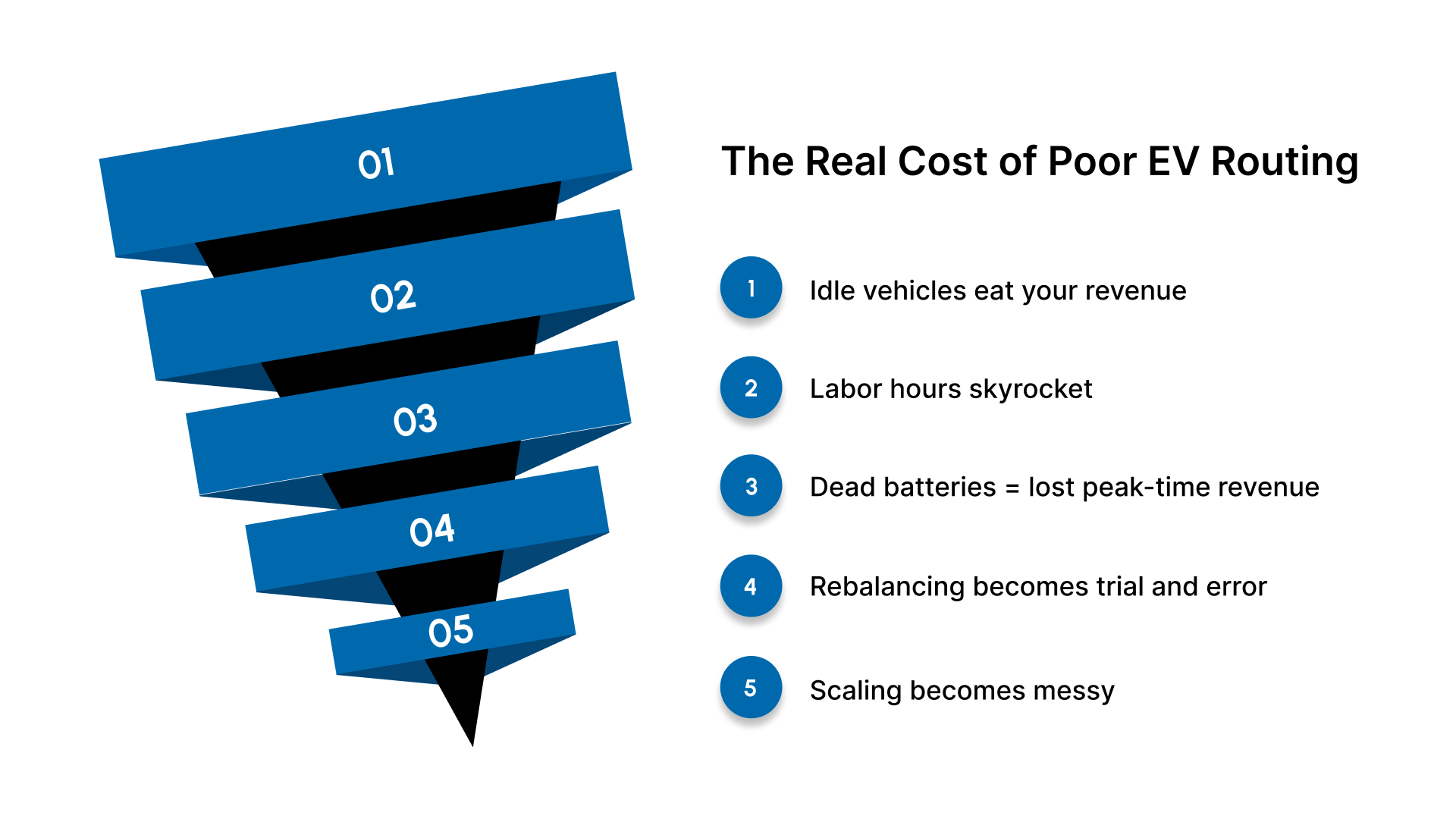
Idle vehicles eat your revenue
When a scooter or e-bike sits in a low-traffic zone, you’re not just losing rides. You’re losing the predictable demand pattern that keeps your fleet profitable.
Labor hours skyrocket
When teams move blindly between vehicles, you burn more hours than necessary. Typical issues:
- Making three trips across town when one smart route would do
- Checking vehicles that don’t actually need servicing
- Missing high-urgency tasks because the team hits low-priority ones first
Dead batteries = lost peak-time revenue
A scooter dying at 5 PM in a downtown zone or a resort guest finding an undercharged vehicle at noon is more than a customer problem. It’s a revenue leak.
Rebalancing becomes trial and error
Without data, operators often shift vehicles based on guesswork. This leads to:
- Overcrowded zones that don’t need more vehicles
- Underserving the areas that generate the most rides
- Higher truck/van usage for rebalancing (fuel and labor cost)
Scaling becomes messy
A 30-vehicle fleet can survive inefficiency. A 300-vehicle fleet collapses under it.
If routing isn’t optimized early, your costs increase faster than your fleet size grows. Scaling without routing tools results in wasted labor during rapid expansion.
Suggested Read: The Future of Mobility: Top Trends Reshaping the Industry
Why EV Routing Is Becoming Essential in 2025?
Across the United States, micromobility isn’t a fad. It is growing into a core part of urban and campus transit. The U.S. micromobility market is projected to reach nearly USD 14.09 billion by 2030, growing at a compound annual growth rate (CAGR) of 17.8% between 2025 and 2030.
For shared-EV fleet operators, this growth translates into both potential rides and rising complexity. EV routing is becoming a non-negotiable operational foundation.
Basically, strong market growth means more demand – and more pressure to perform. How?
- Shared bikes and scooters are riding that wave. In 2023, there were approximately 157 million shared-mobility trips (bike + scooter) in the U.S. and Canada, signaling a notable rebound and resurgence in demand.
- Most new demand isn’t for pedal bikes anymore. Electric vehicles (e-bikes, e-scooters) are increasingly dominant, especially among urban, campus, and tourist markets.
These figures mean more riders, but also more rides per vehicle, more charge cycles, and more pressure on fleet operations.
Without smart routing, scaling quickly becomes a financial risk instead of an opportunity.
How is This Timing Perfect?
Post-COVID, many U.S. cities and campuses have been rethinking transport: commuters and students prefer flexible, eco-friendly rides over crowded buses or cars. Ridership is resurging. Operators are shifting to e-vehicles for shared mobility. E-scooters and e-bikes, being cheaper to run and easier to maintain than cars, attract both everyday users and casual riders.
So, being operationally lean to this trend becomes a competitive advantage. Early adopters stand to capture more market share, reduce costs, and grow sustainably.
How EV Routing Works in Modern Fleet Operations?
EV routing comes to life when you break it down into the day-to-day actions your team takes. It’s not a single feature. It’s a system that uses battery data, demand patterns, and on-ground tasks to make your fleet more predictable and profitable.
Below is precisely how EV routing functions inside a real shared-mobility operation:
1. Battery-Level Monitoring and Smart Charging Decisions
The first layer of routing starts with real-time battery data. Instead of waiting for a vehicle to drop 10% below or die mid-shift, EV routing:
- Monitors every vehicle’s battery level
- Flags vehicles nearing low thresholds
- Prioritizes them based on location, upcoming demand, and team availability
- Suggests the most efficient charging route for your operators
So, smart charging = predictable revenue.
2. Predictive Demand Mapping (Heatmaps + Trip History)
EV routing pairs battery data with where rides actually happen. It uses heatmaps and historical data to identify:
- High-demand zones
- Low-demand cold spots
- Hourly and daily trip patterns
- Seasonal spikes (tourism, campus events, weekends)
The figures can resemble downtown peaks at 8–10 AM or beachfront peaks at 4–7 PM. University fleets may peak right before morning classes.
So, routing ensures vehicles are positioned before demand happens.
3. Smart Task Assignment for Ground Teams
One of the biggest cost leaks for operators is task guessing. Most teams spend too much time deciding:
- Which vehicles to check first
- Which ones need charging
- Which ones must be moved
- Where to deploy next
EV routing fixes this by giving operators a ranked task list, based on:
- Battery urgency
- Distance
- Predicted demand
- Fleet priorities
- Zone rules
This alone reduces unnecessary travel and saves time.
4. Charging Station and Workflow Optimization
Charging inefficiency is one of the highest hidden operational costs. Every unnecessary charging cycle shortens battery lifespan. EV routing also helps plan around real charging constraints:
- Number of chargers available
- Charging speed
- Distance between vehicles and charging points
- Overnight vs daytime charging needs
- Backup swappable batteries (if applicable)
5. Multi-Zone and Multi-Location Optimization
If you operate across:
- Multiple neighborhoods
- Tourist areas
- Campus sections
- Different resort zones
Your team likely wastes hours moving between them.
EV routing reduces cross-zone movement by:
- Prioritizing tasks within each zone
- Reducing inter-zone travel
- Ensuring each zone has the correct number of charged vehicles
- Matching supply with zone-specific demand
6. Rebalancing Vehicles Based on Real Usage
Rebalancing is one of the most misunderstood operational tasks. EV routing makes it simple by helping you:
- Identify zones with too many vehicles
- Spot zones that are running short
- Move only the vehicles that will increase utilization
- Avoid cluttering areas that aren’t generating rides
Good routing ensures you don’t send your team to move vehicles that don’t need to be moved.
7. Live Updates and Dynamic Route Adjustments
EV routing isn’t static. If a new battery alert comes in, or demand spikes unexpectedly:
- Tasks get reshuffled
- New priorities slide to the top
- Operators get updated routes in real time
This is why routing is more than planning… It’s real-time fleet management.
Practical Scenarios Where EV Routing Saves Money
Let’s show exactly how EV routing can turn theoretical benefits into real savings with a solid U.S. case study and some operator-type examples.
A Research Case Study in Indianapolis, USA
A recent academic study of a shared e-scooter system in Indianapolis, IN, USA, illustrates why routing and rebalancing matter for cost control and efficiency. Researchers analyzed trip data and fleet usage patterns and found that many operators were carrying more scooters than demand required.
When they applied a “minimum fleet size + optimized rebalancing” algorithm, the benefits were clear:
- By using the optimized routing + rebalancing model, rebalancing distance costs dropped significantly compared with traditional, static rebalancing methods.
- The time needed to rebalance the fleet decreased by about 12.3% to 27.8%, depending on fleet size and layout.
- This means fewer labor hours, fewer miles driven by team vans/trucks, and lower overall operating costs – all critical when running a profitable EV fleet.
Why does this matter for you?
If a mid-sized fleet of 100+ scooters or bikes uses smart EV routing and rebalancing from day one, you could cut the cost of “empty vehicle movement + labor + idle time” by up to ~30%. Those savings can translate to:
- Faster break-even times
- More consistent rides per vehicle per day
- Lower maintenance and fuel/transport costs for your operations team
This is not just theory. Real operators have seen results.
Now, let’s talk about a hypothetical campus operator scenario.
Scenario – University Campus Fleet
Imagine a campus with 300 dorms and multiple academic buildings. Students need mobility between dorms, classrooms, and common areas, especially between morning and evening.
Without routing:
- Bikes/scooters stay idle near dorms in late morning, while academic-area demand peaks.
- Some vehicles run low on battery midday, missing the peak commute windows.
- Maintenance and charging happen reactively, resulting in inconsistent availability.
With EV routing:
- Demand mapping and historical data predict when and where students ride (morning rush to classes, evening return to dorms).
- Your operations team gets a daily plan: recharge half the fleet overnight, push charged vehicles near academic buildings early, and station extras near dorm clusters before evening.
This would result in better user satisfaction, more rides per day, and more predictable revenue per vehicle.
All in all, if you skip smart EV routing, you accept unpredictability. If you embrace it, you build a fleet that runs like a well-oiled machine.
Also Read: When to Replace Fleet Vehicles and Why It Matters
Key KPIs to Track for Effective EV Routing
To know whether your routing strategy is actually working, you need KPIs that connect directly to cost, uptime, and utilization. Below is a checklist you can use as a founder or fleet manager to audit your operation weekly or monthly.
Use this as a quick operational audit.
| KPI | What It Measures | What It Means for Your EV Routing |
|---|---|---|
| 1. Utilization (Rides/Vehicle/Day) | Average demand per vehicle | If low: poor placement, weak redeployment logic, or battery issues |
| 2. Fleet Uptime (%) | % of vehicles that are ride-ready (charged + available) | Lower uptime signals slow response to low battery alerts or maintenance |
| 3. Low-Battery Response Time | How fast your team handles low-battery alerts | Delays directly cause lost trips during peak hours |
| 4. Operator Travel Distance per Task | Efficiency of on-ground routing | Higher numbers indicate ungrouped tasks, wasted travel, and poor routing |
| 5. Battery Cycle Efficiency | How often vehicles are charged (to avoid degradation) | Too many shallow charges = bad routing and poor battery scheduling |
| 6. Idle Time per Vehicle (Hours/Day) | Hours a vehicle sits unused in a cold zone | High idle time means incorrect zone placement or slow redeployment |
| 7. Cost per Completed Ride | How routing affects operating cost | High cost/ride points to poor route optimization and wasted labor |
| 8. Rebalancing Efficiency | % of redeployments that lead to rides within 12 hours | If lower: vehicles are moved to the wrong zones at the wrong times |
| 9. Critical Battery Incidents | Vehicles dropping below 5–10% battery unexpectedly | Higher rates = routing not catching battery patterns in time |
| 10. Charger/Swap Efficiency | How aligned charging is with demand | Misaligned charging leads to morning shortages and lost rides |
This checklist will help connect routing directly to the question that matters most:
“Is my fleet running efficiently enough to hit break-even on time?”
EazyRide as a Routing & Operations Enabler
EV routing becomes far more effective when your software gives you clear visibility, strong automation, and simple tools for your team. That’s where EazyRide fits in. It doesn’t just show data but also helps fleet operators act on it.
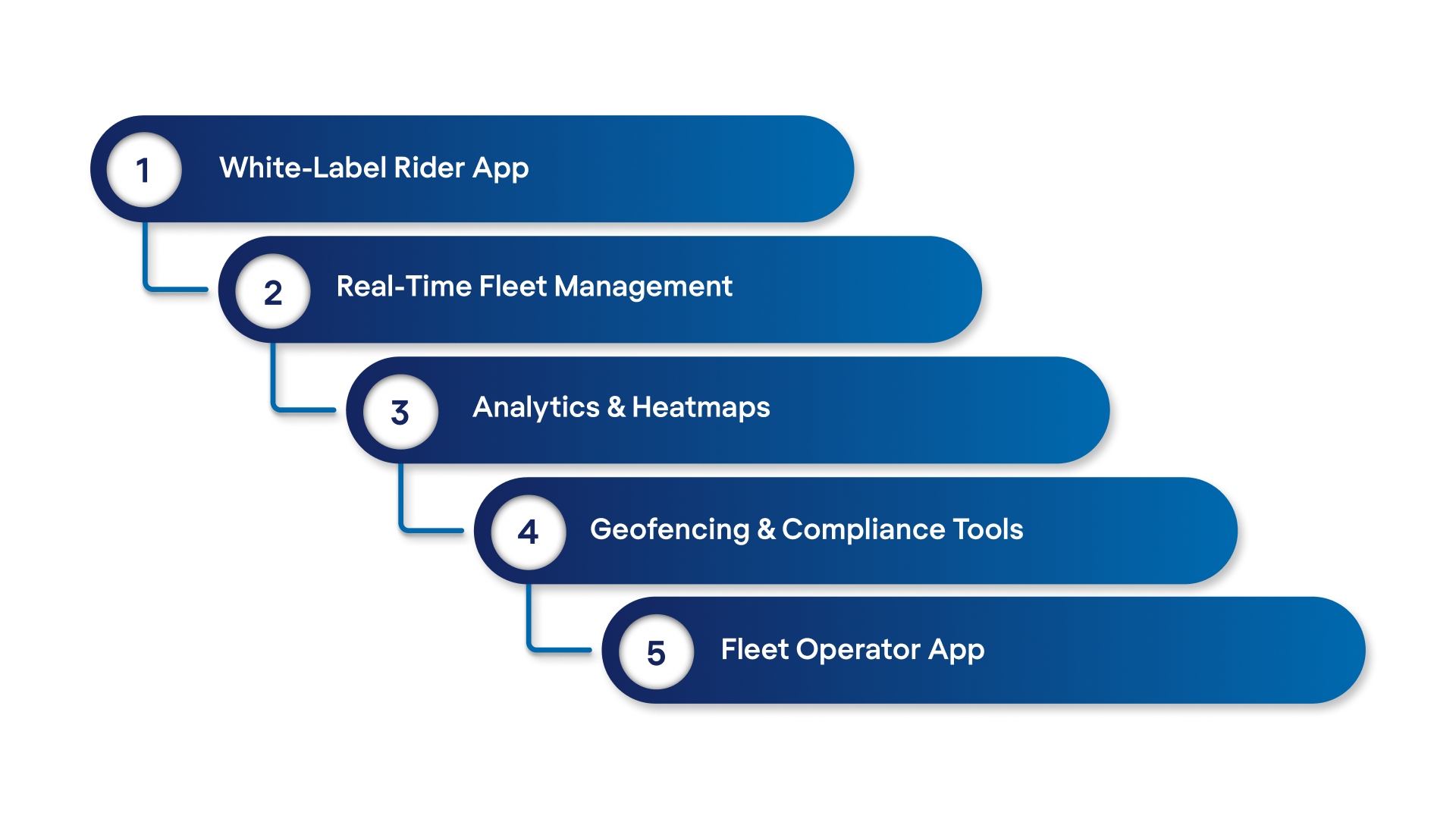
Below are the core capabilities that support smarter routing, optimized deployment, and consistent fleet uptime.
- White-Label Rider App: You can fully customize the app with your own branding, colors, and features. Riders experience a seamless interface to unlock, ride, and pay, but everything reflects your business.
- Real-Time Fleet Management: The admin dashboard displays each vehicle’s live status, including battery level, exact location, recent trips, and usage patterns. This makes routing decisions faster and more data-driven.
- Analytics & Heatmaps: You see precisely when and where rides happen. Hourly, daily, and zone-based insights highlight peak demand periods, underutilized areas, and more.
- Geofencing & Compliance Tools: You can easily set allowed ride zones, no-go areas, slow-speed corridors, and parking zones. You stay compliant with local rules, avoid penalties, and ensure riders remain where they’re supposed to be.
- Fleet Operator App: Your on-ground team gets everything they need in one place, including priority task lists, maintenance workflows, and rebalancing instructions.
In short, EazyRide gives operators the tools to make EV routing predictable, all while lowering operational costs.
Conclusion
Routing isn’t just another technical concept. It’s the difference between a fleet that hits break-even on time and a fleet that struggles with dead batteries, wasted labor, and unpredictable revenue.
Whether you run a city fleet, a campus system, or a resort operation, the principle stays the same: better data leads to better decisions. And when your routing decisions come from real-time battery visibility, demand patterns, and clear task workflows, your fleet becomes easier to manage and more profitable to scale.
If you want to see how operators use EazyRide to plan smarter routes, reduce downtime, and improve daily utilization, the next step is simple. Book a demo with our team and see how EazyRide can simplify your operations.
FAQs
Q1. What exactly does “EV routing” involve for a shared-mobility fleet?
EV routing means planning when and where each electric vehicle should be charged, rebalanced, maintained, or deployed, using live battery and location data, along with usage patterns. It ensures that vehicles are ride-ready when demand peaks and avoids downtime from dead batteries or wasted trips.
Q2. How can EV routing improve fleet profitability and reduce costs?
By maximizing utilization (more rides per vehicle per day), reducing unnecessary labor/travel, preventing mid-ride breakdowns, and optimizing charging cycles, EV routing directly reduces per-ride operating costs and shortens the break-even timeline.
Q3. Do I really need EV routing if I only run a small fleet (e.g., 20–50 vehicles)?
Yes. Even small fleets benefit because routing helps avoid battery-related downtime, ensures efficient use of limited assets, and sets up good operational hygiene that scales well as the fleet grows. It’s easier and cheaper to start organized than to refactor operations later.
Q4. What data does routing software need to work correctly for shared EV fleets?
It needs real-time information on each vehicle’s battery state of charge, current location, trip history (usage patterns), and, optionally, zone constraints or charging-station availability. You can intelligently prioritize charging, rebalancing, and deployment.
Q5. Will EV routing still work if the charging infrastructure is limited, or if I have few chargers per fleet?
Yes, routing becomes even more critical when chargers are scarce. Smart routing helps plan charging schedules, efficiently reuse chargers, and ensure that only vehicles that need charging are sent. This avoids congestion at chargers and increases overall fleet uptime.


