
 AllAnalytics and research

 8 August, 2025
 AI Fleet Management in 2025: Automation, Predictions, and Efficiency Gains
What if your fleet could predict failures before they happen? What if you knew exactly which scooters needed charging, which zones would see demand spikes next hour, and which vehicles were at risk of downtime tomorrow?
For U.S. scooter and e-bike operators, that’s not futuristic – it’s what you need to stay competitive. In 2023 alone, shared-mobility trips in the U.S. topped 133 million, with scooters accounting for roughly half of them.
Yet even as ridership surges, many fleets struggle with inefficiencies. It’s common for operators to lose a significant share of potential rides each month because vehicles are idle, under-charged, or simply misplaced.
That’s where AI changes the game. Instead of reacting to problems, your fleet becomes proactive, predicting demand, forecasting failures, optimizing routes, automating charging, and maintenance scheduling. It makes smarter real-time decisions than any spreadsheet or checklist ever could.
In this guide, you’ll see how AI fleet management can help operators cut costs, improve uptime, reduce labor burden, and scale more profitably. You will understand what actually works now, not just what people hope will work.
Key Takeaways:
- AI cuts major operational leaks by reducing downtime, avoiding unnecessary battery swaps, and improving placement accuracy across scooters and e-bikes.
- Predictive maintenance drives uptime, helping fleets catch failures early and keep more vehicles ride-ready during peak hours.
- AI routing and task automation lower labor costs, making field teams more efficient without adding staff.
- Smarter demand forecasting increases rides per vehicle, helping operators grow revenue without expanding fleet size.
- EazyRide brings these AI capabilities together, giving operators one platform that automates decisions, improves compliance, and scales cleanly.
Let’s start by breaking down the inefficiencies that quietly eat into your revenue.
Inefficiencies That Kill Shared Mobility Profitability
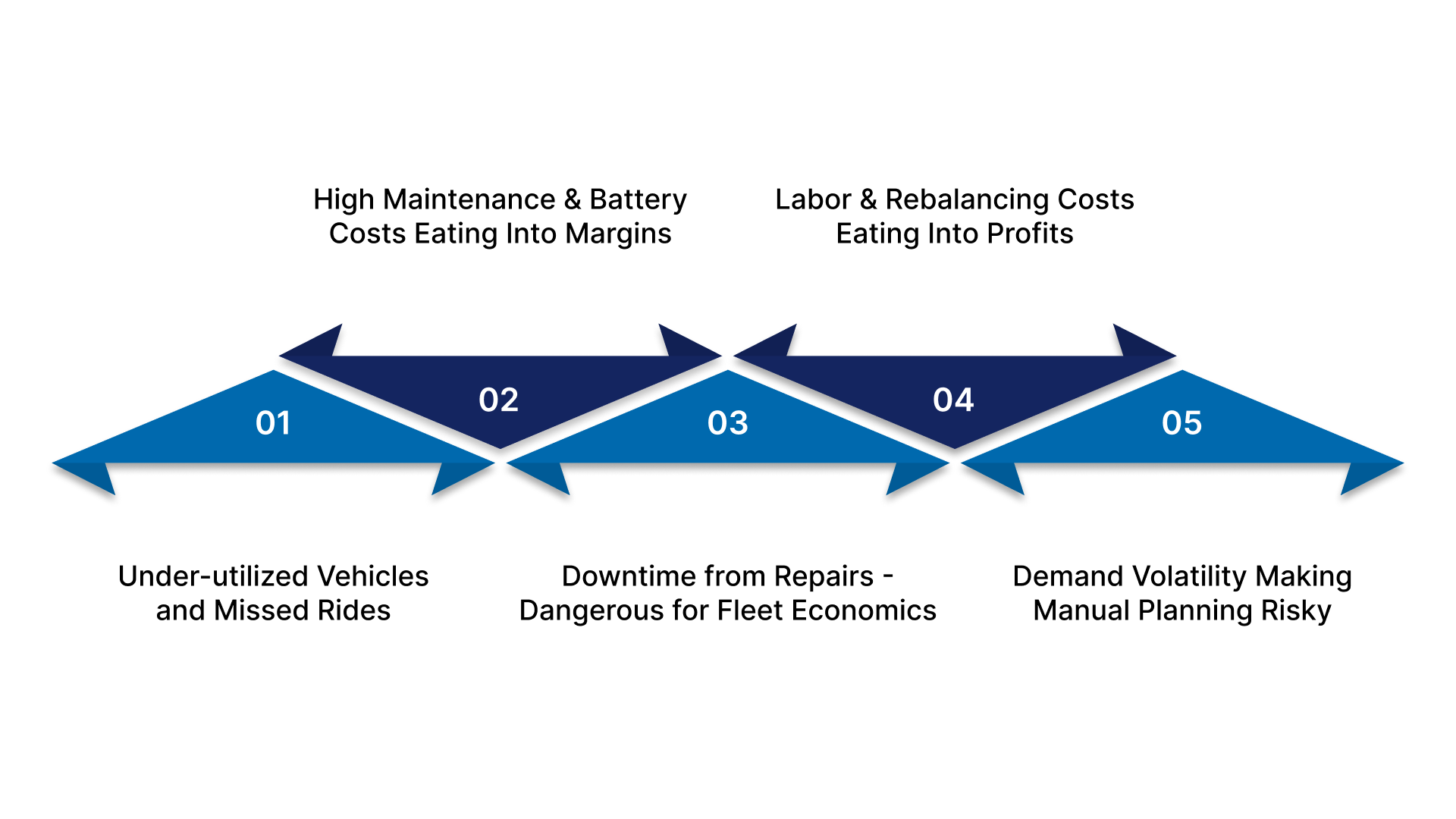
Before AI becomes the obvious answer, you need to understand the real operational leaks that drain money from scooter and e-bike fleets every day. These aren’t theoretical problems. They show up in your utilization numbers, rider complaints, and maintenance logs.
1. Under-utilized Vehicles and Missed Rides
- According to the latest data from NACTO, in many U.S. cities, dockless e-scooters average just 0.6 rides per vehicle per day, and dockless e-bikes around 0.8 r/v/d in low-utilization systems.
- In top-performing markets, usage can spike to 7–8 rides per scooter per day, proving what’s possible with good deployment, demand forecasting, and maintenance.
If your fleet is under-deployed or poorly managed, each idle scooter is a lost revenue slot – often 1–3 rides/day that never happen.
2. High Maintenance & Battery Costs Eating Into Margins
- A recent industry market report estimates that spare parts and maintenance account for 25–30% of the total cost of ownership in shared electric fleets.
- Battery degradation forces replacements for roughly 20% of the fleet annually in some cases, significantly increasing replacement and logistics costs.
Without proactive maintenance scheduling, repair costs and battery swaps quickly spiral out of control, reducing the number of ride-ready vehicles and delaying profitability.
3. Downtime from Repairs – Dangerous for Fleet Economics
- According to a 2025 global fleet-management survey, 24% of all fleets report that “vehicles awaiting repair” is currently the biggest cause of downtime – up from 18% the previous year.
- For a fleet of 100 scooters, that could mean 20–25 vehicles out of service at any given time, dramatically reducing utilization when demand exists.
This means increased downtime → fewer rides → lower utilization → slower break-even.
4. Labor & Rebalancing Costs Eating Into Profits
- Maintenance, charging, rebalancing, and fleet logistics already account for a significant share of operating costs.
- According to shared-fleet cost breakdowns, these post-purchase costs account for 25–30% of ongoing operational costs, before you factor in inefficiencies.
With manual routing and reactive maintenance, labor hours spike. Stealing time, increasing expenses, and limiting the number of scooters each technician can handle.
5. Demand Volatility Making Manual Planning Risky
- Even with overall growth, micromobility demand fluctuates – weather, events, commuting patterns all impact use. In 2023, U.S. shared mobility experienced over 133 million trips, showing demand is high.
- But under-utilization in low-demand zones or times silently drags down per-scooter revenue, making it hard to predict batching, charging, and maintenance in advance.
These inefficiencies don’t just reduce revenue. They create risk.
Suggested Read: 8 Essential Fleet Management Features for Optimal Efficiency
Let’s look at how AI solves for these pains and why 2025 may be the tipping point for AI-powered fleets in the U.S.
Why AI Is Becoming Essential for Fleet Operators in 2025
Shared mobility has reached a point where manual decisions can’t keep pace with daily operations. Fleets are larger. Cities are stricter. Riders expect reliability. And margins shrink fast when your team spends more time reacting than planning.
AI steps in where human effort hits its limit.
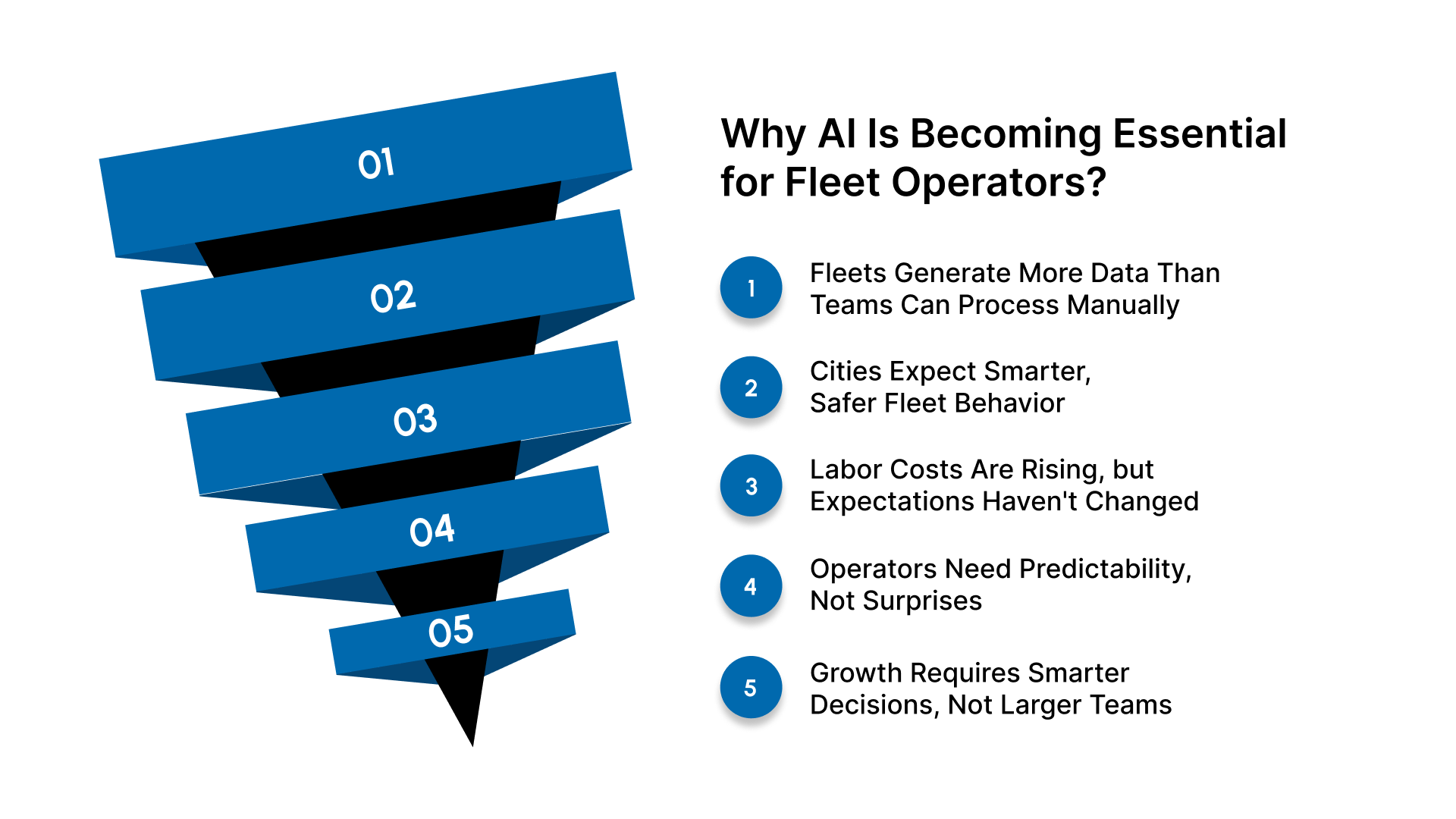
Fleets Generate More Data Than Teams Can Process Manually
Every scooter or e-bike sends a constant stream of location updates, battery levels, error codes, ride behaviors, and parking events. Multiply that across hundreds of vehicles, and no operations manager can interpret all of it in real time.
AI doesn’t just handle the data but turns it into decisions your team can act on immediately.
Better placements. Fewer surprises. Faster turnaround.
Cities Expect Smarter, Safer Fleet Behavior
U.S. cities are past the “pilot” mindset. They want operators who can keep sidewalks clear, manage speed zones, prevent sidewalk riding, and react instantly to misuse. Doing that manually at scale is impossible.
AI helps fleets enforce rules without adding more staff, which is precisely what regulators want to see in 2025.
Labor Costs Are Rising, but Expectations Haven’t Changed
Ground teams remain one of the biggest expenses in shared mobility. Every hour wasted on backtracking routes, unnecessary swaps, or manual inspections chips away at profitability.
AI frees your staff from guesswork by giving them the most efficient route, the exact vehicles that need attention, and the right tasks in the right order.
Operators Need Predictability, Not Surprises
The biggest threats to fleet economics are simple: Unexpected breakdowns. Wrong placements. Missed battery swaps. Riders are opening the app and finding nothing nearby.
AI reduces the uncertainty. It gives operators a fleet that behaves consistently, which means more predictable revenue and fewer fire drills.
Growth Requires Smarter Decisions, Not Larger Teams
Whether you’re adding 50 more scooters, entering a new campus, or expanding into a second city, growth amplifies inefficiencies. Adding more staff or more spreadsheets doesn’t scale.
AI scales cleanly. It maintains high decision quality even as your footprint expands.
Also Read: How AI-Enabled IoT Is Shaping Mobility Operations?
Now let’s simplify things even further. Learn exactly how AI works inside a scooter or e-bike fleet – explained in clear, founder-friendly terms.
How AI Fleet Management Works – With Real Impact
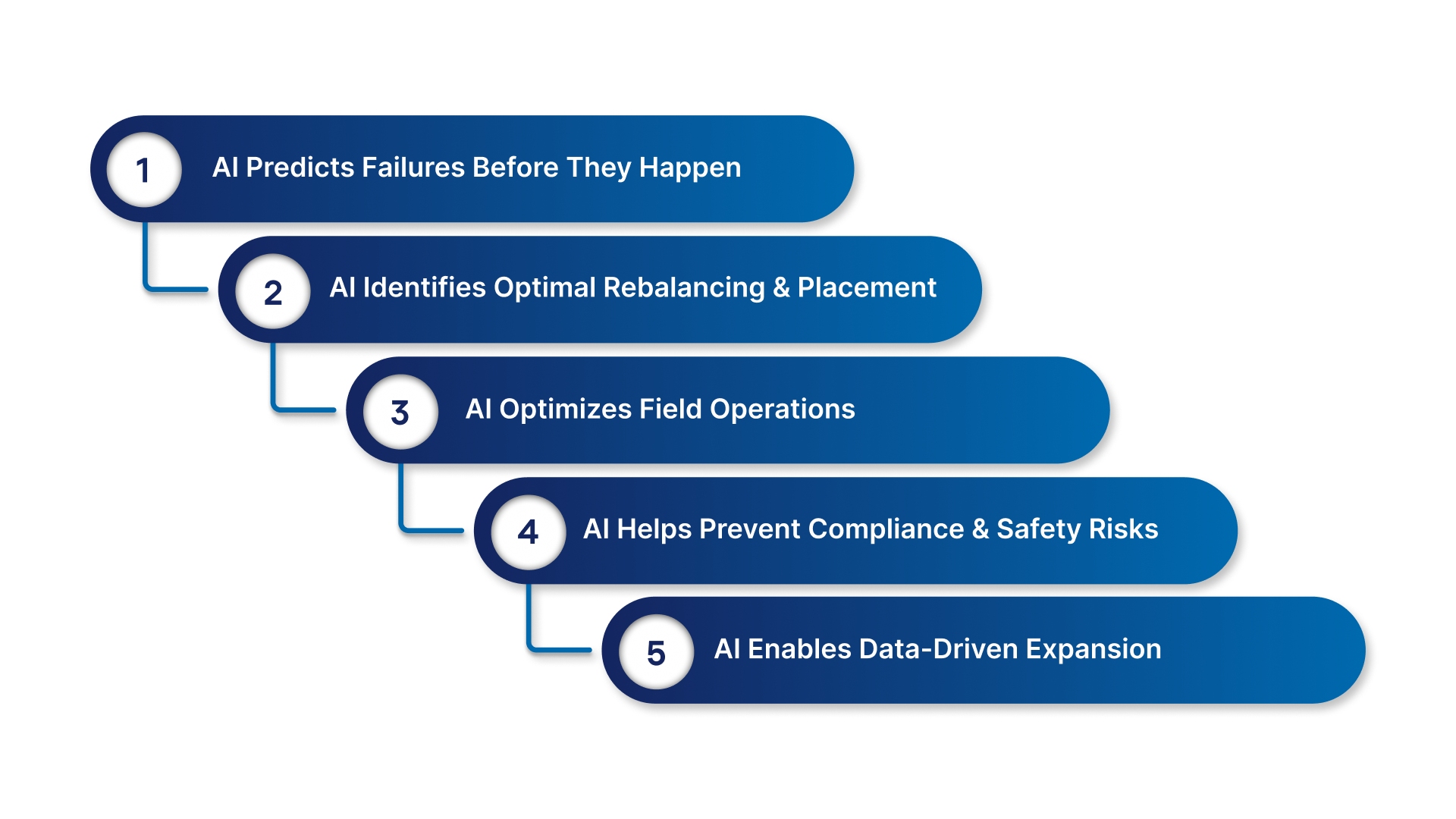
AI may sound lofty, but for a mobility fleet, it breaks down into a few powerful tools that turn messy data into concrete business advantages. Here’s how it works and what you can expect in real-world results.
1. AI Predicts Failures Before They Happen
Connected scooters and e-bikes equipped with sensors (battery, motor, brake, vibration) feed continuous data into an AI engine. The AI spots anomalies such as small battery drops, abnormal vibrations, and repeated error codes that humans easily miss.
Take these real figures as instances:
- Fleets using AI-driven predictive maintenance report up to 40% reduction in downtime compared with reactive maintenance.
- AI maintenance systems also cut repair and upkeep costs by around 25%, while extending scooter lifetime and reliability.
Benefits: More ride-ready vehicles, fewer emergency repairs, and higher uptime, which directly uplifts your revenue potential per scooter.
2. AI Identifies Optimal Rebalancing & Placement
Rather than relying on guesswork, AI analyzes hours of the day, past trip data, user behavior, and even local factors like weather or events. Then it suggests where and when to position scooters or e-bikes to capture the highest demand.
That means you avoid idle vehicles and increase utilization without blindly overspending on hardware.
Benefits: Higher rides per vehicle per day; better return on each unit deployed; more efficient fleet use without unnecessary expansion.
3. AI Optimizes Field Operations
Ground staff no longer stumble through manual checklists. AI assigns tasks, plans efficient routes for charging/repairs/rebalancing, and prioritizes scooters based on predicted needs. This cuts unnecessary travel, reduces labor load, and ensures staff time is spent where it matters most.
Benefit: Lower labor and fuel cost per scooter; a big lever for profitability, especially in sprawling U.S. cities.
4. AI Helps Prevent Compliance & Safety Risks
Sensors + analytics can detect problems like faulty brakes, electrical issues, or patterns of reckless riding (e.g., repeated hard braking or erratic GPS trails). You catch issues early, often before they hit public safety or regulatory thresholds.
AI-enabled maintenance and monitoring systems are increasingly standard in modern fleet operations.
Benefit: Safer rides, fewer fines, lower liability risk, and stronger credibility with city regulators, which is essential for long-term operation in U.S. municipalities.
4. AI Enables Data-Driven Expansion
Because AI tracks every vehicle, every ride, and every failure, over time, you build a dataset that shows exactly when and where you need more units. Want to expand to a new district or add e-bikes? You can simulate demand and maintenance load before you buy a single scooter.
Benefit: Smarter growth, less capital wasted, and a scalable fleet strategy – all backed by real data, not hunches.
With these practical, proven benefits in hand, it becomes clear why AI is quickly shifting from “nice-to-have” to “must-have” in shared mobility.
Next, let’s look at the specific AI tools operators should prioritize when choosing a platform.
AI Fleet Tools That Matter Most (What Operators Should Look For)
Not all “AI solutions” are equal. Some platforms add AI as a buzzword. Others bake it into the core of fleet operations. If you’re choosing a system for scooters or e-bikes, these are the tools that actually move the needle.
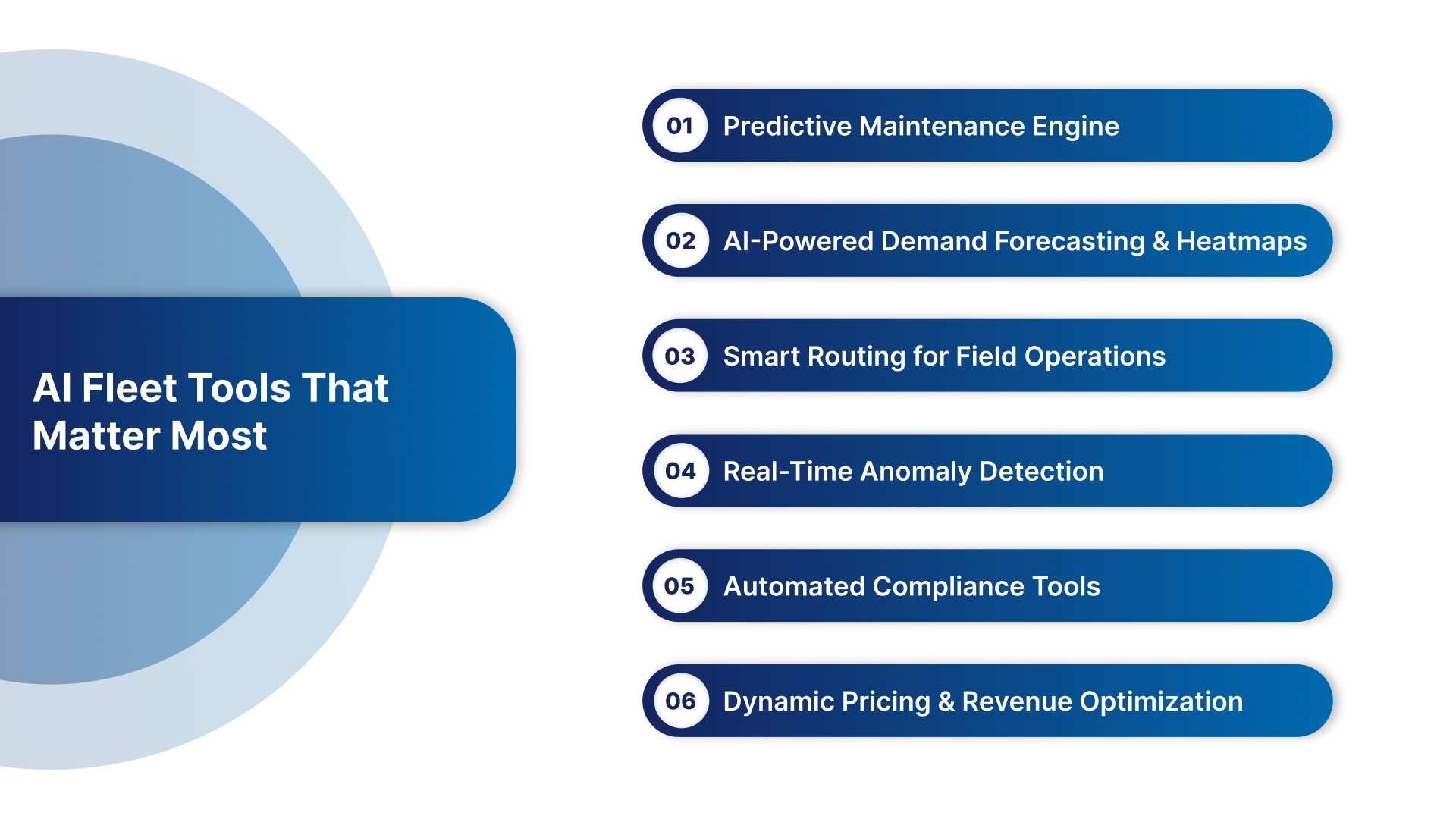
1. Predictive Maintenance Engine
This is the heart of AI fleet management. A proper predictive engine should analyze:
- Battery cycles and degradation
- Repeated error codes
- Vibration/tilt anomalies
- Motor temperature patterns
- Voltage irregularities
Early detection = fewer breakdowns, fewer rider complaints, higher daily utilization.
2. AI-Powered Demand Forecasting & Heatmaps
You don’t just want “where riders were last week.” You want to know where they will be tomorrow morning or in the next two hours. A strong AI model combines:
- Historical trips
- Weather data
- Local events
- Commuting patterns
- Day-part behavior
Correct placements mean more rides per vehicle without increasing fleet size.
3. Smart Routing for Field Operations
This is where AI directly cuts labor costs. Smart routing should:
- Cluster tasks automatically
- Calculate the fastest paths
- Prioritize high-impact scooters
- Assign jobs to the right technician
Ground teams spend less time driving and more time on high-value tasks.
4. Real-Time Anomaly Detection
AI should monitor for unusual patterns such as:
- Sidewalk riding
- Harsh braking
- Sudden GPS drift
- Abnormal movement
- Electrical inconsistencies
Improves safety, reduces fines, supports city reporting, and protects your operating permit.
5. Automated Compliance Tools (Critical for U.S. Cities)
A solid AI platform will help you manage:
- No-ride zones
- Slow zones
- Parking rules
- Eestricted neighborhoods
- Trip-end validation
Avoids fines, city warnings, and disrupted service zones, especially in regulated markets like Chicago, Austin, and San Diego.
6. Dynamic Pricing & Revenue Optimization
AI should adjust pricing based on demand, weather, supply levels, and local spikes. It will increase revenue per scooter without painful price hikes for riders.
Must Read: Smart Fleet On-Board Devices Market Size and Trends Analysis (2025–2026)
Now that we’ve covered the devices and tools that matter, let’s show how EazyRide builds these capabilities into a single operational platform.
How EazyRide Uses AI to Power Smarter Fleet Management?
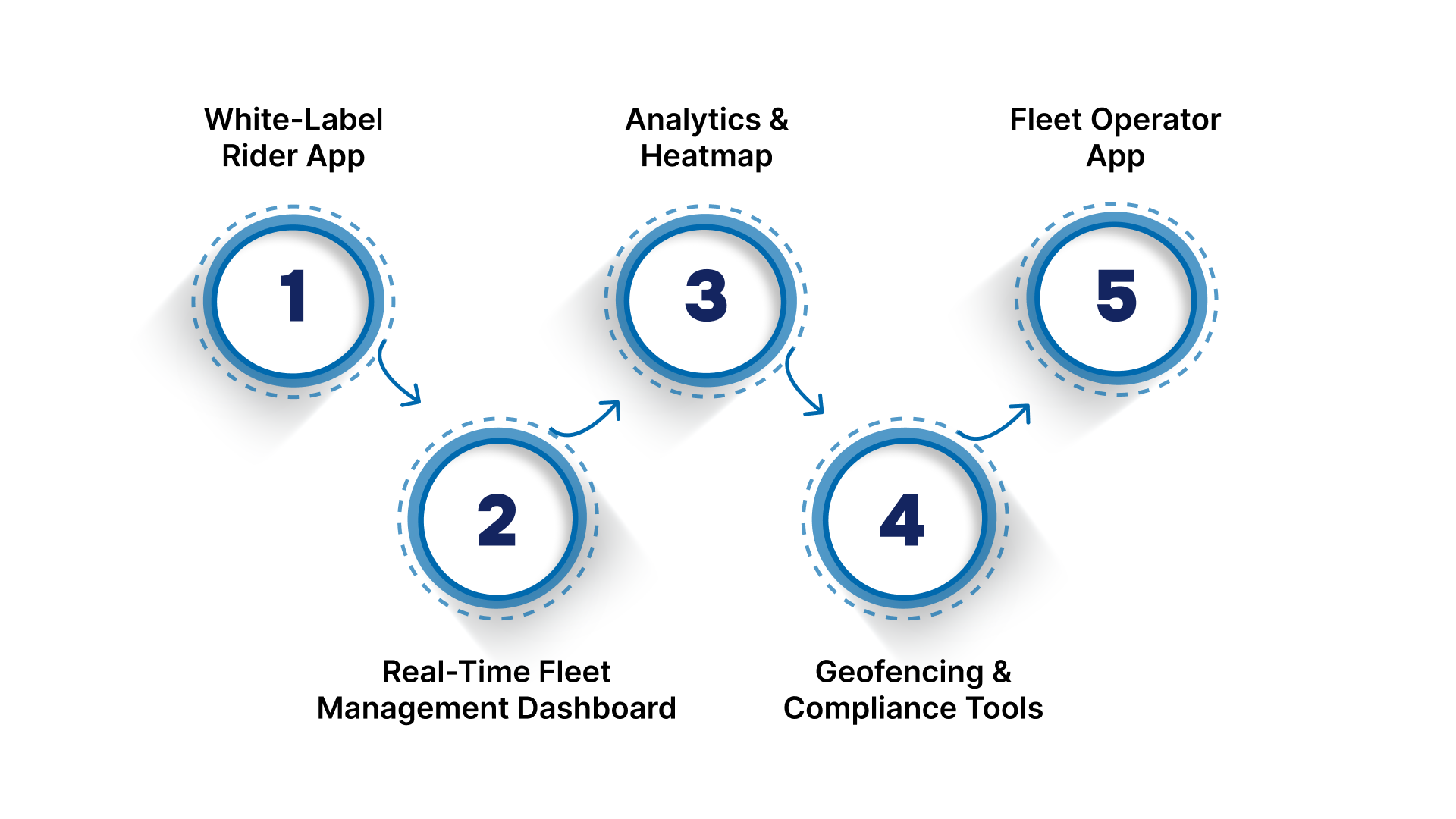
EazyRide is built to help operators run fleets that are predictable, efficient, and scalable without adding more staff or more manual work. The platform combines AI with real-time data to automate the parts of your business that usually drain time and money.
Here’s how EazyRide supports your operations end to end.
- White-Label Rider App: Fully customized to your brand, intelligently suggests nearby vehicles based on demand patterns and even guides riders to preferred parking spots.
- Real-Time Fleet Management Dashboard: Highlights at-risk vehicles, recommends deployments, forecasts demand, and surfaces insights your team would never catch manually.
- Analytics & Heatmap: Uses past trips, time-of-day patterns, weather shifts, and local activity to predict where vehicles should be placed – hour by hour.
- Geofencing & Compliance Tools: Detect violations early, like sidewalk riding, improper parking, no-ride zone entries, and can trigger rider warnings or operator tasks automatically.
- Fleet Operator App: Automatic task assignments powered by AI, repairs, battery swaps, relocations, recoveries, and optimized routes that cut down travel time.
From AI deployment suggestions to predictive maintenance and automated compliance, EazyRide centralizes workflows that usually require multiple systems or constant micromanagement.
Conclusion
AI has become the difference between operators who run predictable, profitable systems and operators who struggle with downtime, rising labor costs, and inconsistent utilization.
When scooters or e-bikes miss just a few rides per day, the losses add up quickly. When ground teams waste time on backtracking, unnecessary swaps, or reactive maintenance, margins tighten even further. But AI fleets avoid these traps. They anticipate demand, prevent breakdowns, and move faster with fewer resources.
That’s where EazyRide stands out. Instead of stitching together multiple tools, you get one platform that guides deployments, automates maintenance decisions, optimizes field routes, and keeps you compliant in U.S. cities.
You spend less time figuring out what’s wrong with your fleet and more time growing it. So, reach out to us today and let’s explore your goals and build a smarter fleet together!
FAQs
1. How does AI actually help a small scooter or e-bike fleet?
AI helps small fleets by reducing manual work. It predicts which vehicles need charging, where demand will appear, and which units are likely to fail soon. This means better uptime and fewer hours spent on rebalancing or repairs, even with a small team.
2. Is AI fleet management expensive to implement?
Not necessarily. Many AI-powered platforms (including EazyRide) include AI features built into the monthly fee. This avoids the high cost of custom development while still giving operators predictive maintenance, smart routing, and AI forecasting.
3. Can AI improve compliance with U.S. city regulations?
Yes. AI can detect misparking, sidewalk riding, slow-zone violations, or abnormal trip patterns in real time. This reduces fines, improves rider safety, and helps operators meet requirements that U.S. cities increasingly enforce.
4. Do I need a large fleet for AI to make a difference?
No. AI has a strong impact even at 50–100 vehicles, as labor, downtime, and misplacement issues are amplified at smaller scales. Better routing and predictive maintenance deliver immediate savings regardless of fleet size.
5. Can AI help me decide where to expand or add more vehicles?
Yes. AI analyzes ride density, peak times, trip patterns, and unmet demand to show whether adding more scooters or entering a new area is financially justified. This helps operators avoid overbuying hardware or expanding blindly.


