
 AllSharing business

 21 January, 2026
 How to Build a Scooter Sharing App Backend: A Technical Blueprint for 2026?
Most founders underestimate what it takes to build a scooter-sharing backend until they’re six months into development with nothing deployed.
You’ve mapped out the rider experience: scan QR code, unlock scooter, ride, park. Simple enough. But behind that 30-second interaction sits a backend that simultaneously manages real-time IoT communication with hundreds of vehicles, processes geospatial data every few seconds, coordinates payment authorizations, enforces geofenced zones, and generates task queues for your operations team.
The gap between “we need an app that unlocks scooters” and “we have production-ready infrastructure” is where most custom builds stall. The challenge isn’t writing code, it’s architecting systems that handle unpredictable real-world conditions at scale without breaking your budget or timeline.
If you’re evaluating scooter-sharing backend source code options or planning custom development, this guide breaks down what you’re actually building, the technical decisions that impact your business model, and when buying infrastructure makes more sense than building it yourself.
Key Insights
- Building a scooter sharing backend from scratch requires 6–12 months of focused engineering, significant capital investment, and ongoing maintenance costs that most operators underestimate.
- You need vehicle management, real-time tracking, payment processing, geofencing, analytics, and fleet operations, each with distinct technical complexity.
- Monolithic backends are faster to build but harder to scale; microservices offer flexibility but require DevOps expertise.
- White-label platforms like EazyRide provide production-ready backends that can be deployed in weeks, eliminating much of the custom development.
- Build custom only if you have unique business logic that existing platforms can’t support; use white-label for faster market entry and proven reliability.
The Real Cost of Building Scooter Sharing Backend Infrastructure
You’re staring at a market opportunity: your city has approved e-scooter permits, your campus wants a sustainable mobility solution, or you’re expanding from bike-sharing into multi-vehicle operations.
The question isn’t whether to build software, it’s whether building from scratch is the right use of your capital.
Most operators underestimate backend complexity. You’re not just building an app that unlocks scooters. You’re building:
- A real-time IoT platform managing hundreds of vehicles simultaneously
- A payment system handling transactions, refunds, disputes, and compliance
- A geospatial engine processing location data continuously
- A fleet operations system coordinating charging, maintenance, and rebalancing
- An analytics infrastructure measuring utilization, revenue, and operational efficiency
When a founder tells us they’re “90% done” with their custom backend, they usually mean they’ve built vehicle unlocking. The operational infrastructure is still ahead.
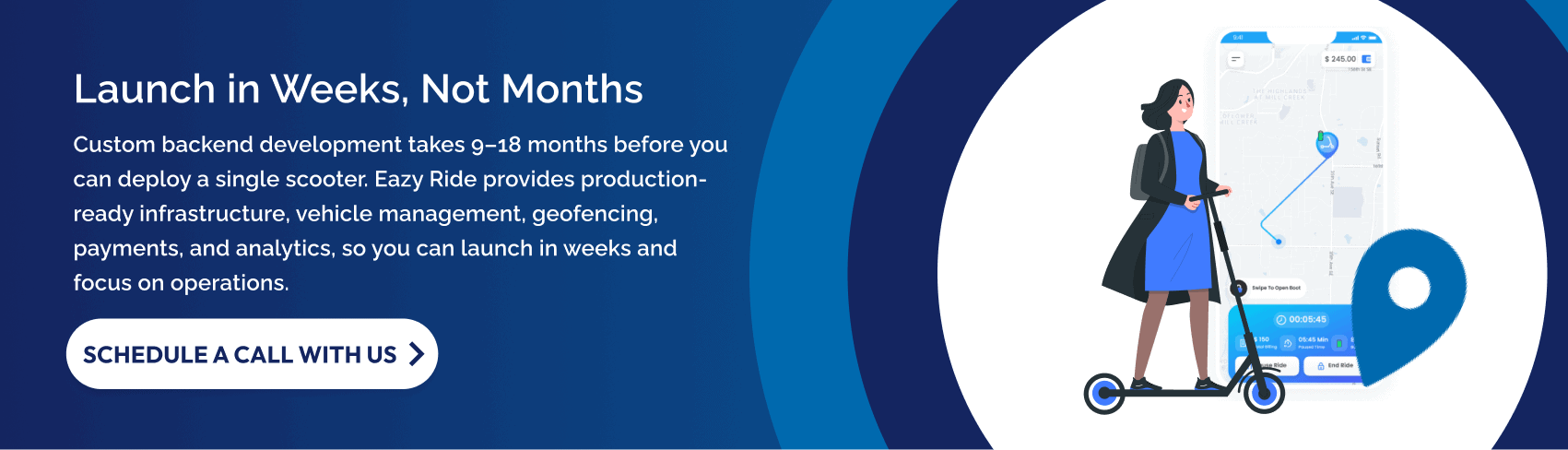
See how operators manage real-time fleet operations without building from scratch, explore EazyRide’s complete vehicle management system and IoT integration capabilities.
Also read: Top ScootAPI Alternative Apps for US Micromobility Operators 2026
Why Scooter Sharing Backends Are More Complex Than They Look?
The technical challenges in micromobility backends aren’t obvious until you’re deep into implementation. What looks simple in a product spec becomes complex when real-world conditions hit your system.
Real-Time Communication at Scale
When a rider scans a QR code, your backend has seconds to authenticate the user, verify vehicle availability, process payment authorization, send an unlock command to the scooter’s IoT controller, and confirm the lock release. Any delay, and your rider opens a competitor’s app.
This requires WebSocket connections, message queuing systems, and sub-second database queries across geographically distributed servers.
Location Data Volume
Every scooter in your fleet continuously transmits GPS coordinates. Your backend must ingest, validate, store, and query this data to support live maps, geofencing enforcement, and trip tracking, without degrading performance as your fleet grows.
Payment Processing Complexity
You’re not just collecting payment per ride. You’re managing:
- Pre-authorization holds to prevent fraud
- Dynamic pricing based on time, distance, or demand
- Promo codes and subscription billing
- Refunds for GPS errors or mechanical failures
- PCI compliance for stored payment methods
- Multi-currency support if you scale geographically
Payment processors like Stripe handle transactions, but you still build the pricing logic, billing cycles, and dispute workflows.
Geofencing That Actually Works
Drawing parking zones on a map is straightforward. Enforcing them when GPS accuracy varies by 10–50 feet, depending on building density, is not.
Your backend must handle:
- Polygon-based zone definitions with varying rules (no-ride zones, slow zones, parking-only areas)
- Real-time fence violations with rider notifications
- Grace periods for GPS drift
- Operator overrides for maintenance access
Also read: How to Build an App Like Uber: A Step-by-Step Guide
Core Components of a Scooter Sharing Backend Architecture
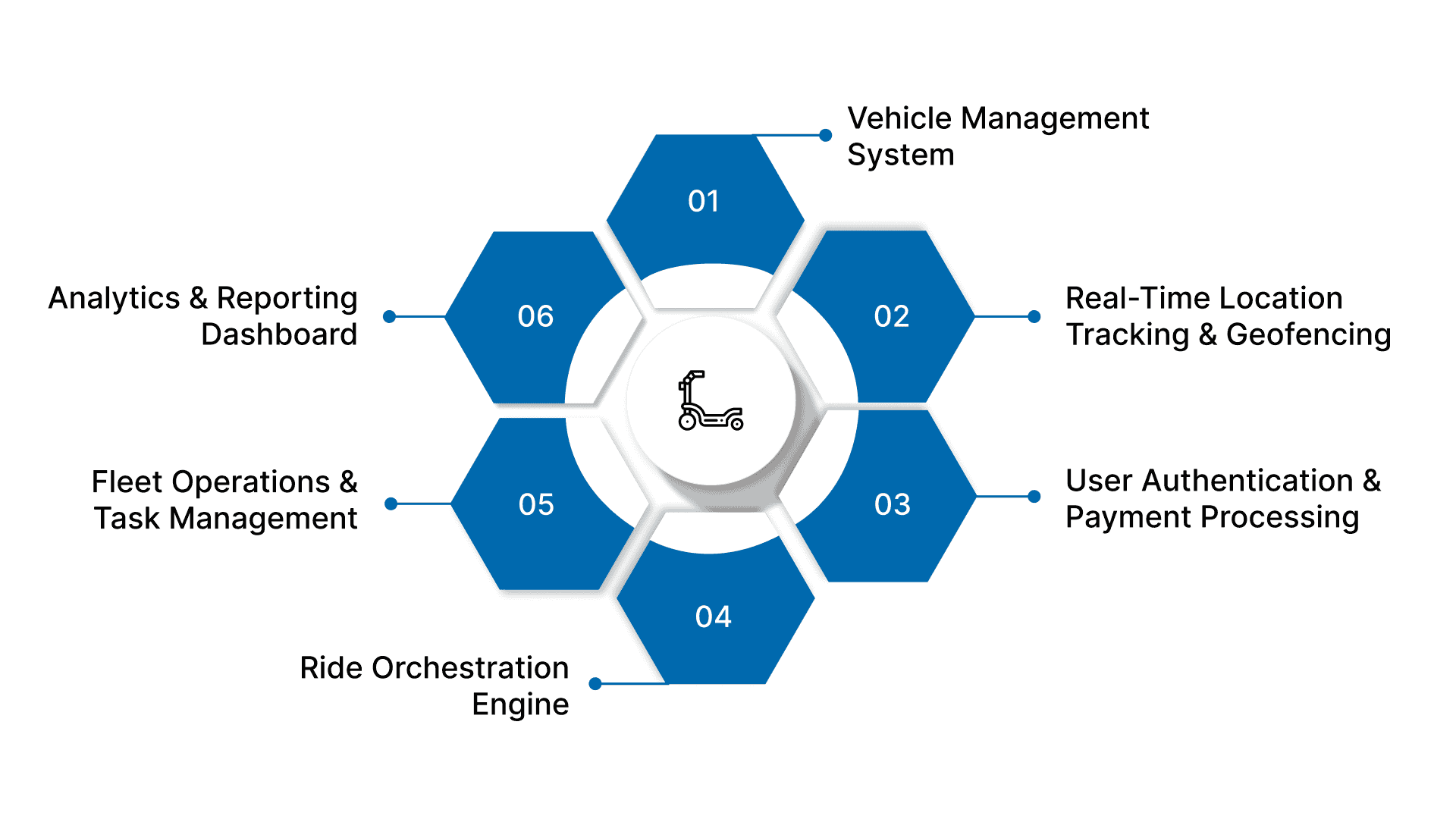
If you’re evaluating scooter sharing backend source code or planning custom development, here’s what you’re actually building:
1. Vehicle Management System
What It Does:
Tracks every scooter’s status (available, in-use, charging, maintenance), battery level, location, lock state, and service history.
Technical Requirements:
- Database schema supporting hundreds or thousands of vehicles with fast query times
- State machine logic for ride lifecycle
- IoT integration via MQTT or HTTP webhooks
- Firmware version tracking for remote updates
Build Complexity: Medium to High
Database design and state management logic alone take significant development time.
2. Real-Time Location Tracking & Geofencing
What It Does:
Ingests GPS data, renders live vehicle maps, enforces geofenced zones, and logs trip routes.
Technical Requirements:
- Geospatial database (PostGIS, MongoDB with geospatial indexes)
- Map rendering API integration (Mapbox, Google Maps)
- Polygon-based zone definitions with rule engines
- Location history storage for compliance
Build Complexity: High
Geofencing accuracy is a major source of rider complaints. GPS drift, tunnels, and tall buildings create edge cases you’ll debug for months.
3. User Authentication & Payment Processing
What It Does:
Handles rider registration, login, payment methods, ride billing, and subscription management.
Technical Requirements:
- OAuth 2.0 or JWT-based authentication
- Integration with Stripe, Braintree, or PayPal
- PCI DSS compliance for stored payment data
- Tax calculation for multi-jurisdiction operations
- Automated retry logic for failed charges
Build Complexity: Medium
Authentication is straightforward. Billing logic for subscriptions, promos, and refunds takes substantial development time.
4. Ride Orchestration Engine
What It Does:
Coordinates the entire ride flow: QR scan → vehicle unlock → ride tracking → trip end → payment capture.
Technical Requirements:
- Asynchronous job processing (Redis, Celery)
- Retry mechanisms for IoT command failures
- Ride state persistence across server restarts
- Idempotency to prevent double-charges
Build Complexity: High
This is your backend’s mission-critical component. Bugs here mean lost revenue or frustrated riders.
5. Fleet Operations & Task Management
What It Does:
Generates charging and maintenance tasks, assigns them to operators, optimizes rebalancing routes, and tracks task completion.
Technical Requirements:
- Task queue with priority levels
- Route optimization algorithms
- Operator mobile app integration
- Predictive maintenance based on usage patterns
Build Complexity: Very High
Route optimization alone is a significant engineering challenge.
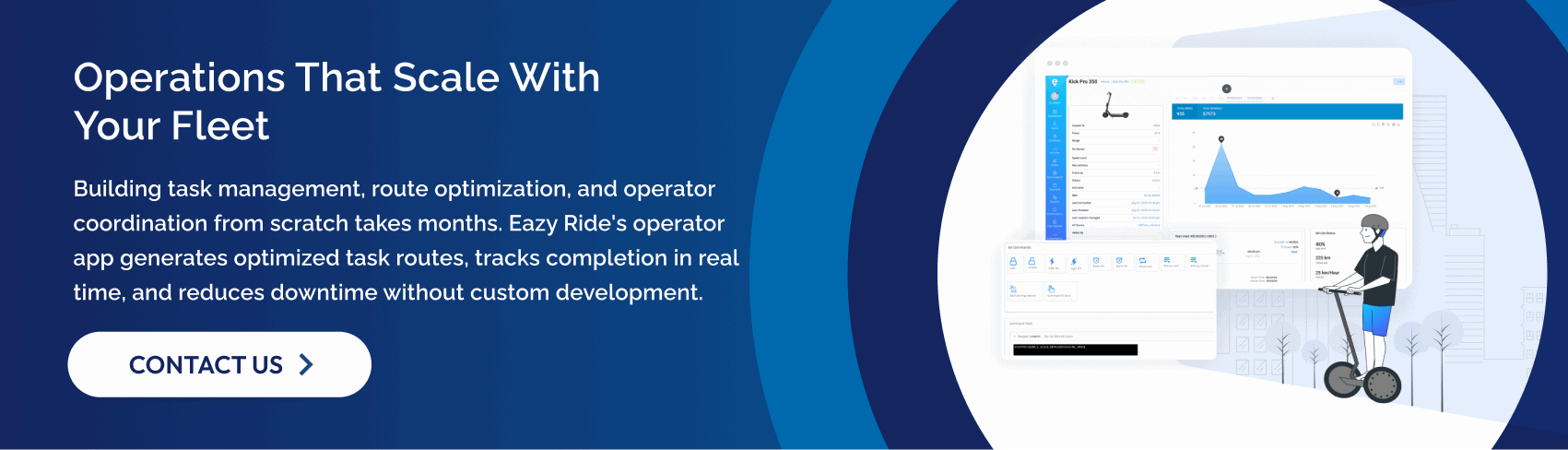
See how the operator app automates fleet coordination with smart task routing, real-time completion tracking, and predictive maintenance alerts with EazyRide.
6. Analytics & Reporting Dashboard
What It Does:
Displays KPIs, revenue trends, utilization heatmaps, rider behavior, and operational metrics.
Technical Requirements:
- Data warehouse or OLAP database
- ETL pipelines for aggregating ride, payment, and location data
- Visualization library (D3.js, Chart.js, or BI tool integration)
- Role-based access for different user types
Build Complexity: Medium
Basic dashboards require substantial development. Advanced analytics add months to the timeline.
Also read: How to Start an Electric Scooter Business in 2026
Technology Stack Decisions That Impact Your Business
Your technology choices have direct business implications, development speed, operational costs, scaling limitations, and hiring requirements, all of which flow from your stack decisions.
Backend Framework Choice
Node.js (Express, NestJS)
- Best for real-time features (WebSockets)
- Large developer talent pool
- Less performant for CPU-intensive tasks
- Use case: Fast prototyping, real-time tracking
Python (Django, FastAPI)
- Excellent for data processing and analytics
- Rich geospatial libraries (Shapely, GeoPandas)
- lower for high-concurrency WebSocket connections
- Use case: Analytics-heavy platforms, route optimization
Go or Rust
- Superior performance and concurrency
- Lower server costs at scale
- Smaller developer ecosystem
- Use case: High-volume fleets
Database Architecture
- PostgreSQL + PostGIS: Industry standard for geospatial operations. Handles millions of location records with proper indexing.
- MongoDB: Good for flexible schemas and rapid iteration, but geospatial queries are less mature than PostGIS.
- Redis: Essential for caching vehicle states, session management, and real-time features.
- Recommended Stack: PostgreSQL (primary) + Redis (cache) + S3 (trip logs, images)
Monolithic vs. Microservices
Monolithic Backend
- All functionality in one codebase.
- Faster initial development
- Simpler deployment
- Harder to scale specific components
- Riskier deployments (one bug breaks everything)
Microservices
- Separate services for vehicles, payments, rides, and analytics.
- Independent scaling
- Fault isolation
- Requires Docker/Kubernetes expertise
- Network latency between services
Recommendation: Start with a monolithic approach for smaller fleets. Plan microservices migration as you scale.
Step-by-Step Framework: Building vs. Buying
The build-versus-buy decision comes down to your competitive advantage, engineering capacity, and time constraints. Here’s how to evaluate your situation.
When to Build a Custom Backend
Build from scratch if you have:
- Unique Business Logic: You’re doing something truly novel that existing platforms can’t support (e.g., autonomous vehicle dispatch, blockchain-based systems, peer-to-peer sharing models)
- Large Engineering Team: At least 3–5 backend engineers committed long-term
- High Capital Reserves: Budget for significant development investment plus ongoing maintenance
- Time Flexibility: You can wait 9–18 months before launch
When to Use a White-Label Platform
Use existing infrastructure if you:
- Need Fast Market Entry: Permits are time-limited, or competitors are moving in.
- Lack of In-House DevOps: You don’t have engineers experienced in real-time IoT systems.
- Want to Focus on Operations: Your competitive advantage is fleet management, not software architecture.
- Plan to Scale Geographically: Proven backends handle multi-city compliance.
Book a demo to evaluate the deployment timeline and see how quickly you can launch your fleet with EazyRide’s white-label platform.
How EazyRide Eliminates Backend Development?
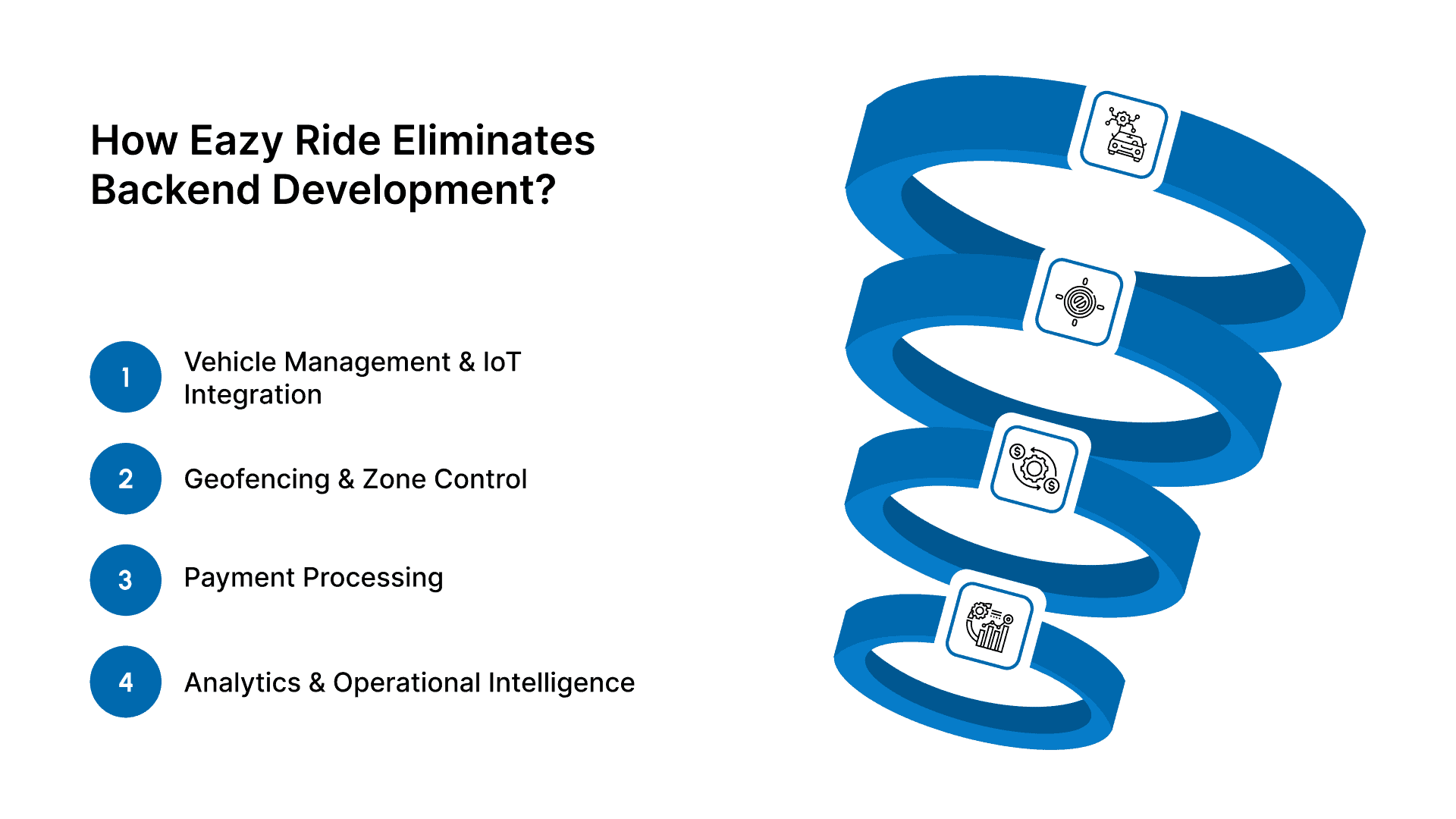
Understanding backend complexity is valuable whether you build or buy. Here’s how EazyRide addresses core technical challenges without custom development.
Vehicle Management & IoT Integration
Our backend handles vehicle lifecycle management out of the box. When battery levels drop below the threshold, the system automatically flags vehicles for charging and removes them from rider-facing maps. Operators see tasks in their app with optimized collection routes.
You configure rules in the admin dashboard instead of writing state logic or IoT integration code.
Geofencing & Zone Control
Our geofencing engine uses polygon-based zones with configurable tolerance buffers. You draw zones on a map interface, and we handle geometry calculations, real-time enforcement, and edge cases like GPS drift.
Payment Processing
Our payment module integrates with Stripe and supports:
- Time-based and distance-based pricing
- Subscription plans (daily, weekly, monthly)
- Promotional campaigns with usage limits
- Automated refund workflows
Operators configure pricing rules through the dashboard. The backend handles transaction logic, tax calculations, and PCI compliance.
Analytics & Operational Intelligence
Our analytics dashboard provides:
- Ride density heatmaps showing demand patterns
- Utilization graphs by time period
- Revenue breakdowns by vehicle, zone, and timeframe
- Predictive alerts for maintenance
No custom BI tool integration required. No ETL pipelines to build.
Explore EazyRide’s analytics dashboard, real-time reporting tools, and operational intelligence features that give you complete visibility into fleet performance.
Conclusion
Building a scooter-sharing backend from scratch is a substantial engineering commitment that diverts resources from what truly differentiates your business: fleet operations, local partnerships, and rider experience.
The technical complexity is real; real-time IoT coordination, geospatial processing, payment compliance, and operational intelligence aren’t solved quickly. Most operators who start custom development either launch significantly late or ship with critical functionality gaps.
White-label platforms like EazyRide exist because this problem has been solved. The backend architecture has been proven in live markets. You don’t need to reinvent geofencing, payment flows, or fleet management; you need to launch quickly and iterate based on real rider behavior.
If your advantage lies in operational excellence, local market knowledge, or innovative business models, allocate your capital there. Let your backend be infrastructure, not a development project.
Schedule a demo to review backend capabilities, explore API documentation, and evaluate how EazyRide fits your technical requirements.
Frequently Asked Questions
1. Can I integrate my own IoT hardware with EazyRide’s backend?
Yes. EazyRide supports any IoT controller that communicates via MQTT or HTTP webhooks. We provide API documentation for custom hardware integrations, and most setups can be configured in a few weeks.
2. How does EazyRide handle data privacy and compliance?
All user data is encrypted at rest and in transit. We provide configurable data retention policies and automated compliance exports. For U.S. operators, we meet CCPA requirements and can segment data by state-specific regulations.
3. What’s the cost difference between building custom vs. using EazyRide?
Custom backend development typically requires substantial investment over 12–18 months, plus ongoing maintenance costs. EazyRide’s white-label platform operates on a per-vehicle SaaS model with no upfront development costs, significantly reducing the total cost of ownership.
4. Can I migrate from a custom backend to EazyRide later?
Yes, but it’s easier before you accumulate significant historical data. We’ve migrated operators with established fleets. The process involves data export, schema mapping, and API cutover, typically taking a few weeks for a complete transition.
5. Does EazyRide support station-based operations or only dockless operations?
Both. You can configure station-based models (users must return to designated docks), dockless (free-floating with geofenced parking), or hybrid models (incentivised docking with overflow zones).


