

 26 December, 2025
 How to Start An Electric Scooter Business in 2026
In 2023 alone, riders in the US took about 65 million shared e-scooter trips, almost on par with shared bike trips. At the same time, the US electric scooter market itself is on track to more than double from roughly $1.2 billion in 2022 to about $2.7 billion by 2030
Those numbers look great on a pitch deck. They also hide the fear you probably feel right now. You do not want to burn $100,000 testing the wrong city, picking the wrong fleet size, or waiting on a custom app that never quite works. You know riders expect a smooth app, GPS, payments, and safe zones from day one, but you do not have a full tech team on standby.
This guide is written for you if you are that first-time founder eyeing 2026 as your launch year. You want a clear path to a city-approved, profitable electric scooter business that runs on solid numbers, realistic costs, and ready software instead of guesswork.
In the next sections, we will walk through how to choose the right market, model your unit economics, handle permits and risk, and plug into technology that helps you go live in weeks, not years.
Quick Glance
- Electric Scooter demand is real and rising: Success in 2026 depends on disciplined planning. Pick the right niche, define your riders, and choose a supportive US city.
- Launch smart, not big: Most winning operators start with 30–50 scooters, validate demand, track rides per scooter per day, and scale only when unit economics prove sustainable.
- Compliance is non-negotiable: expect permits, parking rules, geofencing requirements, curfews, data reporting, and proof you can operate responsibly and safely.
- Your tech stack decides profitability: Reliable rider apps, GPS, payments, analytics, battery tracking, and operator tools are essential to reduce downtime and keep fleets profitable.
- EazyRide helps founders launch in weeks, providing white-label rider apps, admin dashboards, operator tools, geofencing, analytics, and multi-city scalability, so you focus on running the business, not building software.
Understand the Electric Scooter Business Opportunity in the US
Electric scooters have moved from being a novelty to a serious urban mobility business in the US. Shared micromobility reached real scale recently, with North America recording 157+ million shared bike and scooter trips in 2023, including about 69 million e-scooter rides, showing consistent, repeat demand from commuters, students, and tourists.
This growth signals opportunity, but today’s electric scooter business is no longer a simple “buy scooters and deploy” model. Cities now expect compliance, data reporting, safe riding zones, and responsible fleet management. Operators who succeed in 2026 are the ones combining the right market, strong operations, and reliable software.
Before you price a single ride, you need a clear view of where demand and money actually sit in 2026.
Where the Electric Scooter Business Is Growing Fastest in 2026
On the demand side, the story is simple. People are riding more.
Dockless e-scooter trips alone rose to about 69 million in 2023, up 15% from 2022, as systems rebounded after earlier pullbacks.
On the supply side, serious operators are leaning into that growth. The global e-scooter sharing market will reach about $16.1 billion by 2029, growing around 15–16% per year. In parallel, the US electric scooter market across private and shared use is expected to approach $2.7 billion by 2030, with about 10% annual growth.
Behind those numbers are very specific use cases you can build around:
- Short first-mile and last-mile hops to and from transit.
- Tourist sightseeing loops in compact downtowns and waterfronts.
- Campus trips between dorms, lecture halls, and parking lots.
If you understand which of these use cases matches your city, you stop thinking in “units sold” and start thinking in repeat trips per scooter per day.
How City Rules Are Shaping the Business Model
US cities are no longer treating scooters as an experiment. They treat them as part of the street system, with all the rules that imply.
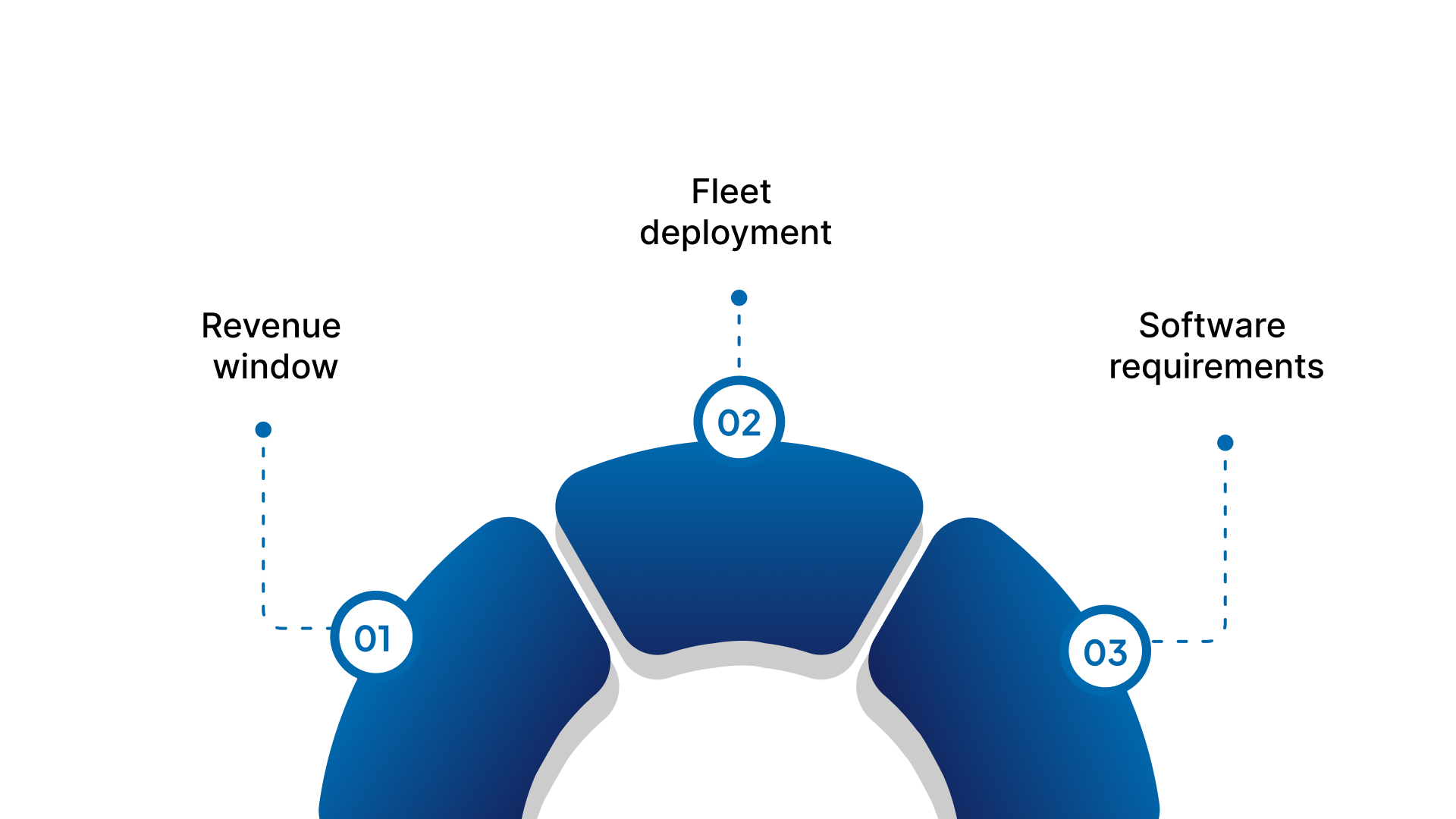
Houston is the clearest example right now. In November 2025, the city approved a nighttime curfew on e-scooters and other micromobility devices from 8 p.m. to 4 a.m. citywide, after more than 500 crash incidents, 78% at night, since 2021. The ordinance bans rentals and use during those hours, with fines up to $500 and the option to impound devices.
For an operator, that decision hits three places at once:
- Revenue window: Late-night “bar close” trips vanish overnight, so your pricing and demand model must adjust.
- Fleet deployment: You may need to pull scooters off the street before 8 p.m., then roll them back out at dawn.
- Software requirements: You now need geofencing, time-based rules, and automated shut-offs that match the ordinance, not just manual habits.
Other cities may not copy Houston exactly, but the trend is clear. If your business depends on shared streets, your model must adapt to curfews, caps, slow zones, and reporting rules that change by city.
Also Read: A Comprehensive Guide to Scooter Types for Mobility Businesses
When you see how quickly demand and regulations are shifting, the next logical step is to choose one niche and one launch city that fit your strengths.
Choose the Right Niche and City
If you want your electric scooter business to survive past launch, choosing “where” and “who you serve” matters more than choosing the scooter model. The operators who succeed in the US pick a clear niche, match it to the right geography, and build a business around predictable trips instead of guesswork.
Common Electric Scooter Business Models in the US
Not every scooter business is built for downtown traffic. Different environments produce different revenue patterns, regulations, and operational workloads. Most successful US operators fall into one of these models:
Tourist rental model: Ideal for waterfronts, historic districts, boardwalks, downtown attractions, and sightseeing zones. Strong weekend demand, seasonal peaks, and premium pricing potential.
Commuter / city-sharing model: Suited for dense urban centers with office districts, mixed-use neighborhoods, and strong public transit. High frequency, shorter rides, and stronger permit oversight.
Campus / university / corporate park model: Thrives where movement stays contained: colleges, tech campuses, medical districts, residential communities. Stable daily usage, recurring riders, and tightly controlled zones.
Resort & hotel partnership model: Built around hospitality environments where scooters enhance the guest experience. Predictable routes, strong branding opportunities, and direct partnership revenue.
The right choice is the one that aligns with your city’s reality, your budget, and the kind of riders you want to serve.
How Many Scooters Do You Actually Need to Start Your Business?
Many founders assume they must launch big to look “serious.” In reality, the smartest US operators start controlled and scale intentionally.
For most first-time fleets, a 30–50 scooter pilot in a tight operating zone is realistic. This range allows you to:
- Understand real rider behavior
- Validate demand without overextending
- Maintain devices properly
- Learn local regulations and city expectations
From there, expansion depends on one simple operator truth:
Rides per scooter per day = revenue clarity.
If your city produces 2–5 rides per scooter per day, you can begin forecasting payback periods and expansion timing. If it doesn’t, scaling only amplifies the problem.
When you commit to a focused niche, a rational city choice, and a realistic starting fleet, you stop playing a guessing game and start building a business you can actually grow. Next comes the part first-time founders often worry about most: permits, insurance, and staying on the right side of US city rules.
Get Real About Permits, Insurance, and Risk Before Launch
If you plan to run an electric scooter business in the US in 2026, treat compliance as part of your operating model. Cities today are far stricter than they were in the early boom years, and the operators who win are the ones who walk into discussions prepared, responsible, and data-driven.
Typical Rules US Cities Apply to Electric Scooter Businesses
Most US cities now regulate scooters as part of their transport ecosystem. Expect structured rules that directly affect revenue, fleet design, and how you operate daily:
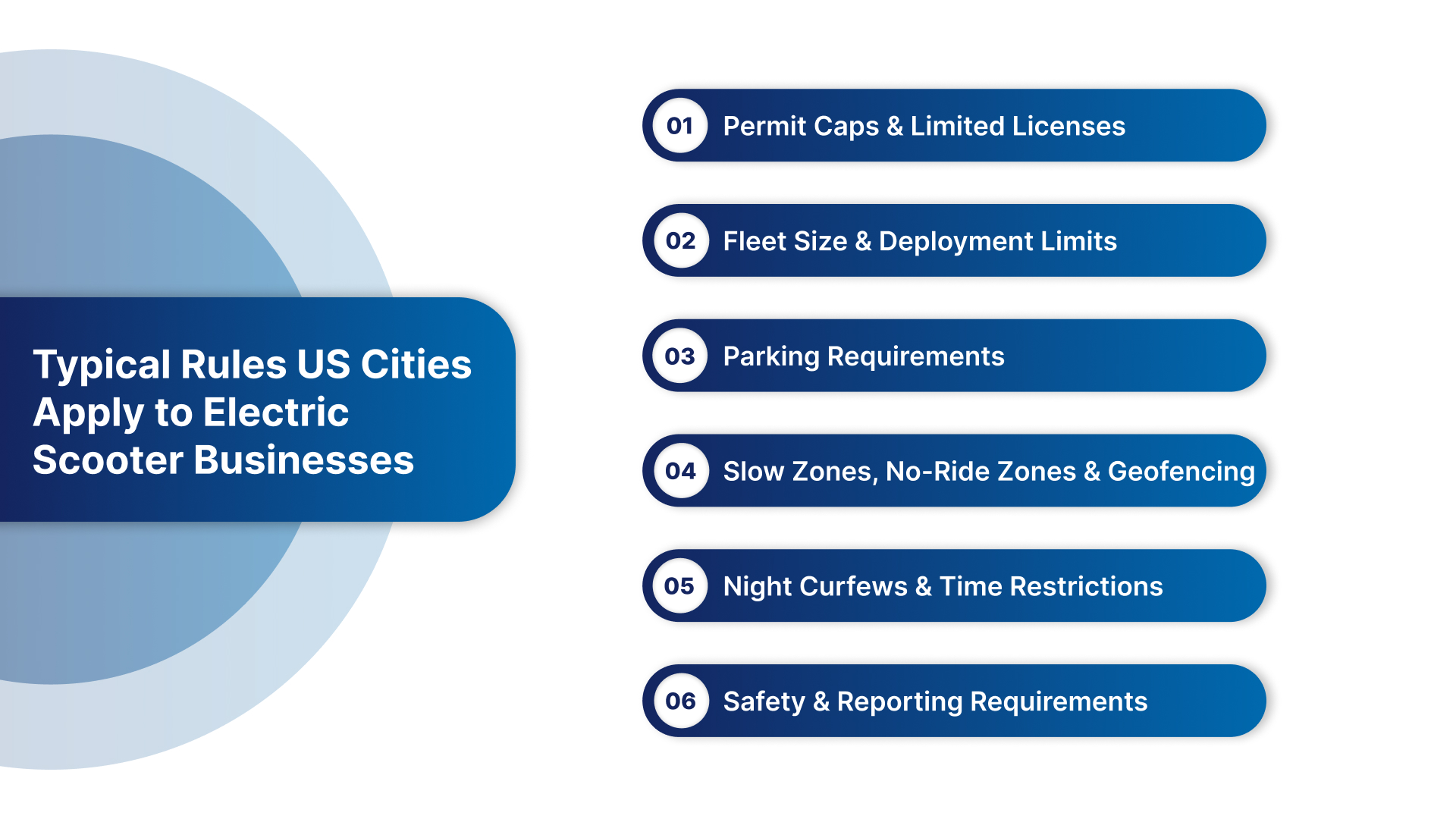
- Permit Caps & Limited Licenses: Cities often restrict how many operators can run and how large fleets can be.
- Fleet Size & Deployment Limits: Authorities may approve a maximum fleet size initially, with increases tied to performance and safety compliance.
- Parking Requirements: Expect designated parking areas, penalties for clutter, and proof that you can keep sidewalks usable.
- Slow Zones, No-Ride Zones & Geofencing: Cities require speed-restricted areas, pedestrian priority zones, and restricted public spaces — making strong software essential.
- Night Curfews & Time Restrictions: Houston’s example made this real. After hundreds of nighttime crashes, the city introduced a citywide 8 p.m. to 4 a.m. micromobility curfew, significantly reshaping when operators can earn revenue. That’s the kind of regulatory environment you’re working in today.
- Safety & Reporting Requirements: Cities increasingly expect crash reporting, rider education tools, operational standards, and proof you can enforce them.
In short: compliance isn’t paperwork. It shapes fleet size, when scooters can operate, where they can go, and how profitable your model can be.
How to Approach City Officials Like a Serious Operator
Cities are far more open to scooter businesses that look like infrastructure partners, not opportunistic vendors. When you enter discussions, you need to show capability, not enthusiasm.
To position yourself as a credible operator, walk in with:
- A data transparency plan: Be ready to show trip data, safety metrics, and community impact reporting.
- A clear parking & street management approach: Demonstrate how you’ll prevent clutter and how your tech enforces it.
- Geofencing & control technology: Cities trust operators who can actually enforce rules, not rely on riders to behave.
- Incident response & safety strategy: Show processes for crashes, vandalism, misuse, and public complaints.
- Community & city benefit framing: Think beyond profit — talk about access, tourism benefit, mobility equity, and integration with local transit.
Build a Simple Financial Model for Your Electric Scooter Business
If you treat your electric scooter business like a serious company instead of a gadget project, your numbers start guiding your decisions instead of guesswork. A simple, realistic financial model helps you understand how much to invest, how fast you can recover it, and whether your city can support a profitable fleet.
Startup Costs and Capital You Should Plan For
Most first-time operators underestimate how much it takes to launch properly. A practical startup range for a small US scooter fleet generally sits between $10,000 and $100,000+, depending on how ambitious you go. Here’s how that usually breaks down:
Typical one-time launch expenses include:
- Scooters & hardware → buying high-quality, shared-fleet grade devices (not consumer scooters)
- IoT modules / locks / GPS → for tracking, geofencing, and compliance
- Software platform → rider app + admin dashboard + payment system
- Permits & city application costs → varies widely by location
- Branding & setup → decals, onboarding materials, launch marketing
A lean founder launching 30–50 scooters in one zone can often land near the lower to mid part of this range. Larger fleets, multi-zone launches, or fully custom tech stacks push far higher. The key is not to start “cheap.” Start right-sized for learning, credibility, and operations.
Operating Costs, Margins, and Break-Even Targets
Your ongoing costs will define whether your business survives beyond excitement. Expect recurring operating expenses such as:
- Charging & battery swaps
- Storage / warehouse space
- Maintenance & spare parts
- Field staff / operator support
- Software subscription
- Insurance & compliance admin
- City fees (where applicable)
Well-run scooter fleets tend to see healthier numbers. However, poor deployment, weak software, or unmanaged downtime can erase those profit margins quickly.
Your financial core revolves around two questions:
- How many paid rides per scooter per day can your city realistically produce?
- How efficiently can you keep those scooters charged, available, and rideable?
If those two fall into place, your break-even period becomes predictable instead of hopeful.
KPIs That Decide If Your Scooter Business Survives
Numbers make or break an electric scooter business. These are the KPIs every serious operator tracks:
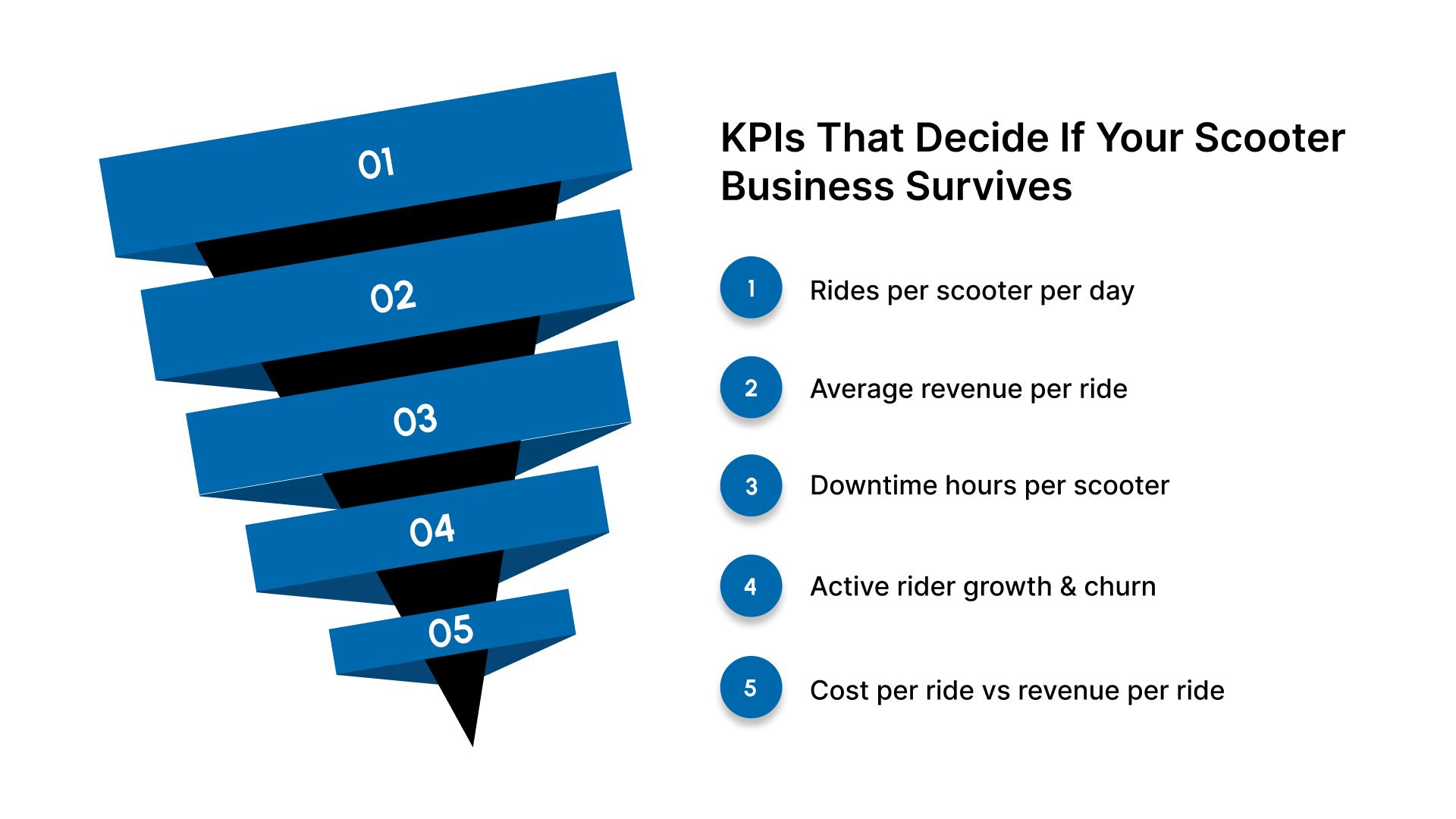
- Rides per scooter per day (RPSPD): The single strongest health indicator. Most viable fleets chase consistent, repeatable daily rides.
- Average revenue per ride: Influenced by your city’s willingness to pay, ride length, and pricing structure.
- Downtime hours per scooter: Every offline hour kills revenue. Charging, maintenance, and retrieval efficiency matter.
- Active rider growth & churn: Are riders sticking with you, or just trying you once?
- Cost per ride vs revenue per ride: A brutally honest profitability lens.
With clear economics in place, the next step is choosing technology that supports your targets instead of draining your budget, and that’s where your platform decisions start to matter more than your scooter count.
Design Your Tech Stack: Apps, IoT, and Analytics
In 2026, your tech stack is not a “nice to have.” It’s what decides rider trust, city compliance, and whether your operations make money instead of firefighting problems.
What Your Riders Expect From an Electric Scooter App
Top-ranking platform guides consistently highlight that riders expect a fast, familiar, app experience that works without confusion:
- Real-time map with available scooters
- Instant unlock via QR/Bluetooth with minimal friction
- Clear pricing displayed upfront
- Secure in-app payments without failures
- Ride history & receipts for transparency
- Easy in-app support if something goes wrong
If any of these feel slow or unclear, riders simply do not come back.
What Your Operations Team Needs Behind the Scenes
Operators need strong backend visibility to keep fleets reliable and profitable:
- Live scooter status + GPS location tracking
- Battery monitoring + charging alerts
- Maintenance flags & health tracking
- Trip data + usage reporting
- Heatmaps & analytics to identify high-demand areas
- Task workflows for field teams for swaps, repairs, and redeployment
This is what helps you reduce downtime, protect margins, and stay compliant with city rules.
With the right technology foundation, your scooter business runs like an operation, not an experiment, and that puts you in a much better position to scale confidently.
Plan Operations Like a Fleet Manager
Running an electric scooter business is about running a disciplined mobility operation every single day.
How to Size and Deploy Your Fleet Across Zones
Launching everywhere at once is how many fleets fail. Smart operators start controlled, learn fast, and scale deliberately.
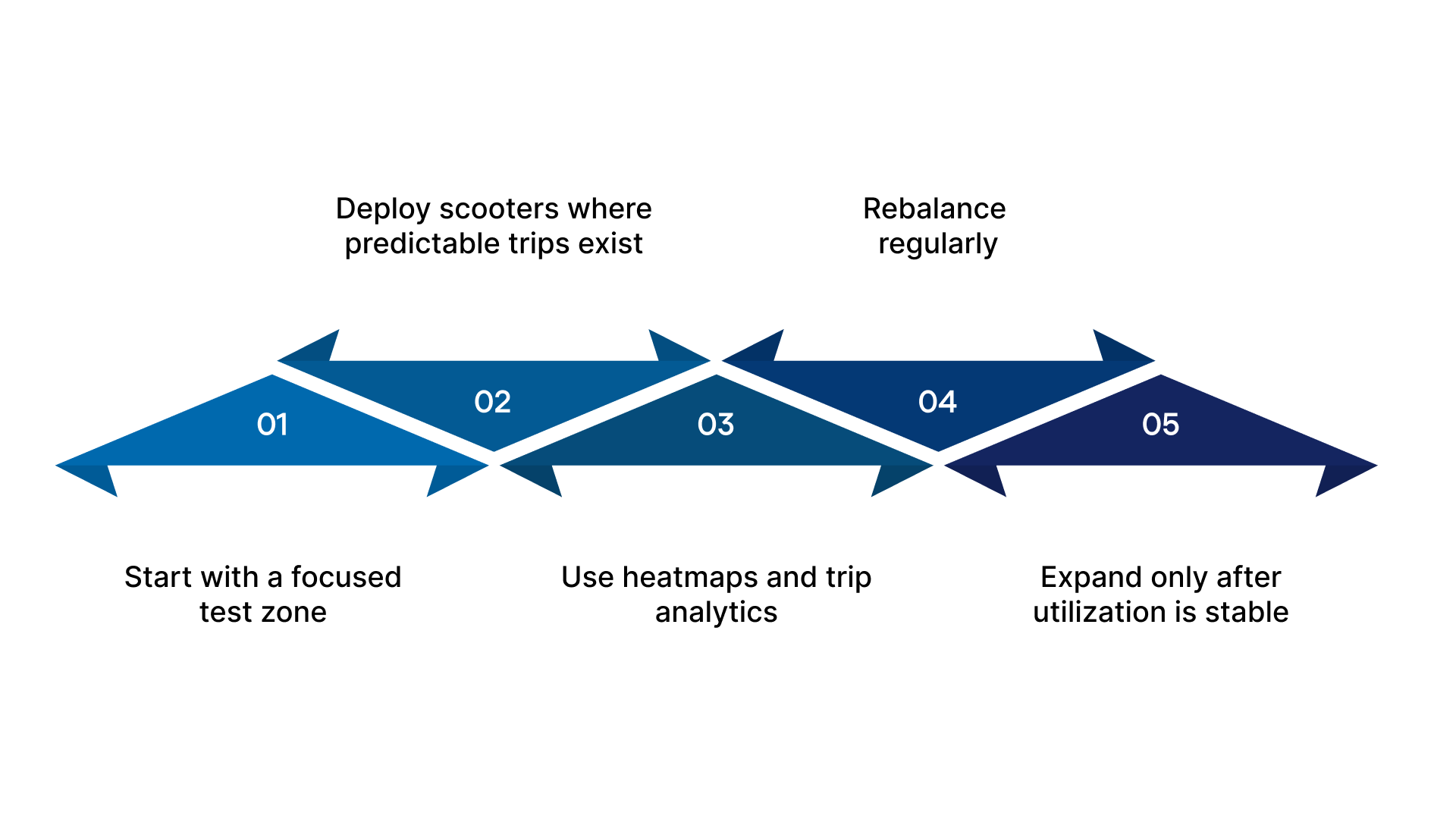
- Start with a focused test zone instead of an entire city
- Deploy scooters where predictable trips exist (tourist corridors, campuses, downtown cores)
- Use heatmaps and trip analytics to see where rides actually happen
- Rebalance regularly so scooters don’t cluster in low-demand areas
- Expand only after utilization is stable, not because you “feel ready”
Daily Operational Routines for a Healthy Fleet
A profitable scooter fleet is not “set and forget.” There’s a daily rhythm behind every reliable operation:
- Charging & battery swaps so scooters stay available
- Routine checks for tires, brakes, and overall condition
- Cleaning & presentation, especially in tourist or brand-sensitive environments
- Morning redeployment to high-demand spots before rush periods
- Midday adjustments based on usage data
- Evening assessment for damaged or misplaced scooters
This is where operational discipline protects revenue.
Safety, Parking Discipline, and City Relations
Your relationship with the city is a business asset. Respecting streets, pedestrians, and policy keeps you operating long term.
- Clear in-app parking guidance so riders know exactly where to leave scooters
- Geofencing + slow zones to align with rules and safety expectations
- Physical signage where needed to reinforce order and prevent clutter
- Fast complaint response to maintain public trust
- Visible commitment to safety to show the city you’re a partner, not a problem
Also Read: 9 Great Electric Scooters for Micro-Mobility Operators in 2025
When operations are under control, you can finally shift focus to something far more exciting: marketing that brings the right riders in and turns your fleet into a consistent revenue engine.
Market Your Electric Scooter Business to the Right Riders
If your scooters are well-deployed but riders never find them, your business never scales. Marketing for an electric scooter business is about speaking to the right people in the right places with pricing that makes sense for how they ride.
Positioning and Pricing for Your Chosen Niche
Your pricing and positioning should match how riders actually use scooters in your city, not a generic template.
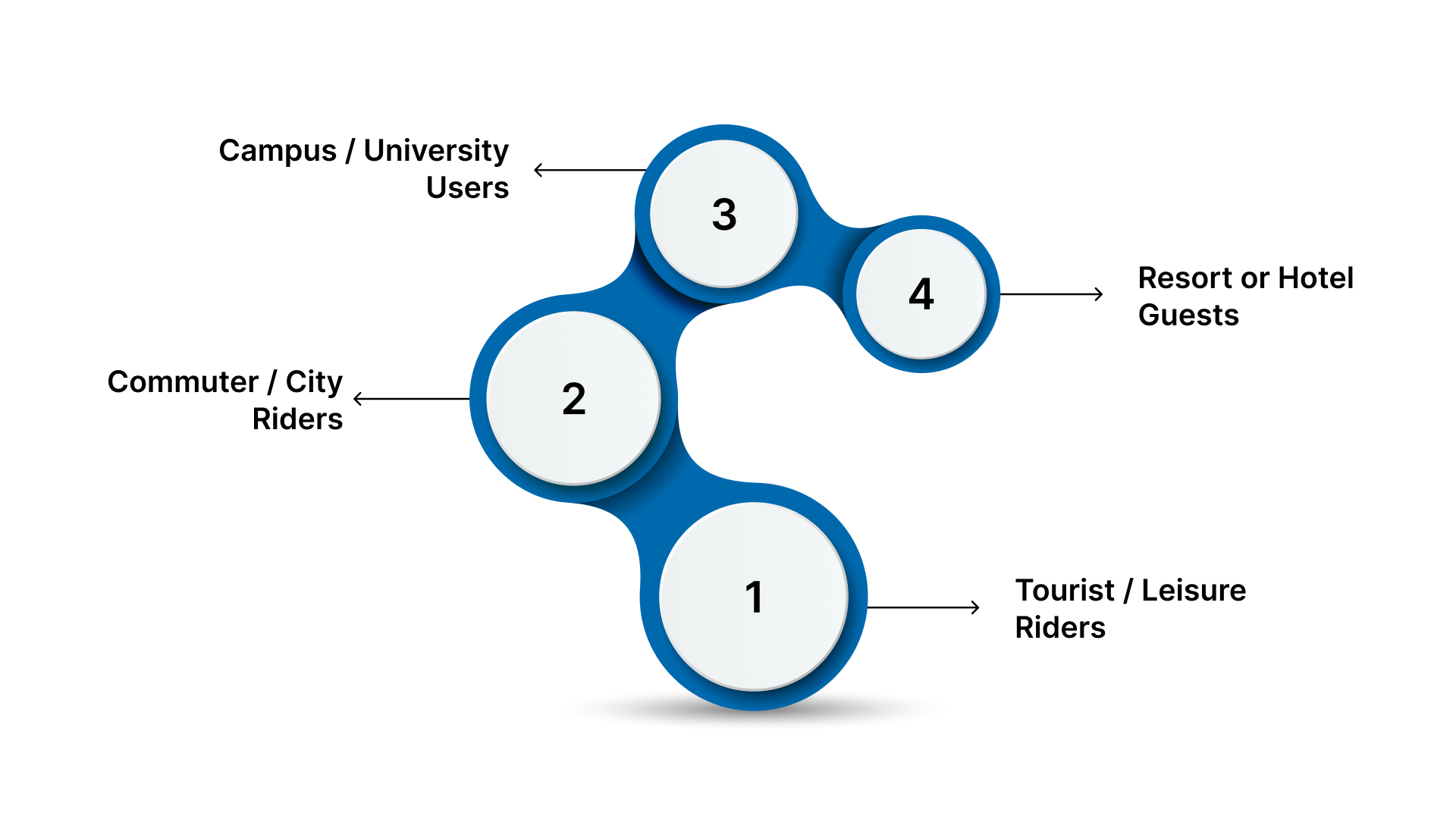
- Tourist / Leisure Riders
- Short discovery trips, sightseeing loops, and casual exploration
- Works best with: day passes, hourly bundles, tourist packages, hotel tie-ins
- Highlight: fun, freedom, easy movement between attractions
- Commuter / City Riders
- Routine weekday travel between home, transit, offices, and lunch spots
- Works best with: weekly commuter passes, subscription plans, predictable rates
- Highlight: convenience, reliability, and time saved
- Campus / University Users
- Highly repeatable travel patterns inside a defined area
- Works best with: semester plans, student discounts, group pricing
- Highlight: speed, affordability, and everyday utility
- Resort or Hotel Guests
- Experience enhancement, comfort travel, and on-property mobility
- Works best with: integrated pricing via hotel, guest ride bundles, branded experience
- Highlight: convenience, enjoyment, premium feel
A well-fitted pricing model does two things: it builds loyalty and helps you stabilize revenue.
Local Marketing Playbook for US Scooter Operators
Scooter adoption grows faster when your brand becomes a visible part of the city.
- Own Your Digital Presence
- Set up Google Business Profile
- Add accurate locations, service hours, pricing info
- Optimize for “electric scooter rentals near me / in your city” search intent
- Build Local Partnerships
- Hotels, resorts, attractions, convention centers
- Universities, coworking spaces, and corporate campuses
- Local tourism boards and business districts
- Make Riders Your Marketers
- Encourage rider reviews and UGC photos
- Promote short clips on Instagram & TikTok
- Use local micro-influencers (travel bloggers, student creators, city lifestyle pages)
- Be Physically Present
- On-site signage in high-footfall areas
- Clear instructions where scooters are available
- QR-based discovery so people can start in seconds
Good marketing doesn’t just drive awareness, it converts curiosity into repeat rides.
Once you have riders coming in and data flowing through your system, you can use a platform like EazyRide to keep everything under one roof.
How EazyRide Helps You Launch and Run an Electric Scooter Business in Weeks
If you want to build a real electric scooter business without spending months on development or patching systems together, EazyRide gives you the full technology stack you need: already tested, already reliable, and ready to brand.
Launch a Branded Electric Scooter Business Without Building Software
Instead of hiring developers, waiting on product builds, and risking technical failures, EazyRide lets you launch fast with a complete white-label platform:
- Rider app for iOS & Android with your brand, logo, and colors
- Custom pricing rules for passes, subscriptions, or per-minute models
- City-specific geofencing for slow zones, no-ride areas, and parking rules
- Secure payments and rider onboarding built into the experience
You get a professional, trustworthy platform from day one, without writing a single line of code.
Run Daily Fleet Operations With a Single Dashboard and Operator App
EazyRide isn’t just an app for riders. It’s a full operations system designed for real fleet managers:
- Live vehicle tracking to know where every scooter is
- Battery status & usage health so downtime doesn’t surprise you
- Geofencing tools to stay compliant with city rules
- Maintenance alerts & status flags to protect fleet reliability
- Dedicated operator mobile app for charging, repairs, redeployment, and on-ground tasks
Everything you need to control the fleet sits in one place, not across spreadsheets and disconnected tools.
Grow From One City to Many Without Rebuilding Your Stack
When your fleet works, you don’t want your tech stack holding back expansion. EazyRide is built for operators planning to scale:
- Multi-zone and multi-city support to manage multiple areas cleanly
- Role-based permissions so teams, partners, and staff get the access they need
- Advanced analytics & heatmaps to guide scaling decisions, pricing optimization, and performance tracking
This gives you the ability to expand confidently instead of rebuilding technology every time you grow.
Conclusion
If you’re planning to launch an electric scooter business in 2026, success won’t come from enthusiasm alone. It comes from making disciplined choices: picking the right city and niche instead of trying to cover everything, respecting permits and risk instead of gambling with compliance, and building real unit economics instead of relying on optimistic guesses.
Instead of spending months building technology from scratch, using a proven mobility platform helps you launch faster, run cleaner operations, and scale with confidence.
If you’re serious about starting an electric scooter business in 2026, schedule a demo with EazyRide to help you go from idea to live fleet in weeks, not months.
FAQs
1. Is an electric scooter business profitable in 2026?
Well-managed US scooter fleets can see healthy gross margins when utilization is strong, downtime is minimized, and pricing fits the city’s riding behavior. Profitability improves when founders focus on the right zones, compliance, and strong technology instead of just adding more scooters.
2. How much does it cost to start an electric scooter business in the US?
Most first-time operators should expect a startup cost range of $10,000 to $100,000+, depending on fleet size, scooter hardware quality, insurance, permits, storage, and software choices.
3. How many scooters do I need to start a rental fleet?
A realistic starting point for most US operators is 30–50 scooters in a focused launch zone. This allows you to test demand, learn rider behavior, stay compliant, and control maintenance without overwhelming operations.
4. What permits or licenses do I need to run an electric scooter rental service?
Most US cities now require:
- A formal micromobility permit or operator approval
- Fleet size and deployment approval
- Compliance with parking, no-ride, and slow-zone rules
- Reporting and data-sharing requirements
- Insurance and safety documentation
5. Should I build my own scooter app or use a white-label platform for my electric scooter business?
For most founders, a white-label platform is the smarter move. Building custom software takes months, costs significantly more, and requires ongoing maintenance. A proven white-label solution already includes rider apps, fleet dashboards, operator tools, geofencing, payments, and analytics, letting you launch faster and focus on running a profitable business, not managing development.


