
 AllMicro Mobility Model

 20 June, 2025
 Micromobility Solutions for Cities and Campuses: Use Cases and Options
Cities are clogged. Commuters waste hours stuck in traffic and deal with rising pollution. Meanwhile, demand for fast, cheap, and clean transportation continues to grow. That’s where micromobility solutions – shared e‑bikes, e‑scooters, and light electric vehicles – come in, offering a smarter way to move.
The global micromobility market was worth about US $40.6 billion in 2024 and is expected to more than double to US $91.2 billion by 2030, growing at a 14.5% annual rate. In the U.S. alone, micromobility revenue is projected to grow from roughly US $5.26 billion in 2024 to US $14.09 billion by 2030.
But this isn’t just about business growth. It’s about solving real problems. Shared micromobility offers a way to reduce emissions, ease congestion, and cover short trips quickly; all while staying affordable and sustainable.
On top of that, more companies and institutions are seeing value in offering corporate micromobility solutions: options like e‑bikes or scooters for employees cut commute times, reduce parking headaches, and support sustainability goals.
In this blog, we’ll dig into how micromobility solutions are reshaping urban mobility and corporate commuting. Look out for the real benefits, trends driving the shift, and how cities and businesses can make the most of this transformation.
Key Takeaways:
- Micromobility Reduces Traffic & Pollution: E‑bikes and e‑scooters help cut congestion and CO₂ emissions by replacing short car trips in urban areas.
- Corporate Adoption Enhances Efficiency & Sustainability: Offering micromobility options to employees lowers commuting time, parking costs, and supports eco-friendly goals.
- EazyRide Optimizes Fleet Operations: EazyRide provides real-time data and tools to manage fleets efficiently, reducing costs and boosting performance.
- Smart Micromobility Adoption is Essential for the Future: Cities and businesses that adopt micromobility now will gain long-term benefits in cost savings, sustainability, and mobility.
How Traffic Congestion and Pollution Are Crushing Mobility?
In most major cities, traffic congestion isn’t just an inconvenience; it’s a business and environmental crisis. Every year, cities like New York, London, and São Paulo lose billions of dollars due to traffic congestion.
The average U.S. commuter lost 63 hours stuck in traffic in 2024 – nearly eight full workdays wasted. That’s after recovery from the pandemic slowdown, according to the 2025 Texas A&M Transportation Institute (TTI) Urban Mobility Report. Those hours don’t just disappear. The economic impact of traffic delays in the U.S. is estimated at US $269 billion per year.
Even beyond lost time and money, the environmental cost is heavy. Traditional short car trips contribute to emissions. Replacing many of these with micromobility, such as e‑bikes, can significantly reduce CO₂ per trip.
Here’s what this really means for urban operators & corporate businesses:
- Corporate commuters are spending days every year stuck in traffic – time that’s unproductive and frustrating.
- Cities are bleeding value: from lower productivity to higher fuel costs, pollution, and pressure on infrastructure.
- Relying on traditional transport modes like cars and buses, and on congested roads, is becoming unsustainable, both financially and environmentally.
Suggested Read: Benefits of Sustainable Transportation
If your city or business keeps operating on the old model, you’re not just lagging. You’re imposing major downsides on customers, employees, and the environment.
That’s why it’s time to re-evaluate how we move. And that’s where micromobility solutions come in.
What Exactly Are Micromobility Solutions?
Micromobility solutions refer to lightweight vehicles designed for short-distance travel (typically under 5–10 miles) that are easy to ride, park, and operate. These include bikes, e‑bikes, electric scooters (e‑scooters), and other small, often shared, electric or human-powered vehicles.
Key attributes that define micromobility include:
- Light vehicles, often under 500 kg, usually with limited speed, and ideal for urban streets.
- Can be individually owned or part of a shared fleet, giving flexibility for both private use and shared‑mobility services.
- Designed for short trips – filling the “last‑mile” or short‑distance travel gap that is often inefficient for cars or public transit.
The global micromobility market was valued at US $40.6 billion in 2024, and is forecast to nearly double to US $91.2 billion by 2030. Growth is driven by both rising urban congestion and increasing demand for flexible, affordable transportation.
In North America alone, shared micromobility ridership continues to surge: 2024 saw a 31% increase, bringing total trips to at least 225 million across the region. For operators, this means more trips per vehicle to capture, translating into higher demand for efficient fleet management, maintenance scheduling, and rebalancing efforts.
This ensures maximum fleet utilization and service reliability.
Best Micromobility Solutions for Urban and Corporate Mobility
Micromobility solutions have proven to be a transformative force for both urban mobility and corporate environments. From dockless scooters in cities to corporate fleets designed to reduce parking demand, each solution is uniquely suited to solve specific challenges.
Here’s a tabular look at the top micromobility solutions for each category:
Urban Mobility Solutions:
These solutions are designed to improve the overall movement of people within crowded, high-demand urban areas. They offer flexible, eco-friendly options to tackle traffic congestion, pollution, and last-mile connectivity.
| Solution | What is it? | Key Benefits |
|---|---|---|
| Dockless E-Scooter Sharing | Scooters available to pick up and drop off at various locations. Ideal for short, urban commutes. | Flexible and scalable for short trips; reduces car dependence and lowers urban emissions. |
| E-Bike Sharing | Shared electric bikes for quick, eco-friendly travel, often integrated with public transport. | Eco-friendly, low-cost option that complements public transit and promotes sustainability. |
Corporate Micromobility Solutions:
These solutions are customized for organizations, helping companies manage employee commuting, support sustainability, and reduce overhead costs such as parking and transportation subsidies.
| Solution | What is it? | Key Benefits |
|---|---|---|
| Corporate Fleets (E-Scooters & E-Bikes) | E-scooters or e-bikes provided to employees for commuting, reducing parking & promoting sustainability. | Boosts employee satisfaction, reduces parking congestion, and supports corporate sustainability goals. |
| Campus Fleets | Shared micromobility solutions on university campuses for students and staff. | Affordable and efficient transport for students and staff, encouraging sustainable commuting. |
| Resort Fleets | E-scooters and e-bikes offered to resort guests for easy access to amenities. | Enhances guest experience, reduces reliance on cars, and supports eco-friendly tourism. |
This table offers a clear overview of the various micromobility solutions, their applications, and the benefits they bring. And these micromobility solutions are already in full swing, delivering substantial gains.
See how.
These Solutions Are Already Reshaping How Cities Move
Cities around the world are already feeling the changes that micromobility brings, such as fewer cars on the road, cleaner air, and more efficient short‑trip traffic. Here’s how:
According to one study, when shared e‑scooters and e‑bikes are restricted, daily commute times in cities increased by 9–11 %, and post‑event traffic delays jumped by as much as 37 %. That shows what happens when micromobility options disappear – car traffic surges back.
There are more incidents to help see the opportunities & results:
- Replacing Short Car Trips: In many urban areas, up to 18 % of short‑distance car trips (under 5–10 km) can realistically be replaced by micromobility modes like e‑bikes or scooters.
- Reducing Emissions & Pollution: Shared micromobility has a tangible environmental benefit. For example, studies show that shared e‑bikes reduce carbon emissions by about 108–120 grams per kilometre compared to car trips.
- Widespread Adoption & Real Usage Patterns: In 2024, shared micromobility in North America helped offset approximately 101 million pounds (about 46 million kg) of CO₂ emissions – by replacing car‑based trips with e‑bikes, scooters, and other micromobility devices.
- Integration With Public Transport & Multi‑Modal Mobility: Rather than replacing public transport, micromobility often complements it. For many riders, it fills the “last mile”, connecting home or work to transit hubs. This makes the overall transport network faster and more efficient.
You can see that micromobility is already changing the way people move, but what exactly are the best benefits for cities and businesses?
Let’s break it down ahead.
Top Benefits of Micromobility Solutions for Urban Mobility & Businesses
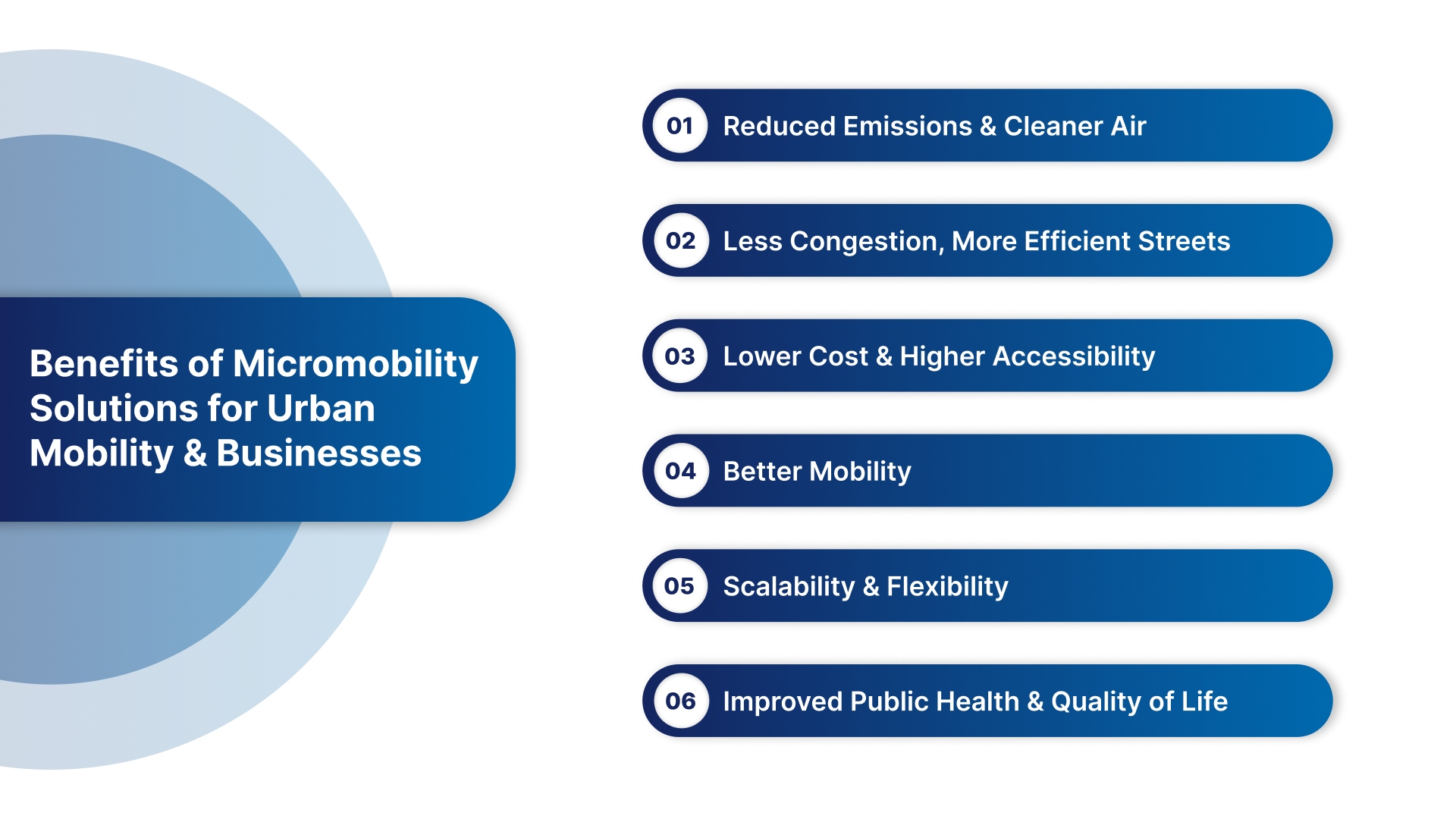
Using micromobility, such as shared e‑bikes, e‑scooters, and other lightweight vehicles, isn’t just trendy. For cities and businesses, it delivers concrete gains. Here are the key benefits:
1. Reduced Emissions & Cleaner Air
- Shared e‑bikes reduce carbon emissions by 108–120 g CO₂ per kilometre compared with equivalent car trips – a clear win for city sustainability.
- Because of lower emissions and less reliance on cars, micromobility helps cities improve air quality and reduce urban pollution.
2. Higher Network Efficiency & Less Congestion
- By replacing short car trips (mainly under 5–10 km), micromobility lightens traffic load, helping reduce gridlock and making commutes faster for everyone.
- For businesses located in dense urban clusters, this means employees and customers spend less time stuck in traffic, boosting productivity and satisfaction.
3. Cost-Effective & Highly Accessible Mobility
- Micromobility offers a lower‑cost transport alternative compared with owning a vehicle or even relying on high‑frequency taxi/ride services.
- For shared mobility providers and corporate fleets alike, the lower maintenance and energy costs of e‑bikes/scooters make them a cost-effective mobility solution.
4. Improved Last-Mile Connectivity
- Micromobility fills the “last mile” gap. It connects people to public transport or workplace hubs for short distances, where cars are inefficient.
- This flexibility makes it ideal for daily commutes, errands, campus travel, or intra-city travel and improves mobility access for a wide range of users.
Also Read: Why Micromobility Hubs Matter for Urban Mobility Businesses in 2025
5. Scalability & Flexibility for Growing Demands
- Shared micromobility solutions scale well: you can start small (a few bikes or scooters) and expand as demand grows, without the overhead associated with large vehicle fleets or traditional transit infrastructure.
- For businesses, this flexibility supports sustainable transportation initiatives, helps manage operational costs, and offers a practical alternative to parking-heavy or car-dependent transport models.
6. Healthier Employees and a Better Quality of Life
- Regular use of e‑bikes or scooters encourages light physical activity, especially compared with car commutes. That can improve public health over time.
- Reduced traffic and better air quality contribute to a more livable city environment. This enhances the overall quality of life for residents and the appeal for employees, customers, and tenants.
Key Challenges of Micromobility Solutions You Must Know
Even though micromobility offers many benefits, there are serious hurdles cities, operators, and businesses must overcome before these solutions can deliver their full potential. Ignoring these risks can lead to poor adoption, safety liabilities, and wasted investment.
1. Safety & Infrastructure Gaps
Challenge: Lack of dedicated lanes and unsafe road conditions lead to high accident rates for shared e‑scooters and e‑bikes.
Solutions:
- Cities must prioritize protected bike lanes and safer intersections. Operators should use geofencing tools to enforce slow-speed zones in high-traffic areas and provide real-time safety alerts through their apps.
- For example, smart helmets with impact sensors can automatically notify the operator if a fall occurs, enabling quicker responses to safety incidents.
2. Regulatory & Policy Uncertainty
Challenge: Inconsistent or unclear regulations on speed limits, parking, and vehicle use make it difficult for businesses to scale.
Solutions:
- Operators can partner with local governments to shape clear, data-driven policies. For example, real-time compliance dashboards can be implemented that track vehicle usage and parking adherence.
- These insights can help cities introduce dynamic zoning policies that adjust based on traffic patterns and usage rates.
3. Operational & Maintenance Challenges
Challenge: Inadequate maintenance and fleet rebalancing lead to poorly performing or unavailable vehicles.
Solutions:
- Utilize IoT sensors to monitor vehicle health (battery levels, tire pressure, etc.) and automate maintenance schedules.
- For instance, predictive maintenance can be triggered when a vehicle shows signs of wear. AI-driven tools can automatically redistribute vehicles to high-demand areas, reducing downtime and increasing availability
4. User Behavior & Adoption Barriers
Challenge: Safety concerns and unfamiliarity with micromobility discourage potential users.
Solutions:
- Implement onboarding tutorials and in-app safety tips for first-time users. For example, a mandatory safety checklist (helmet use, speed limits) can pop up before a ride starts.
- Operators can also create incentive programs that reward safe riding (e.g., reduced fees for users who complete safety training modules) to build positive behavior.
5. Scalability & Equity Concerns
Challenge: Micromobility may not perform well in low-density or suburban areas, leading to inequitable access.
Solutions:
- Use data analytics to identify underserved areas and deploy flexible fleet models (e.g., on-demand vehicles) in low-density zones.
- Public-private partnerships with local governments can also help create subsidized rides or special pricing for underserved communities, ensuring equitable access while maximizing fleet utilization.
To succeed, micromobility solutions must address these obstacles head-on. By solving these, cities and businesses can ensure lasting success and meet the growing demand for cleaner, more efficient transport options.
The Future of Micromobility: What’s Next?
As cities, businesses, and commuters evolve, micromobility isn’t staying still. It’s transforming fast. Here are the trends shaping the next wave of micromobility solutions.
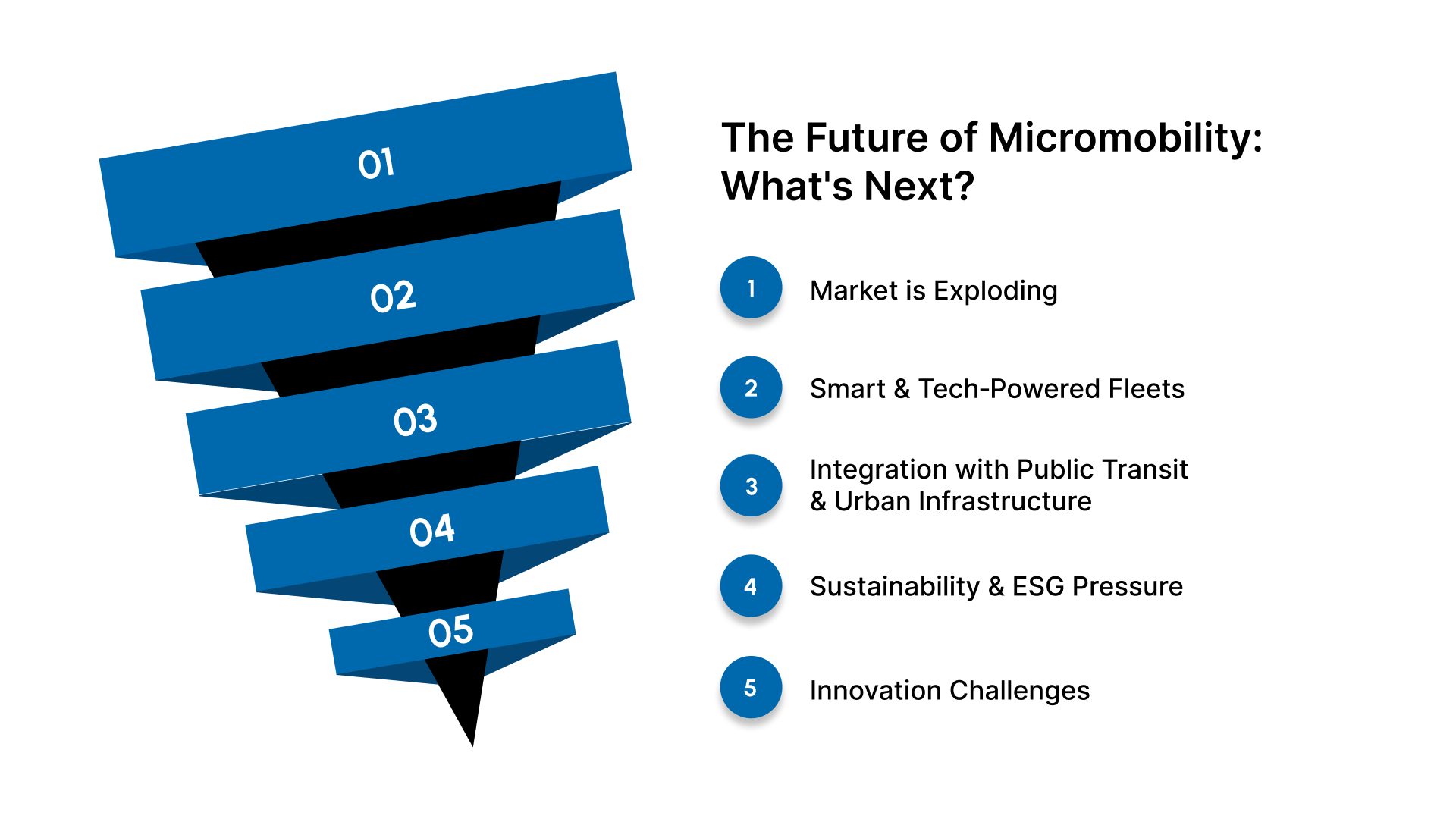
1. Market is Exploding
The global micromobility market, including shared bikes, e‑scooters, and light electric vehicles, is projected to grow upto US $287.8 billion by 2035, at a CAGR of 13.0%.
- In the U.S. and other major markets, adoption is accelerating not just for scooters but also for shared bicycles and e‑bikes. This reflects a shift in preference and infrastructure support.
- This growth suggests more cities, campuses, and corporate campuses will adopt shared micromobility. Meaning the window to establish a fleet or mobility program is wide open now.
Suggested Read: Shared Mobility Market Trends and Future Insights 2025
2. Smart & Tech‑Powered Fleets
Advances aren’t limited to vehicles. Integration of software platforms, IoT connectivity, and real‑time fleet management tools is growing. The market for micromobility integration systems alone is expanding rapidly.
- Research into autonomous micromobility (self‑driving e‑scooters / bikes) is already underway. For example, projects show that small fleets of autonomous micromobility vehicles can self‑rebalance dynamically based on real‑time demand. This reduces idle vehicles and improves availability.
- That means future fleets won’t just be “shared bikes/scooters.” They’ll be smart fleets, with predictive deployment, dynamic balancing, and minimal manual intervention. For operators, that translates to lower labor costs and higher uptime.
3. Integration with Public Transit & Urban Infrastructure
Cities are increasingly recognizing micromobility as a complement (not competitor) to public transit. Shared scooters and bikes fill the “first‑mile / last‑mile” gap, linking homes, transit hubs, offices, and commercial zones.
- Urban planners are reallocating city space. They are dedicating protected bike lanes, reducing car‑only lanes, and encouraging low‑speed zones to support the growth of micromobility.
- As infrastructure and regulations evolve, using micromobility becomes safer and more convenient. This makes it more attractive for daily commuting, not just occasional use.
4. Sustainability & ESG Pressure
With increasing awareness about carbon emissions and urban pollution, micromobility is being framed as a key pillar in city‑wide sustainability strategies. Shared e‑bikes and scooters help reduce car dependence, lower emissions, and promote cleaner transport.
- Corporations and real‑estate developers are under growing pressure to offer “green” mobility solutions for employees or residents.
- Micromobility is becoming a standard offering on corporate campuses, in residential complexes, and in mixed‑use developments.
- Early adopters will benefit: reduced parking/transport overhead, improved brand image, and compliance with future environmental standards.
5. Innovation Challenges
As usage grows, regulatory frameworks are tightening. Cities will demand safety standards, geofencing, usage tracking, and responsible vehicle deployment. Services that don’t meet them risk being restricted.
- To succeed long‑term, micromobility operators must focus on data‑driven fleet management, real‑time maintenance, safety monitoring, and smart deployment. The winners will be those who build robust, scalable, and compliant operations.
- User experience will matter more than ever. Smooth unlock/payment flows, availability, safety, reliability, and integration with other transport modes will separate short‑lived pilots from sustainable, large‑scale services.
So, what does all this mean for you?
If you are an entrepreneur or fleet operator, it’s a prime time to enter — market growth + tech innovation + demand = opportunity. Planning a micromobility service now gives you a head start before competition saturates.
For businesses and corporate campuses, micromobility can soon be as standard as Wi-Fi – a key part of mobility, sustainability, and employee satisfaction strategies.
And as for the city planners and policymakers, supporting micromobility infrastructure (bike lanes, smart parking, regulations) will pay off – cleaner air, less traffic, and more efficient use of public space.
EazyRide as Your Micromobility Operations & Fleet Management Enabler
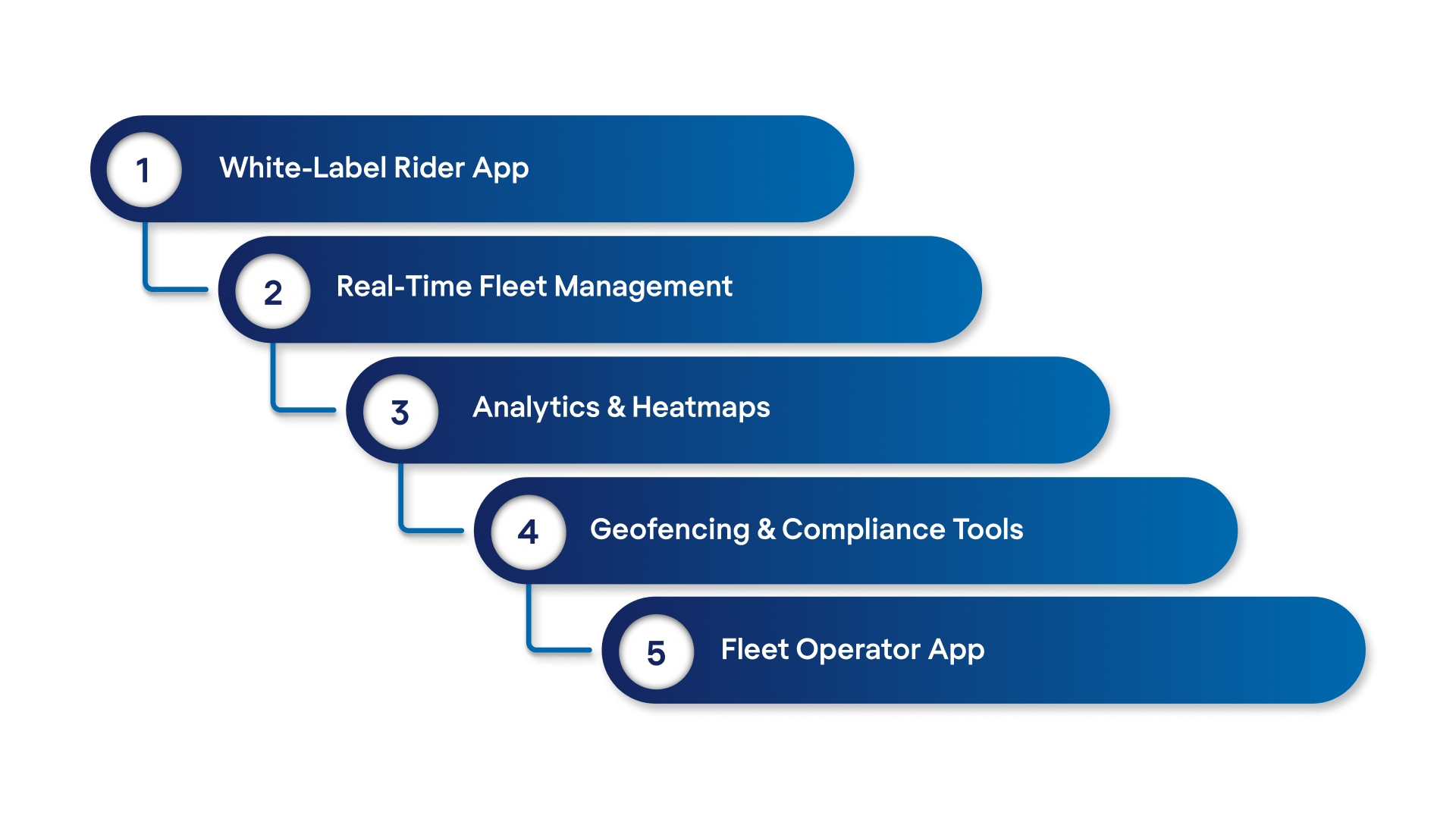
Micromobility solutions become much more effective when your platform not only tracks data but also empowers you to act on it. That’s where EazyRide comes in. It’s more than just tracking.
It provides fleet operators with the tools to simplify operations, optimize fleet performance, and ensure scalability, all while reducing costs. Here’s how:
- White-Label Rider App: Fully customize with your business branding, colors, and features. Riders experience a seamless interface to unlock, ride, and pay, all while your company’s identity is reflected in every interaction.
- Real-Time Fleet Management: Provides live vehicle status, including location, battery level, recent trips, and usage patterns. This visibility allows operators to make quick, data‑driven routing and operational decisions.
- Analytics & Heatmaps: Gain deep insights into where and when your fleet is used. Heatmaps and zone-based data highlight peak demand periods, underutilized areas, and inefficiencies.
- Geofencing & Compliance Tools: Define allowed zones, no-go areas, and speed limits. This ensures compliance with local regulations, preventing penalties and ensuring that vehicles are used safely and responsibly within designated areas.
- Fleet Operator App: Has everything needed, including priority task lists, maintenance workflows, and rebalancing instructions. Operators are always in sync with the fleet’s needs, improving efficiency and response times.
With EazyRide, operators can make smarter decisions, reduce operational costs, and improve fleet uptime – all through a single structured platform.
Conclusion
Today, where efficiency and sustainability are at the forefront of successful transportation strategies, micromobility solutions are no longer optional but essential. With EazyRide, you gain full control over your fleet’s performance, safety, and operational costs.
By using real-time data, optimizing fleet deployment, and ensuring compliance, EazyRide equips you with the tools to stay ahead of the competition and future-proof your urban and corporate mobility plans. Whether you’re a city operator looking to ease traffic congestion or a corporate team aiming for employee satisfaction and sustainability, EazyRide has the solutions you need to succeed.
Ready to embrace smarter transportation solutions that save you time and money? Request a demo today to see how EazyRide can transform how you manage your micromobility fleet.
FAQs
Q1. What exactly counts as a “micromobility solution”?
A micromobility solution typically involves light, short‑range vehicleslike shared e‑bikes, e‑scooters, or electric bicycles designed for short trips (usually under 5–10 km).
Q2. Is shared micromobility really better for the environment than cars or taxis?
Yes. Shared e‑bikes and e‑scooters produce significantly lower greenhouse‑gas emissions compared with cars for short trips, and help reduce reliance on fuel‑powered vehicles.
Q3. Can micromobility work in a corporate or campus setting (not just for public urban use)?
Absolutely. Corporate micromobility, where a company offers shared e‑bikes/scooters to employees, can reduce commute costs, ease parking demand, and support sustainability goals. It’s a growing trend for businesses.
Q4. What are the main safety or regulatory concerns with micromobility?
The biggest concerns are safety (accidents, rider behavior), inadequate infrastructure (bike lanes, parking), and unclear regulations (parking, usage rules). Without good policy and infrastructure, risks increase.Read the full ScienceDirect article
Q5. Will micromobility replace public transport or cars entirely?
Not necessarily. Many studies show micromobility complements public transport by solving the “last‑mile” problem and handling short trips. It’s best viewed as part of a multi‑modal mobility system.


