
 Analytics and research

 12 August, 2026
 Electric Micromobility: Devices, Rules, and How Fleets Run
More than 400 cities worldwide now run shared micromobility programs, and the vehicles behind them, e-scooters, e-bikes, and mopeds, have become a normal part of how people move short distances. For a fleet operator, though, “electric micromobility” isn’t a trend. It’s inventory, charging logistics, compliance, and uptime.
This guide breaks down what electric micromobility actually covers, the main device types and how they’re regulated, and the operational realities that decide whether a fleet makes money or bleeds it. If you’re planning a launch or rethinking your current setup, start here.
What Is Electric Micromobility?
Electric micromobility refers to small, lightweight electric vehicles built for short urban trips, usually under five miles. Think e-bikes, e-scooters, mopeds, and hoverboards, not cars or full motorcycles. They’re light, cheap to run, and charge from a standard wall outlet.
The category is growing fast. The global micromobility market is projected to reach USD 75.85 billion in 2025, at a 20.4% compound annual growth rate. Most of that growth is shared fleets in dense cities, where a scooter parked on the right corner beats a car stuck in traffic.
How those vehicles get deployed varies a lot by setting. A campus, a resort, and a downtown grid each need different vehicle mixes and zone rules. Our guide to micromobility solutions for cities and campuses walks through the common use cases.
The Main Types of Electric Micromobility Vehicles
Each vehicle type serves a different rider and a different route. Here’s how the four most common ones compare.
| Vehicle | Typical top speed | Range per charge | Best for |
|---|---|---|---|
| E-bike | 20–28 mph | 20–60 miles | Commuting, longer trips |
| E-scooter | 15–20 mph | 10–40 miles | Short shared-fleet trips |
| E-moped | 28+ mph | 40+ miles | Longer commutes, delivery |
| Hoverboard | 6–12 mph | 6–12 miles | Recreation, last-100-meters |
E-Bikes and the Three-Class System
E-bikes split into three classes, and the class decides where you can legally ride:
- Class 1: pedal-assist only, up to 20 mph. Allowed on most bike paths.
- Class 2: throttle-assist, up to 20 mph. Good for casual short trips.
- Class 3: pedal-assist up to 28 mph. Built for roads and longer commutes, usually barred from bike paths.
In the US, the Consumer Product Safety Commission caps e-bike motors at 750 watts (1 horsepower). Get the class wrong on a shared fleet and you inherit a compliance headache in every city you enter.
E-Scooters
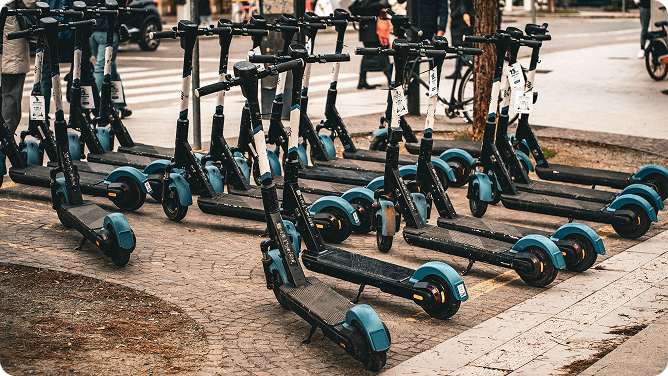
E-scooters are the workhorse of shared micromobility. Motors run 250W to 750W, top speeds sit between 15 and 20 mph, and range lands anywhere from 10 to 40 miles depending on battery and terrain. They’re light (20 to 40 lbs), portable, and cheap to maintain at scale, which is why most rental fleets lead with them. Keeping them safe and tracked in the field is its own discipline, covered well in this look at telematics for micromobility SMEs.
E-Mopeds
Some e-scooter models add pedals and cross into moped territory; others drop them and count as motorcycles. E-mopeds run 500W to 2000W and hit 28 mph or more, which puts them under stricter rules. In the US they often need registration, insurance, and a valid driver’s license, unlike e-bikes and standard e-scooters.
Hoverboards
Hoverboards are handlebar-free, self-balancing boards steered by body weight. Motors sit around 200W to 400W, speeds top out near 12 mph, and range rarely passes 12 miles. They’re mostly recreational and don’t feature in serious shared fleets, but they’re part of the same electric micromobility family.
Charging and Range: The Part Operators Underestimate
Here’s what the spec sheets don’t tell you: charging is an operations problem, not a hardware footnote. Most devices charge in 2.5 to 9 hours on a standard 120V outlet, and that window quietly sets your daily fleet availability.
Run 200 scooters and you can’t wall-charge them one by one overnight. Operators solve this two ways. Swappable batteries let field staff hot-swap a dead pack in seconds and charge the packs centrally. Fixed-battery vehicles get collected, charged, and redeployed, often by gig chargers paid per vehicle. Each model changes your labor cost and your uptime.
The math matters. A scooter that spends nine hours charging and two hours in transit is only earning revenue the rest of the day. Range, charge time, and swap strategy together decide how many rides each vehicle actually delivers, which is the number that drives payback. The electric vehicle-as-a-service model leans hard on getting this loop tight.
Safety and Regulation
Electric micromobility brings real safety and compliance obligations. The recurring ones:
- Helmets and speed limits. Helmet laws vary by region; many cities also cap device speed to protect riders and pedestrians.
- Lithium-ion battery risk. These batteries can overheat or catch fire if mishandled. UL-certified batteries and clear charging guidelines are non-negotiable for a fleet.
- Local zoning. Cities restrict sidewalk riding, set parking zones, and mark no-ride areas. Getting compliant fast is often a permit condition.
- Insurance. Operators and sometimes riders may need liability coverage, especially for e-mopeds.
Compliance isn’t a one-time checkbox. When a city changes a rule, you need to push it to every vehicle quickly, which is where fleet software earns its keep.
Benefits of Micromobility
Beyond convenience, electric micromobility delivers measurable public benefits, and those benefits are what win city permits:
- Less congestion. Short scooter and bike trips replace short car trips, easing traffic and street noise.
- Lower emissions. Zero-tailpipe vehicles cut air pollution and greenhouse gases in dense areas.
- Wider access. Programs like LA’s Mobility Wallet extend affordable transport to underserved neighborhoods.
- Better planning data. Anonymized trip data helps planners place bike lanes and parking where riders actually go.
What Actually Makes a Shared Fleet Work
Owning the vehicles is the easy part. Running them profitably comes down to control, and that lives in software, not hardware.
EazyRide’s geofencing module lets you draw no-parking zones, speed-restricted areas, and service boundaries directly on the admin dashboard. Rules push to every vehicle in real time, with no firmware update required. In deployments we’ve supported, operators using geofencing report up to 40% fewer parking violations than manual enforcement, which is often the difference between keeping a city permit and losing it.
The other half is visibility. Live GPS and IoT tracking across 10+ hardware brands tell you where every vehicle sits, how much charge it has, and when it needs collection. One dashboard runs e-scooters, e-bikes, and mopeds in the same account, so a mixed fleet doesn’t mean juggling two logins. If you’re comparing platforms before you commit, our breakdown of the best micro-mobility software in 2026 lays out the trade-offs.
Frequently Asked Questions
How long does a micromobility device take to charge?
Most electric micromobility devices charge in 2.5 to 9 hours on a standard 120V outlet. Battery capacity and charger type set the exact time.
Do you need a license to ride an e-scooter?
In most US states, no license is needed for e-scooters. E-mopeds are different and often require registration, insurance, and a valid driver’s license.
What is the three-class e-bike system?
Class 1 e-bikes are pedal-assist to 20 mph, Class 2 add a throttle, and Class 3 assist to 28 mph. Local rules decide where each is allowed.
How do operators stop riders parking anywhere?
Geofencing. Operators draw no-parking and slow zones on a dashboard, and the rules push to every vehicle in real time without a firmware update.
Are electric micromobility devices worth it for cities?
Yes. They cut short car trips, ease congestion, and lower emissions. Shared fleets also give planners real trip data to improve bike lanes and parking.
The Bottom Line
Electric micromobility isn’t one product; it’s a spread of vehicles, each with its own speed, range, rules, and charging burden. The operators who win aren’t the ones with the flashiest scooters. They’re the ones who can retune a zone, swap a battery, and prove compliance to a city before the permit window closes.
Scoping a launch or rethinking a fleet you already run? A short review will tell you more than a week of vendor calls. See how EazyRide’s fleet management software handles it, or book a free demo.


