
 Uncategorized

 16 November, 2026
Last-Mile Mobility Solutions: How Cities, Campuses and Operators Close the Final-Mile Gap
Last-mile mobility solutions are the vehicles, software and operating systems that cover the final stretch of a trip, the few miles between a transit hub, a workplace or a campus gate and someone’s actual destination. The term gets used two different ways. Freight companies mean the last leg of a package’s journey to a doorstep. Cities, campuses and private operators mean the last leg of a person’s journey, the gap that a train, a bus or a parking lot cannot close on its own. Both readings are correct and the industry increasingly solves them with the same shared fleets of electric bikes, scooters and low-speed vehicles.
The two problems share a cost structure, too. Last-mile services account for 41% of overall supply chain costs, more than double any other category of spend such as warehousing, sorting or parceling (Capgemini Research Institute, 2019). That makes it the costliest link in the chain. On the passenger side, at least 237 million shared micromobility trips were taken across North America in 2025, according to NABSA, the industry’s bikeshare and scooter-share trade association, in the seventh annual edition of its survey. Reducing either cost means solving the same final mile differently than the miles before it.
What Counts as a Last-Mile Mobility Solution
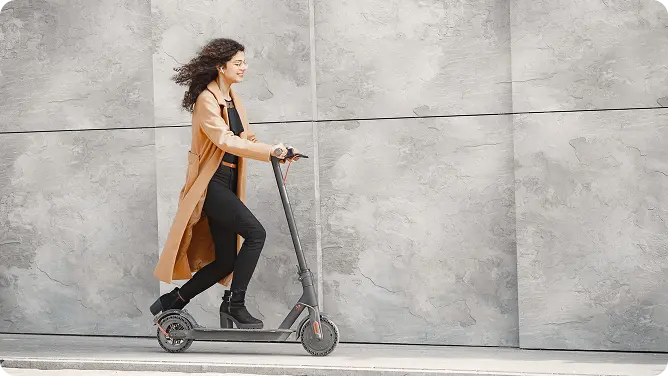
Four categories cover most of what operators actually deploy today. Shared e-bikes and e-scooters fill short urban trips where a car is overkill and a walk takes too long. Golf carts and other low-speed vehicles serve resorts, beach towns and residential communities where streets are narrow and speeds stay under 25 miles an hour. Campus shuttles and micro-fleets move students and staff across distances a shuttle bus runs too infrequently to cover. Autonomous delivery robots and cargo bikes handle the freight side, closing the gap between a depot and a front door without a driver in the loop.
What ties them together is not the vehicle type. It is the software layer underneath: the booking, billing, locking and rebalancing logic that turns a pile of individual vehicles into one dispatchable fleet. A city or a homeowners association rarely owns that logic in-house, which is why a dedicated fleet management platform exists to give a smaller operator the same controls a major city program runs on.
How Urban Mobility Solutions Are Transforming Last-Mile Delivery
Most coverage of “last mile” still treats delivery and passenger movement as separate industries. That split is breaking down. Cargo e-bikes and compact EVs are absorbing delivery volume that vans used to carry into dense downtown cores, cutting both curb time and emissions per parcel. At the same time, the same locking, routing and telematics stack that tracks a passenger scooter now tracks a delivery pod on the same streets.
The practical effect is that an operator building a shared mobility business is rarely choosing between serving riders or serving packages. A fleet management platform that handles vehicle health, route efficiency and billing works for both and a growing number of operators run mixed fleets that shift capacity between passenger and freight use depending on the time of day. EazyRide’s overview of micromobility use cases for cities and campuses breaks down which vehicle types fit which demand pattern.
What’s Happening Across Urban Centers Globally
The scale of this shift shows up clearest in North America’s own numbers. NABSA’s latest State of the Industry report counted shared micromobility systems in at least 403 cities across North America in 2025, running roughly 350,000 vehicles (NABSA 2025 State of the Industry Report). 70% of riders report using shared micromobility specifically to connect to transit, not as a standalone trip, which confirms that most of this ridership is solving a first-and-last-mile gap rather than replacing a full commute.
Growth has not been limited to flagship cities. Mid-sized metros and university towns now account for a growing share of new system launches, largely because the software and vehicle costs that once limited micromobility to well-funded transit authorities have dropped enough for a smaller city, a campus or a single company to run its own program. That shift in who can afford to launch a system is arguably the bigger story than the trip counts themselves.
The Numbers Behind the Transformation
Ridership data backs up the trend line. North American shared micromobility trips rose about 5% to at least 237 million in 2025, the third record-setting year in a row, despite inflation and fare pressure across transit broadly (NABSA data reported by GovTech). Notably that growth came while the number of host cities slipped from 415 to 403, so existing systems carried more trips rather than new markets adding them.
Market forecasts vary by a wide margin depending on what gets counted as “micromobility,” but the direction is consistent: Grand View Research puts the global micro-mobility market at $46.3 billion in 2025, rising to $52.9 billion in 2026 and $126.5 billion by 2033 at a 13.3% CAGR, while other publishers land well above and below that. The spread comes from definition rather than from disagreement about direction: some analysts fold ride-hailing or privately owned vehicles into the same number and others count shared fleets on their own.
Strategic Imperatives Reshaping Urban Mobility Solutions
Three priorities now separate a program that scales from one that stalls after launch. The first is electrification. Combustion carts and gas-powered support vehicles are becoming a liability as cities tighten emissions rules and the vehicles themselves cost more to run per mile once fuel and maintenance are counted against a fleet’s utilization. The second is transit integration. A program that connects cleanly to a rail stop or a bus line captures far more repeat ridership than one that competes with transit for the same short trips. The third is treating the fleet as one product rather than many vehicles, which is the thinking behind a true mobility-as-a-service approach. EazyRide’s comparison of mobility-as-a-service companies lays out what separates a MaaS platform from a simple rental app.
None of these imperatives are optional for long. A fleet that skips electrification or transit integration today is rebuilding its operating model later, under pressure, instead of planning for it now.
Growth Challenges Confronting Operators
The obstacles are operational before they are financial. Rebalancing vehicles across a service area by hand does not scale past a few dozen units and most new operators underestimate how much labor that eats until volume climbs. Regulatory fragmentation is a second drag: a company running fleets across several cities or campuses often faces a different permit, insurance and data-sharing requirement in each one, with no common standard across them. Theft, vandalism and battery degradation round out the list, costs that rarely show up in a launch budget but compound every month a fleet runs without health monitoring in place.
Growth Drivers Propelling Transformation Forward
Three forces are pushing the opposite direction, hard enough to outweigh those challenges for most operators. Municipal sustainability mandates are pushing cities to replace single-occupancy car trips with lower-impact alternatives and shared electric fleets are usually the fastest option to stand up. Corporate and campus demand is rising independently of any city program, as employers and universities look for a way to move people across a property without adding parking. And delivery economics are pulling freight operators toward the same vehicle types passenger fleets already use, since a cargo e-bike or a compact EV clears the same curb-space and emissions hurdles a delivery van cannot. EazyRide’s look at the environmental case for sustainable transportation covers the impact side of that argument in more depth.
Top Three Growth Opportunities Driving the Transformation
The clearest openings right now sit at the intersection of a defined, bounded area and a defined rider group, not in open-city competition with an established operator. Campus and corporate micro-fleets are the first: a university or an employer with a few hundred acres and a predictable population is an easier launch than an open city and EazyRide’s campus mobility software is built around exactly that density and schedule pattern. Smart city partnerships are the second, where a municipality contracts a single operator to run multimodal first-and-last-mile service around transit stops, a model EazyRide supports through its smart city mobility software. Resort, beach-town and golf-cart-based community mobility is the third, an underserved niche where EazyRide’s golf cart and LSV fleet software gives a smaller operator the same tracking and billing tools a citywide scooter program runs on, scaled to a few dozen vehicles instead of a few thousand.
Best Practices for Industry Leadership
Operators who stay ahead treat three things as non-negotiable. Vehicle health has to be monitored remotely, not discovered when a rider calls in a dead battery, which is where telematics for a smaller micromobility fleet earns back its cost quickly; EazyRide’s guide to telematics for SME micro-mobility operators covers what that tracking should include at a smaller fleet’s budget. Pricing has to flex by zone, time of day and vehicle type instead of running one flat rate across a whole service area. And every new market has to be tested with a vehicle count small enough to fail cheaply before it scales, since the operators that lose money early are almost always the ones that launched with more vehicles than they had rebalancing capacity to support.
Frequently Asked Questions
What is the difference between last-mile delivery and last-mile mobility?
Last-mile delivery refers to moving a package the final distance to a doorstep, while last-mile mobility refers to moving a person the final distance from a transit stop, campus gate or workplace to their actual destination. Both increasingly run on the same shared fleets and fleet management software.
Which vehicles are used for last-mile mobility solutions?
Shared e-bikes, e-scooters, golf carts and other low-speed vehicles cover passenger trips, while cargo e-bikes, compact EVs and autonomous delivery robots cover the freight side. The choice depends on trip distance, area density and whether a driver is involved.
Why do cities and campuses need a dedicated last-mile mobility program instead of relying on transit alone?
Transit systems are built for longer, higher-volume routes and rarely reach every final destination. About 70 percent of shared micromobility riders use these services specifically to connect to transit, which shows the gap is in the first and last mile, not the main route.
How do operators keep last-mile mobility costs under control at scale?
Remote vehicle health monitoring, zone-based pricing and software-driven rebalancing are the three levers that keep cost per trip down as a fleet grows past a few dozen vehicles, since manual tracking and flat pricing both break down well before a fleet reaches that size.
The Takeaway
Last-mile mobility solutions are no longer a niche add-on to transit or a side problem for logistics companies to solve alone. They are the fastest-growing layer of urban transportation and the operators winning in this space are the ones treating vehicles, software and pricing as one system instead of three separate purchases. Whether the goal is a campus shuttle network, a smart city partnership or a resort’s golf cart fleet, the path to scale runs through the same operational question: can every vehicle be tracked, billed and rebalanced without a person doing it by hand. See EazyRide’s pricing and plans to find the right starting point for a fleet of any size.


