
 AllSharing business

 12 January, 2026
 ScootAPI vs EazyRide for E-Scooter Sharing: What Operators Should Know?
The e-scooter software market looks deceptively simple until you start evaluating actual platforms. Some vendors promise rapid deployment but deliver generic apps that hurt your brand perception. Others tout endless customization but require months of engineering work before your first vehicle hits the street. Meanwhile, your competitors are already operating, your permits have expiration dates, and every week of delay represents lost revenue you’ll never recover.
The U.S. micromobility market reached $5.2 billion in 2024, with shared e-scooters being the revenue-generating vehicle type. As municipalities expand permitting and corporate campuses invest in employee mobility, choosing the right software platform has become a make-or-break decision. This guide breaks down what matters when evaluating e-scooter sharing apps, compares leading options, such as ScootAPI and EazyRide, and reveals the operational pitfalls that derail launches.
Key Insights
- Most e-scooter software platforms either prioritize fast setup at the expense of customization or require extensive technical work, slowing market entry.
- Demand for shared micromobility continues to grow, increasing pressure on operators to launch quickly and scale without platform changes.
- The most important evaluation criteria include white-label capability, deployment speed, day-to-day operational tools, pricing flexibility, and support for multi-vehicle fleets.
- A comparison of ScootAPI vs EazyRide for e-scooter sharing highlights clear differences in deployment speed, operator control, and long-term scalability.
- Platforms that combine rapid deployment with strong fleet management and real-time insights are better suited for operators planning sustained growth.
Why E-Scooter Software Selection Determines Operational Success?
You’re not just choosing an app. You’re selecting the infrastructure that governs fleet utilization, rider experience, maintenance workflows, and revenue capture.
The right software platform addresses three critical business layers:
- Rider Acquisition and Experience: Your branded app must feel native, load quickly, and handle payments seamlessly. Generic white-label apps with visible watermarks or clunky UX hurt conversion rates and increase support tickets.
- Fleet Operations: Your team needs real-time visibility into vehicle status, battery levels, and maintenance needs. Without automated alerts and location tracking, you’re managing by spreadsheet, which doesn’t scale past 50 vehicles.
- Business Intelligence: You must track utilization patterns, peak demand zones, and revenue per vehicle to make informed decisions about rebalancing, expansion, and pricing adjustments.
Most platforms excel at one layer but compromise on the others. That’s where operators get stuck.
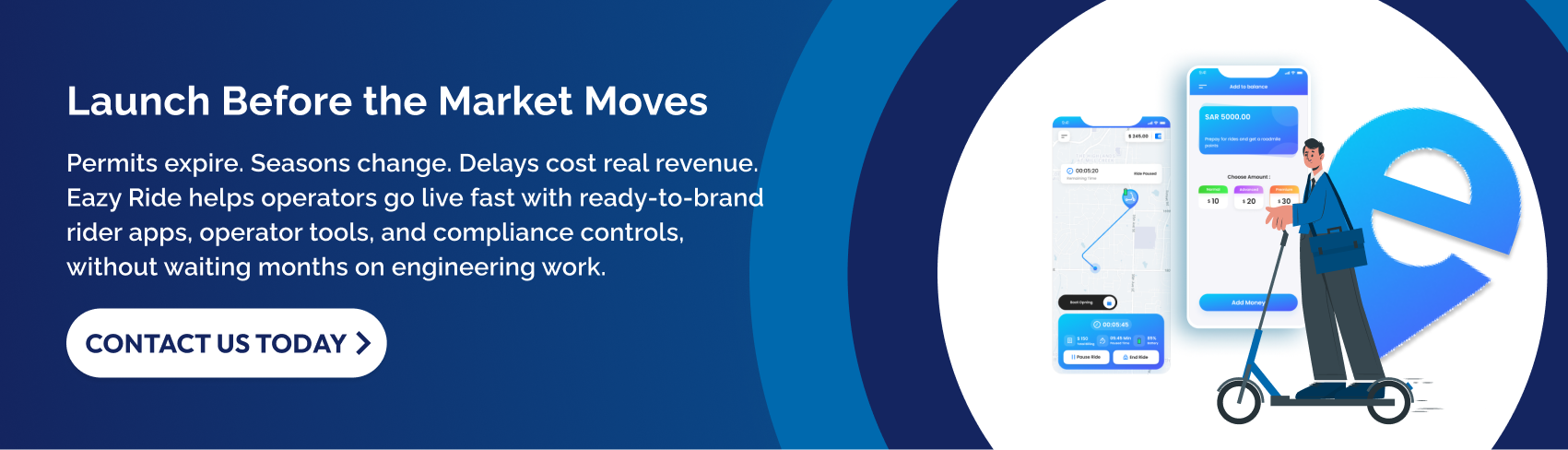
Book a demo to see how EazyRide handles all three layers, rider experience, fleet operations, and business intelligence, from a unified platform designed for rapid deployment.
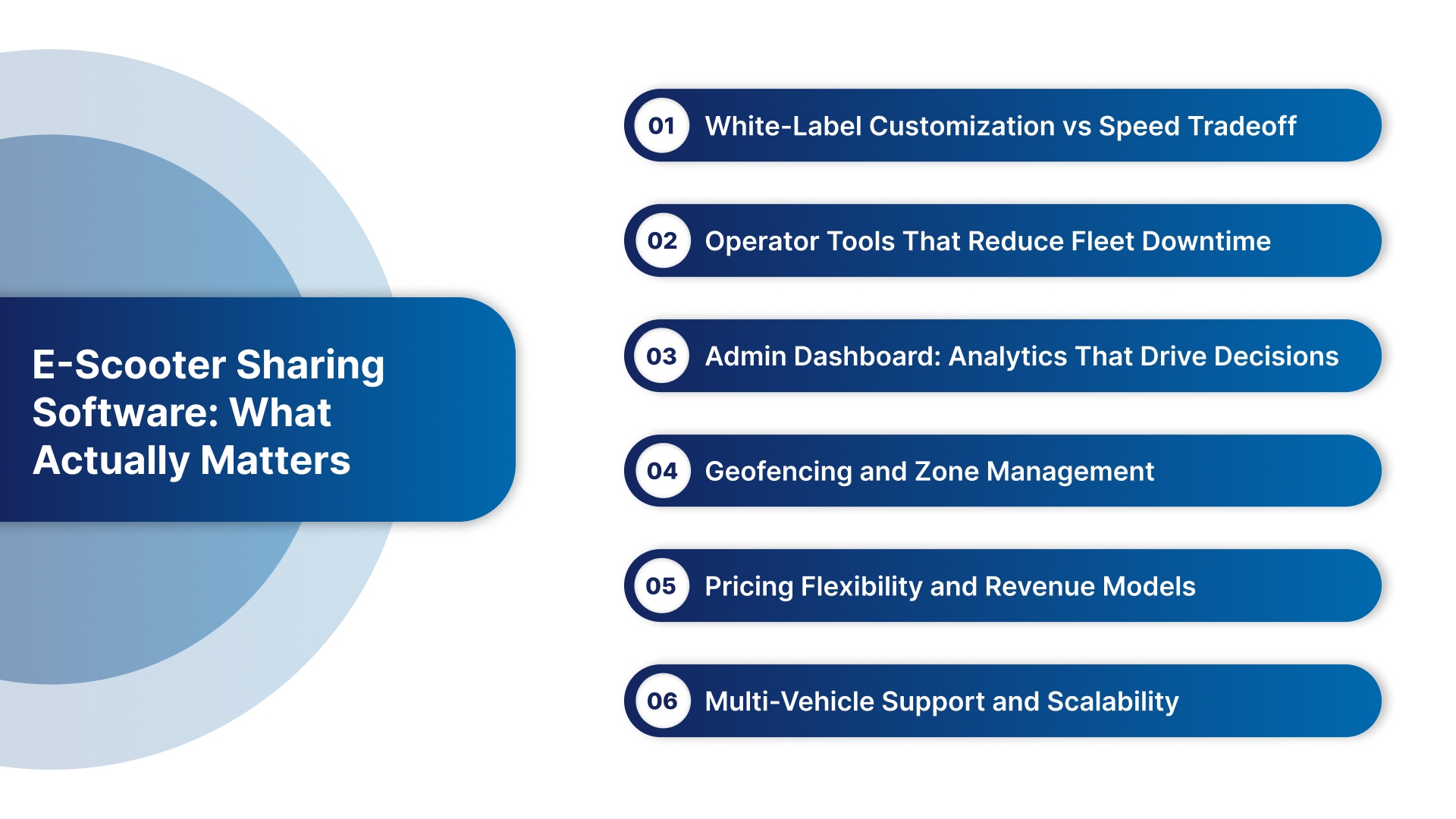
Comparing E-Scooter Sharing Software: What Actually Matters
When evaluating platforms, focus on these operational realities rather than marketing claims. The following factors separate deployment-ready solutions from those that will consume months of your team’s time and budget.
1. White-Label Customization vs Speed Tradeoff
The Challenge: You need your brand identity front and center, but you also need to launch quickly to capture seasonal demand or meet permit deadlines.
What to Look For:
- Pre-built iOS and Android apps that accept your branding (logo, colors, name) without custom development.
- App store submission handled by the platform, or clear documentation for your team.
- Estimated timeline from contract signature to app store availability.
- Whether “white-label” means truly brandless or includes vendor watermarks in user flows.
How Platforms Compare:
When comparing ScootAPI vs EazyRide for e-scooter sharing on customization and speed:
- ScootAPI: Offers API-first architecture, giving technical teams maximum flexibility. However, this typically requires 6-12 weeks of integration work and assumes you have iOS/Android developers on staff or budget. Best suited for operators with engineering resources.
- EazyRide: Provides pre-built white-label rider apps that accept branding configuration without code changes. Typical deployment timeline is 2 weeks from contract to app store submission. Designed for operators prioritizing speed over deep technical customization.
2. Operator Tools That Reduce Fleet Downtime
The Challenge: E-scooters require constant attention, charging, maintenance, and rebalancing. Without proper tools, your operations team burns hours on inefficient routes and misses critical issues.
What to Look For:
- Dedicated operator/fleet app separate from rider app with task management
- Real-time vehicle status: battery %, location, fault codes
- Task automation: the system generates charging/maintenance tasks based on thresholds you set
- Route optimization: suggests efficient pickup routes for rebalancing
- Maintenance logging: tracks repair history per vehicle for warranty and replacement decisions
Many platforms include a basic admin dashboard but lack purpose-built operator tools. This forces field teams to work in laptop dashboards rather than mobile-optimized task interfaces.
3. Admin Dashboard: Analytics That Drive Decisions
The Challenge: You need to identify which zones generate revenue, which vehicles underperform quickly, and when demand peaks shift. Platforms that only show aggregate totals leave you guessing.
What to Look For:
- Heatmaps: visual overlay showing ride start/end density by zone
- Vehicle-level metrics: rides per day, revenue per vehicle, downtime percentage
- Time-series data: hourly/daily demand patterns to inform rebalancing
- User cohort analysis: new vs returning rider behavior, churn indicators
- Exportable data: CSV downloads for custom analysis or board reporting
The difference between “we have analytics” and actionable analytics is specificity. Can you identify that Vehicle #47 has completed only 3 rides in 10 days because it has been consistently parked in a low-demand zone? If not, your dashboard isn’t granular enough.
EazyRide’s admin dashboard provides real-time analytics with heatmaps and vehicle-level performance tracking, enabling operators to make data-driven rebalancing decisions within hours, not weeks.
4. Geofencing and Zone Management
The Challenge: City permits typically restrict where vehicles can be parked, ridden, or stationed. Without robust geofencing, you risk permit violations, fines, and angry city officials.
What to Look For:
- Flexible zone types: no-park zones, slow zones, operational boundaries, preferred parking areas
- Enforcement mechanisms: app prevents rides from starting/ending in restricted zones or charges penalty fees
- Dynamic updates: you can modify zones in real-time without app updates
- Visual zone editor: map-based interface for drawing boundaries, not just coordinate entry
5. Pricing Flexibility and Revenue Models
The Challenge: Test different pricing structures, including unlock fees, per-minute rates, daily passes, and memberships, and adjust them based on utilization data.
What to Look For:
- Multiple pricing models: time-based, distance-based, subscription, promotional codes
- Dynamic pricing capability: surge pricing during peak demand (if permitted)
- Pass and membership options: daily, weekly, monthly, unlimited plans
- Promotional tools: referral credits, first-ride discounts, corporate partnerships
- Revenue reporting: clear breakdown of income by pricing tier
Rigid pricing structures limit your ability to respond to competition or maximize revenue. If a corporate campus wants a custom annual membership for 200 employees, can your platform support that? If not, you’re leaving revenue on the table.
6. Multi-Vehicle Support and Scalability
The Challenge: Many operators start with a single vehicle type and plan to expand later. If your platform cannot support multiple vehicle types natively, adding new vehicles often entails additional costs, engineering effort, and operational disruption.
What to Look For:
- Vehicle flexibility: Support for multiple vehicle types within the same platform, without needing separate systems or rebuilds
- Unified fleet management: A single dashboard to monitor and manage all vehicle types together
- Vehicle-specific controls: Different pricing, zones, and speed rules based on vehicle type
- Support for multiple operating models: Ability to handle both dockless and station-based operations as your strategy evolves
ScootAPI vs EazyRide: multi-vehicle capability
- ScootAPI: Offers strong API flexibility that allows custom vehicle configurations. However, each new vehicle type typically requires additional engineering effort and setup work.
- EazyRide: Designed for multi-vehicle operations from the start, with native support for different vehicle types under a single system. Operators can add and manage new vehicle types without reworking the platform.
Also read: The Ultimate Guide to E-Scooter App Development
Pitfalls That Derail E-Scooter Operations
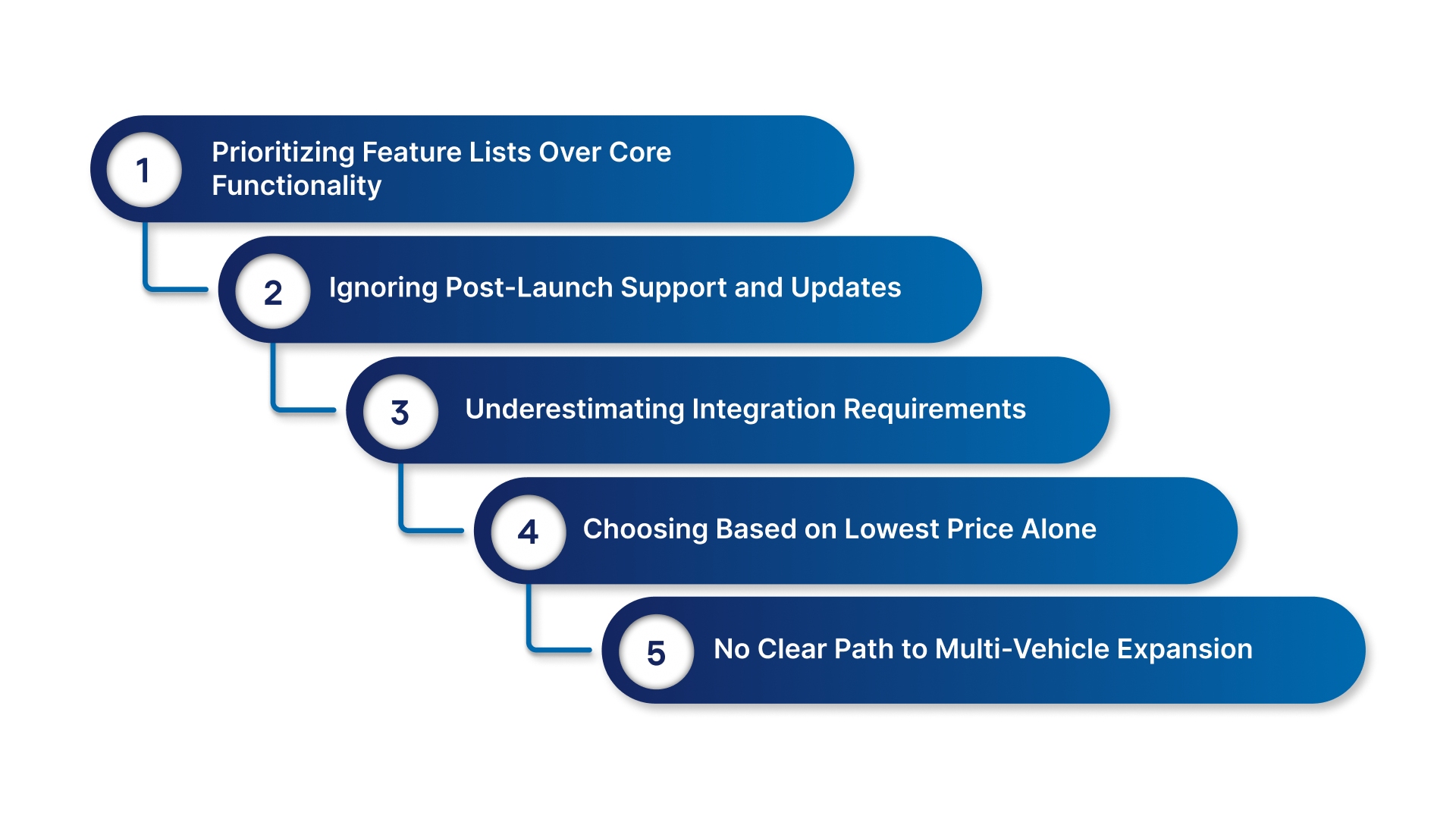
The difference between a smooth launch and ongoing operational friction often comes down to platform selection. Small assumptions made during evaluation can turn into major blockers post-launch. The following pitfalls show where operators commonly misstep.
Pitfall 1: Prioritizing Feature Lists Over Core Functionality
What Happens: You choose a platform for its advanced AI routing or blockchain integration, but it lacks basic geofencing or operator task management. Your team can’t enforce city permit requirements.
How to Avoid: Focus on operational fundamentals first. Advanced features mean nothing if you can’t deploy on time or manage daily operations effectively.
Pitfall 2: Ignoring Post-Launch Support and Updates
What Happens: The platform demos well, but the vendor provides minimal support after go-live. When iOS releases an update that breaks your app, resolution takes weeks.
How to Avoid: Ask about support SLAs, response times, and how platform updates are handled, and request references from current customers about their support experience.
Pitfall 3: Underestimating Integration Requirements
What Happens: The vendor claims “easy integration,” but your team discovers you need custom API development, payment gateway setup, and complex server configuration.
How to Avoid: Get specific about what “turnkey” or “white-label” actually means. Request a detailed implementation checklist showing your team’s responsibilities versus the vendor’s.
Pitfall 4: Choosing Based on Lowest Price Alone
What Happens: You select the cheapest platform only to discover hidden fees for app store submissions, additional user seats, or data storage. Total cost of ownership is 2-3x the quoted price.
How to Avoid: Request complete pricing, including all fees, limits, and potential overages. Calculate the 12-month total cost based on your projected fleet size and usage.
Pitfall 5: No Clear Path to Multi-Vehicle Expansion
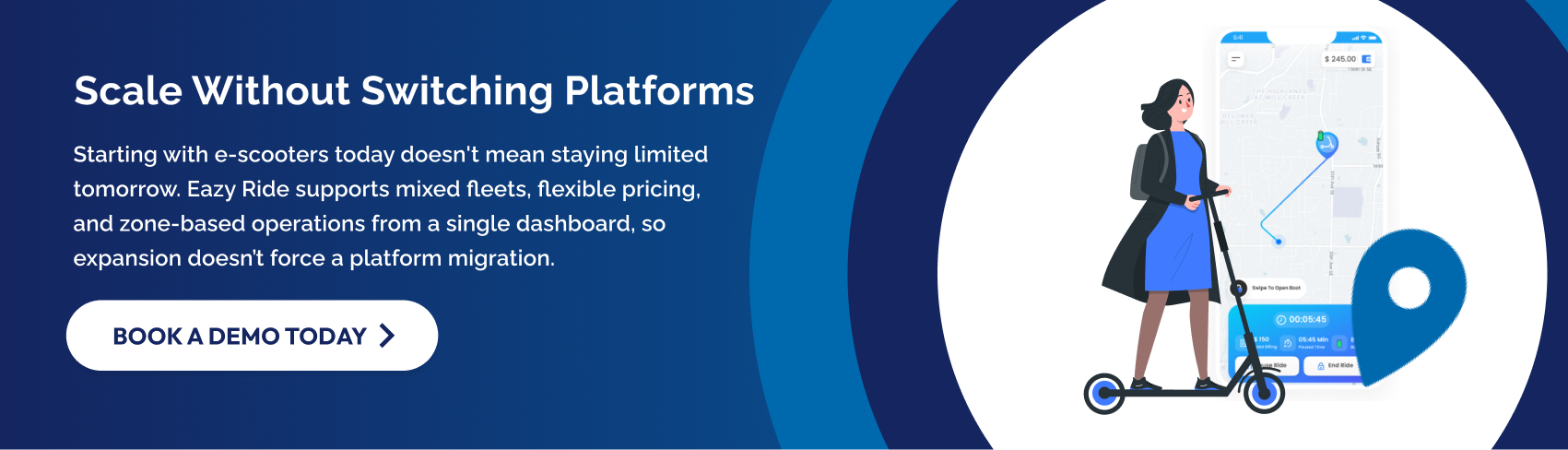
What Happens: You launch e-scooters successfully, but when you want to add e-bikes, you discover the platform doesn’t support mixed fleets. You face choosing between limiting your business and migrating to a new platform mid-operation.
How to Avoid: Even if you’re starting with a single vehicle type, confirm that the platform supports your 18-month roadmap. Ask to see examples of operators running mixed fleets.
Also Read: Scooter Sharing System Design Guide 2026: Launch & Scale
How EazyRide Addresses Core Operational Challenges?
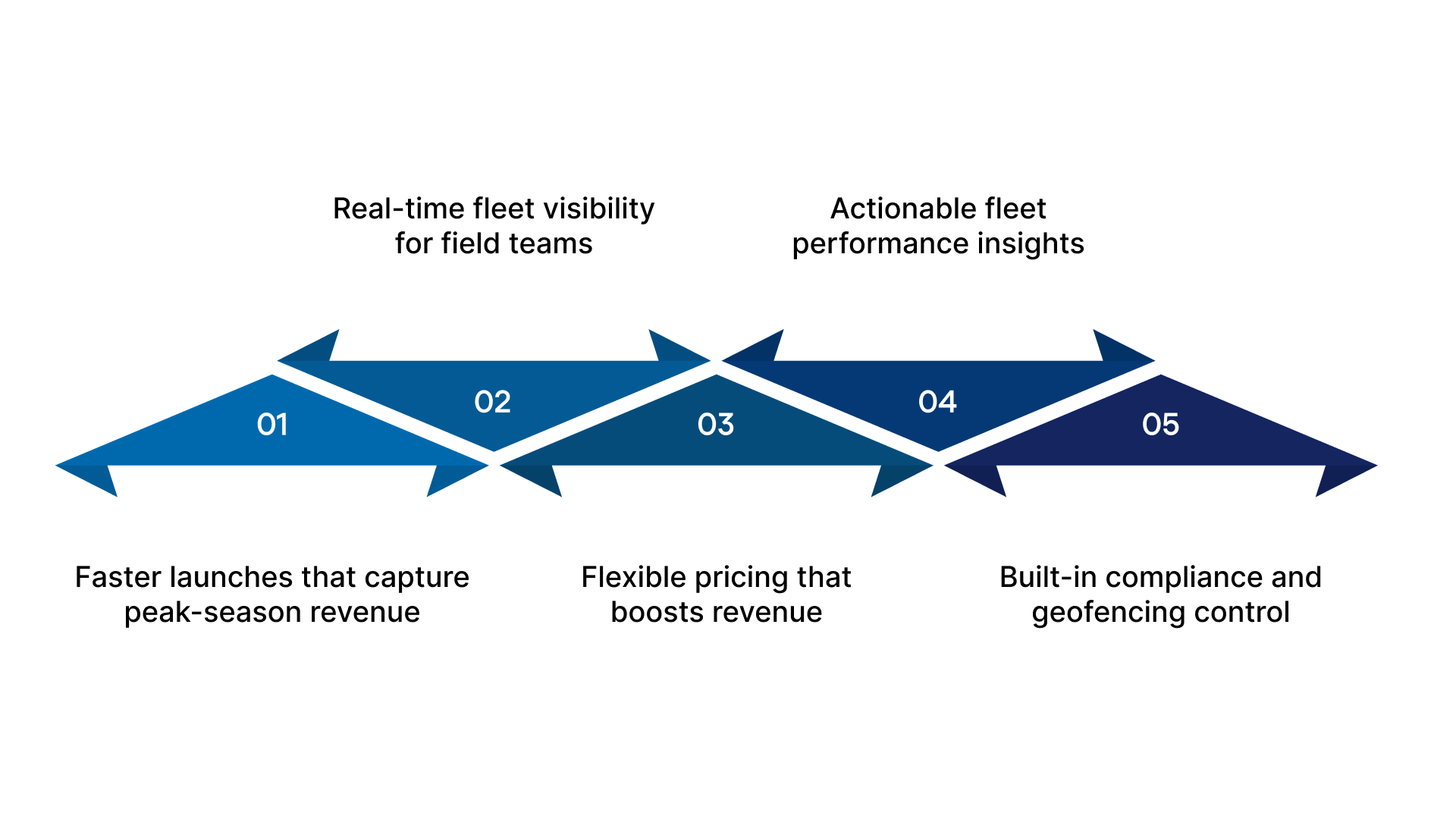
Running a shared mobility operation comes with daily operational trade-offs. Speed, visibility, pricing control, and compliance directly impact profitability. EazyRide is designed to address these pressure points without adding operational complexity.
Faster launches that capture peak-season demand
- Pre-built white-label rider apps for iOS and Android
- App store setup and deployment handled end-to-end
- Operators can go live quickly without long development cycles
- Teams start generating revenue soon after launch
Real-time fleet visibility for field teams
- Dedicated operator app with live vehicle status
- Automated charging and maintenance task lists
- Fewer manual checks and less wasted driving time
- More efficient daily fleet operations
Flexible pricing that drives higher revenue
- Multiple pricing models managed from one dashboard
- Instant updates for promotions and memberships
- Easy experimentation without engineering support
- Faster optimisation of pricing strategies
Actionable fleet performance insights
- Real-time analytics by zone and vehicle
- Clear visibility into high- and low-performing areas
- Smarter rebalancing and deployment decisions
- Improved vehicle utilisation across the fleet
Built-in compliance and geofencing control
- Custom no-park and restricted zones
- Real-time enforcement within the rider app
- Ride completion is blocked in prohibited areas
- Strong adherence to city and campus regulations
Conclusion
Choosing e-scooter sharing software determines whether you launch on time, manage operations efficiently, or spend months fighting with inadequate tools. The evaluation criteria are straightforward: deployment speed, white-label quality, operator tools, analytics depth, geofencing capability, pricing flexibility, and scalability. Most platforms compromise on at least two of these factors, forcing you to choose between speed and functionality or between branding and affordability.
When comparing ScootAPI vs EazyRide for e-scooter sharing or evaluating BloomSharing vs EazyRide e-scooter software, focus on your operational priorities. Do you have engineering resources and need maximum technical flexibility? Or do you need to launch quickly with proven tools that handle fleet operations from day one? The market has matured enough that you shouldn’t accept compromise on core requirements.
EazyRide enables operators to launch branded micromobility services in approximately two weeks with white-label apps, comprehensive fleet management tools, and real-time analytics, without requiring in-house development teams.
Book a demo to evaluate whether EazyRide’s platform aligns with your launch timeline and operational requirements.
Frequently Asked Questions
1. What’s the realistic timeline to launch an e-scooter sharing service?
With a deployment-ready platform like EazyRide, operators can go from contract signature to live operations in approximately 2 weeks. This includes white-label app configuration, admin dashboard setup, fleet operator app training, and initial vehicle deployment.
2. How many e-scooters do I need to launch a viable operation?
Urban operations typically start with 50-150 vehicles to achieve meaningful coverage and test demand patterns. Campus or corporate deployments can succeed with 25-50 vehicles, given the concentrated geography. Start smaller and expand based on utilization data rather than over-deploying initially.
3. Can one platform support both e-scooters and e-bikes?
Yes, multi-vehicle platforms like EazyRide allow operators to manage e-scooters, e-bikes, and mopeds from a single admin dashboard with vehicle-specific pricing and operational rules. This is critical for operators planning to expand beyond one vehicle type.
4. How do I prevent permit violations and geofencing issues?
Choose a platform with robust geofencing tools that allow you to define multiple zone types (no-park, slow, operational boundaries). The rider app should enforce these rules by preventing ride completion in restricted areas or applying penalty fees, with zones updating in real-time.
5. What’s the difference between white-label and fully branded apps?
True white-label apps display only your branding throughout the entire rider experience with no vendor watermarks, co-branding, or references to the platform provider. Some vendors use “white-label” to describe apps that include your logo but still show the vendor’s name in settings or support flows.


