
 AllAnalytics and research

 14 August, 2025
 Scooter Rental Business Insurance: A Practical Guide for Operators in 2025
In a scooter rental business, one bad incident can cost more than an entire season’s revenue. A rider slips on a wet sidewalk. A tourist crashes into property on your resort. A student uses a scooter without proper verification. And suddenly you’re dealing with an injury claim, a damaged vehicle, and a liability question you weren’t prepared for.
For many operators, this is the moment they first search for scooter rental business insurance. If you’re launching a fleet, expanding to a new city, or placing scooters on private properties, a question becomes even more urgent: “What insurance do I actually need to protect my business and stay compliant?”
The right coverage protects you from lawsuits, property damage claims, medical bills, and regulatory fines. The wrong coverage, or not enough of it, can stall your entire operation overnight.
This guide breaks down everything operators need to know: the types of coverage required, where rental fleets face the most liability, how insurance integrates with modern tools, and how smarter operations can lower premiums over time.
Key Takeaways:
- Insurance is critical for scooter rental businesses: It protects against accidents, theft, property damage, and liability, ensuring long-term sustainability and compliance.
- The right coverage lowers premiums: Well-managed fleets with geofencing, maintenance logs, and incident tracking show insurers that you’re proactive, which can reduce insurance costs.
- Product liability and general liability are essential: These cover injuries caused by malfunctioning scooters and accidents involving pedestrians, vehicles, or property damage.
- Technology helps reduce risk and insurance costs: Tools like real-time fleet management, analytics, and geofencing can prevent incidents and make your fleet more insurable.
- Scalability requires proper risk management: As your fleet grows, so does your liability. Proactive safety measures and smart risk management can help keep your business profitable and insurance premiums under control.
Why Scooter Rental Business Insurance Matters More in 2025
Scooter rental fleets are expanding across U.S. cities, campuses, resorts, and residential communities, and with that growth comes a sharp rise in liability risk. Claims are increasing, regulations are tightening, and property owners are demanding stronger proof of coverage before allowing scooters on-site.
However, insurance only pays off when you know what you’re protecting against. In 2024, U.S. emergency-room-treated e-scooter injuries spiked by ~ 80% compared with the previous year, from ~64,300 in 2023 to roughly 115,700 in 2024.
So, as much as growth is good, liability scales with the fleet. Insurance protects your business, your riders, and your operating rights.
The Biggest Liability Risks for Scooter Rental Operators
Accident claims have increased as fleets grow. Shared e-scooter riders are estimated to suffer injuries at a rate of 7.8 per 100,000 trips, compared with 2.2 per 100,000 trips for cyclists. This makes scooter trips ~3.6× more likely to lead to emergency care.
More riders means more exposure, and even a single injury claim can run into thousands in medical bills and legal fees. These arguments make insurance not just wise, but essential.
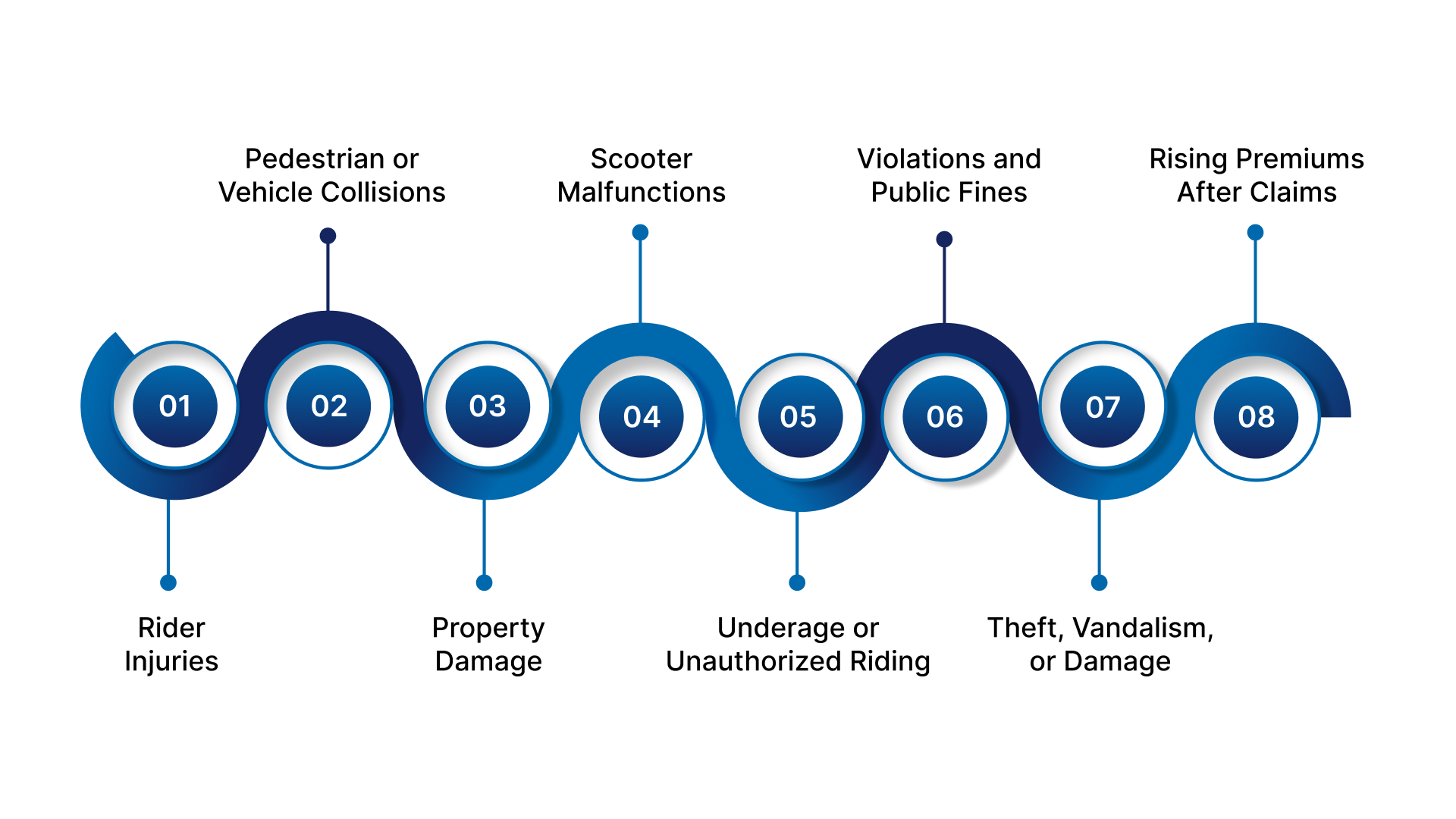
Here are some key liability risks most likely to hit an operator:
1. Rider Injuries
Because e-scooters are ~3.6 times more likely to cause emergency-room injury than bikes, every fleet operator must assume that falls or malfunctions will happen. General liability insurance becomes critical when riders slip, crash, or are injured on a faulty scooter.
2. Pedestrian or Vehicle Collisions
Shared urban use means scooters operate in mixed traffic. Given the high injury incidence, collisions with pedestrians or motor vehicles (or parked cars) often trigger claims – mainly when head trauma or impact injuries occur.
3. Property Damage
Head injuries and frequent accidents among e-scooter users lead to a credible risk of property damage – broken railings, landscaping, parked cars, building fixtures – triggering liability for operators, especially on private lands.
4. Scooter Malfunctions
Mechanical failures contribute to many serious injuries. An abrupt battery cut-out, fault braking, or faulty build can result in serious accidents. This makes operational liability insurance important, beyond just general liability.
5. Underage or Unauthorized Riding
A significant portion of injured scooter riders are younger or ride without helmets – many not following safety norms. Operators who allow unverified or underage riders invite severe liability, especially if a claim arises.
6. Violations and Public Fines
With widespread rental fleets, many incidents occur when scooters obstruct sidewalks, ADA ramps, or public paths. It generates complaints, fines, or property-liability claims. Combined with high injury rates, these legal exposures are frequent and unpredictable.
7. Theft, Vandalism, or Damage
Higher utilization and frequent redistributions increase the risk of theft or vandalism. Even if injuries or collisions are avoided, replacement costs, downtime, and operational disruption can spiral, increasing indirect liability and forcing expensive out-of-pocket fixes.
8. Rising Premiums After Claims
Because injuries and hospitalizations for scooters are rising fast, nearly tripling over five years, insurers now view scooter fleets as high-risk clients. A few small claims can sharply raise premiums or even trigger coverage denial, which threatens fleet sustainability in the long term.
Types of Insurance Every Scooter Rental Business Needs
Insurance can feel confusing and expensive until you understand what you’re actually protecting yourself from. Most scooter-related claims come from a small set of predictable incident types, and each requires a different kind of coverage.
Below is a breakdown of the insurance policies that matter most.
1. General Liability Insurance
What does it cover?
Injuries to others or damage caused by your scooters. This includes pedestrians, cars, storefronts, and property on campuses or resorts. This is the one policy that protects you when someone gets hurt around your scooter, not necessarily because of a malfunction.
For instance, a rider bumps into a pedestrian outside a hotel entrance. The pedestrian‘s ER visit becomes your liability. General liability covers it.
2. Product Liability Insurance
What does it cover?
Any injury caused by mechanical defects like brake failures, loose handlebars, sudden battery cutoffs, electrical faults, or structural issues. If a scooter cuts power mid-ride and the rider crashes, even if the manufacturer is at fault, you, the operator, will be included in the claim.
For instance, a battery drops from 40% to zero due to a malfunction. Rider falls, and product liability steps in.
3. Commercial Auto Liability
What does it cover?
Any accident involving a motor-driven rental vehicle, such as mopeds, seated scooters, and Class-3 e-bikes. Cities often require commercial auto insurance documentation before approving moped rental permits.
For example, a renter crashes a moped into a parked car. You’re covered only if you have commercial auto liability.
4. Property & Equipment Insurance
What does it cover?
Stolen scooters, vandalized units, damaged charging stations, or weather-related loss. Even with GPS, scooters get thrown in rivers, damaged during events, or stripped for parts. Without equipment insurance, replacing 10–20 vehicles can wipe out your month’s profit.
So, if you have a weekend festival and it ends with multiple scooters vandalized, property coverage absorbs the cost.
5. Workers’ Compensation
What does it cover?
Injuries sustained by your staff during charging, rebalancing, repairs, battery swaps, transporting scooters, and other tasks. Staff regularly do these things and work late hours, increasing strain and injury risk. U.S. regulations require workers’ comp if you have employees.
So, if a technician strains their back lifting a scooter into a van, workers’ comp covers medical care.
6. Cyber & Data Liability
What does it cover?
Breaches involving rider IDs, payment info, GPS routes, or personal data. Fleet platforms store thousands of rider accounts. A breach can cost tens of thousands in legal notifications, credit monitoring, and penalties.
With the rise in API integrations (insurance APIs, telematics, etc.), cyber risk is growing, mainly because scooters track location, payments, and identity. For example, your system has been compromised, exposing rider payment information. Cyber insurance covers legal and recovery costs.
7. Umbrella Liability
What does it cover?
Claims that exceed your primary insurance limits. Tourist-heavy areas, campuses, and downtown zones see the highest accident rates. When a severe injury occurs, such as fractures, vehicle collisions, or head trauma, total claims can surpass general liability limits.
So, if a severe rider injury results in a claim that exceeds your GL limit, umbrella liability closes the gap.
Also Read: Understanding Insurance for Electric Scooters
Now, understanding what’s covered is just the first step. But how much will it all cost? Let’s take a look at the pricing structure for scooter rental insurance and what factors determine your premium.
How Much Does Scooter Rental Business Insurance Cost?
Insurance is an expense, but also protection. For a scooter rental business, how much you pay depends heavily on fleet size, vehicle types, operational risk, and coverage limits.
For many small scooter rental companies in the U.S., a basic liability policy with about USD 1 million coverage costs roughly USD 52 per month (~USD 624 per year). Typical general liability premiums for small businesses can range from USD 42 to USD 85 per month, depending on business type and risk exposure.
So, put simply, for a modest fleet, inclusive liability insurance doesn’t necessarily break the bank. But what drives insurance costs higher (or lower)?
It’s a mix of factors:
| Cost Factor | Impact on Premium |
|---|---|
| Fleet size & vehicle count | More scooters = higher risk pool → higher premium |
| Vehicle type (e-scooter, moped, e-bike) | Mopeds / motorized vehicles are higher-risk → higher cost |
| Location/operation area | Dense cities, tourist zones, campuses = more claims history → higher premium |
| Coverage limits (per-incident / aggregate) | Higher limits = more expensive policy |
| Claims history & fleet safety record | Frequent past claims = higher premium or denial |
| Additional coverage add-ons (theft, equipment, workers’ compensation) | Adds to the base premium depending on coverage extent |
Use insurance cost not as a fixed overhead, but as part of a risk management strategy. The right coverage enables expansion into new zones, helps secure city/permit compliance, and protects against high-cost claims.
How to Reduce Liability and Lower Insurance Costs?
Insurers don’t just look at your coverage. They look at how predictable and well-controlled your fleet is. If your operation shows discipline, your premiums drop. If it doesn’t, you pay more.
Here are the operational moves that actually influence what you pay and why they matter.
1. Set Clear Riding and Parking Zones
Scooters placed in the wrong areas lead to pedestrian collisions, ADA complaints, and property damage. Using precise geofencing for ride areas, parking zones, and restricted regions demonstrates to insurers that your fleet is structured, not left to chance.
- Why it matters: City records show that many claims stem from sidewalk interactions and improper parking, not high-speed crashes. Zoning reduces both.
2. Maintain a Verified Rider Base
A surprising share of severe scooter injuries involve inexperienced or underage riders using someone else’s account. Requiring ID verification or age checks immediately reduces the likelihood of high-severity claims.
- Why it matters: Claims involving minors are among the most expensive because long-term injury risk is higher.
3. Keep a Clean Maintenance Trail
Mechanical issues like loose bolts, soft brakes, and unstable stems are frequent contributors to hospital-treated injuries. Your best defense is a consistent maintenance log: inspections, battery checks, part replacements, and repair timestamps.
- Why it matters: In many claim disputes, maintenance logs are the deciding factor between an operator paying out of pocket or being fully protected.
4. Charge With Intention
A scooter powering down mid-ride is more than an inconvenience; it often leads to falls or collisions. Use battery thresholds, charging schedules, and no-ride rules for low-battery vehicles to prevent shutdown incidents.
- Why it matters: Low-battery falls are among the most common operator-preventable accidents.
5. Use Data to Position Scooters in Safer Zones
Your fleet data already tells you where the risks are: sharp turns, uneven surfaces, crowded walkways, and places where riders consistently brake hard. Deploying scooters away from high-incident micro-zones reduces both claims and equipment wear.
- Why it matters: Insurers care about repeat-risk areas. If you ignore them, you look unpredictable. If you manage them, your risk profile improves.
6. Document Every Incident
Minor falls, brake checks, and low-battery interruptions help you spot patterns early. A documented operational record shows insurers that your fleet is managed proactively, not reactively.
- Why it matters: Fleets with strong incident documentation qualify for better rates because insurers have fewer unknowns to factor into pricing.
Insurance pricing isn’t about having the “right policy,” but about proving your fleet won’t cause avoidable claims. Your premiums decrease because your risk decreases.
Suggested Read: Scooter Investments: A Smart Mobility Opportunity for Entrepreneurs
How EazyRide Supports Your Fleet’s Insurance and Risk Management?
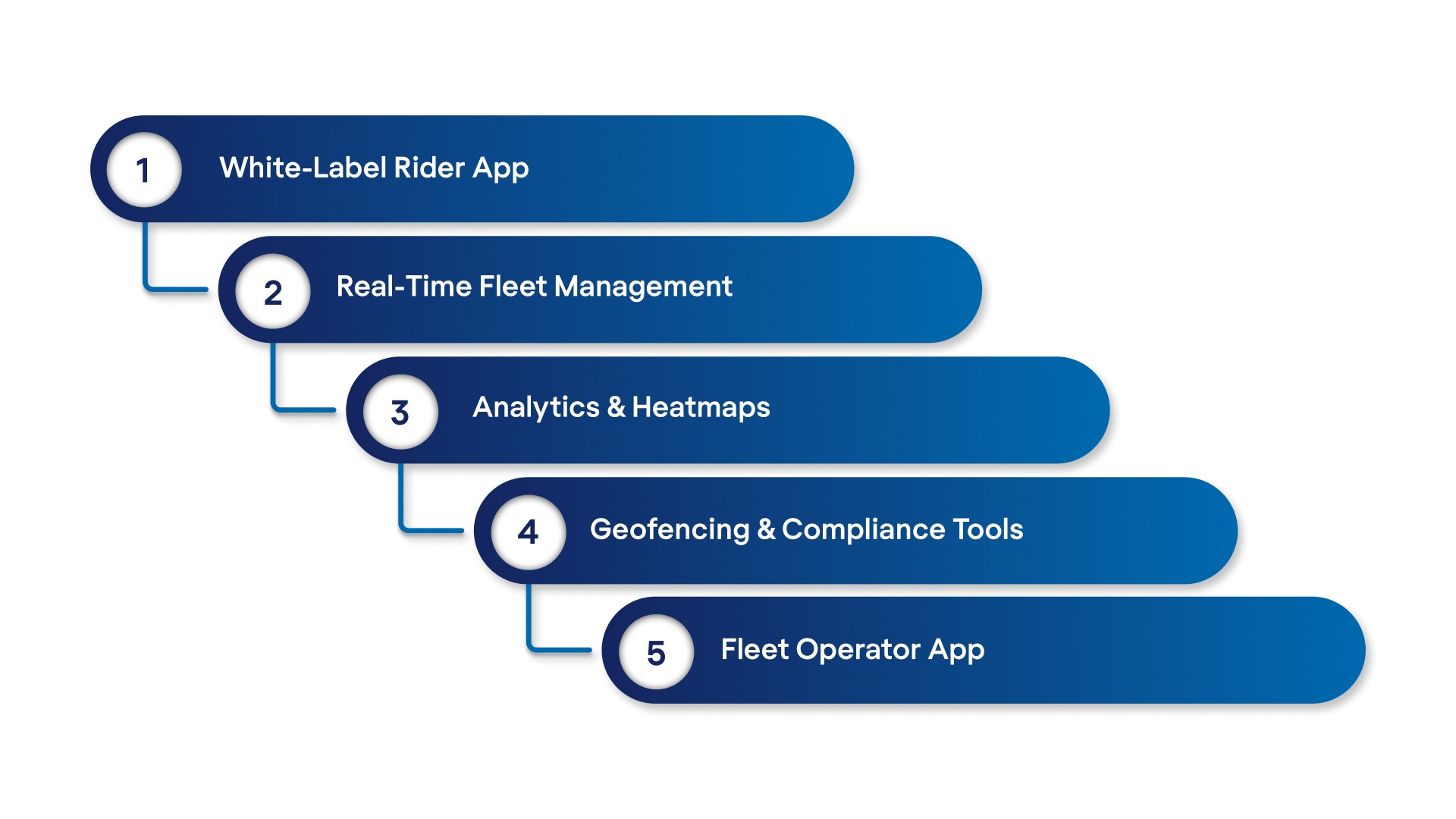
EazyRide provides the tools you need to reduce risk, improve fleet efficiency, and ensure compliance with local regulations – all of which directly impact your insurance costs and coverage terms.
Below are some of the key features that make EazyRide an invaluable tool:
- White-Label Rider App: Fully customizable with your branding, ensures a seamless, professional experience for customers while keeping your business’s identity front and center.
- Real-Time Fleet Management: Admin dashboard provides real-time insights into your fleet’s performance. You can track each vehicle’s battery levels, current location, and usage patterns, enabling data-driven decisions for fleet deployment.
- Analytics & Heatmaps: Detailed analytics that help you understand customer behavior, peak demand times, and revenue patterns. These insights allow you to improve fleet efficiency and maximize usage.
- Geofencing & Compliance Tools: Ensure your e-bikes stay within allowed operational areas. With speed limits, no-go zones, and ride restrictions tailored to your city or campus, EazyRide helps you maintain compliance with local regulations.
- Fleet Operator App: Centralizes all your team’s tasks, from rebalancing bikes to managing maintenance schedules. Your on-the-ground staff will have a streamlined workflow to ensure that all tasks are completed efficiently.
By making your fleet more efficient and predictable, you help minimize claims, comply with local regulations, and build trust with your insurer.
Conclusion
Insurance isn’t just a business expense; it’s the foundation of a sustainable scooter rental operation. Without the right coverage and risk management in place, a fleet can quickly go from profitable to financially unviable due to accidents, theft, or regulatory penalties.
And when your fleet management decisions are backed by real-time data, automated compliance tools, and proactive incident tracking, your insurance costs drop, and your operational efficiency is enhanced.
If you want to see how operators are using EazyRide’s tools to reduce risk, lower insurance premiums, and improve fleet performance, the next step is simple.
Book a demo with our team and see how EazyRide can help you build a safer, more profitable scooter rental business!
FAQs
Q1. What type of insurance is mandatory when I start a scooter rental business?
Most U.S. municipalities or campus/resort operators require general liability insurance (often with coverage limits between USD 1–2 million) to cover bodily injury or property damage caused by your scooters.
Q2. Does my regular auto or homeowners insurance cover scooter rentals?
No. Standard auto or homeowners policies usually exclude damage or liability for two‑wheeled, rental, or motorized scooters. So you need dedicated scooter rental insurance or commercial liability coverage.
Q3. If I have a small fleet (20–50 scooters), are insurance costs prohibitively high?
Not necessarily. For many small businesses, general liability and basic coverage cost around USD 42 to USD 85 per month, making insurance affordable even for small operators.
Q4. Will insurance cover scooter theft or vandalism?
Only if you carry property or equipment insurance (or rental‑equipment coverage), standard liability doesn’t cover theft or vandalism. It protects against damage claims and replacement costs only if such coverage is included.
Q5. Does having detailed maintenance logs, geofencing, or ride-tracking help reduce my insurance costs?
Yes. Insurers view well‑managed fleets with maintenance records, zone compliance, and incident logging as lower risk, which can lead to lower premiums and easier policy approval.


