
 AllAnalytics and research

 1 July, 2025
 Are E-Bikes Street Legal? An In-Depth Guide for U.S. Mobility Operators
E-bikes are becoming a common sight on American streets, but what makes them street legal, and what does it take for businesses to operate them?
With the U.S. electric bike market expected to grow to $3.86 billion by 2032, the rise of e-bikes is more than a trend—it’s a direct result of city investments in bike infrastructure, innovation in transportation, and a national shift toward cleaner, more sustainable travel options.
For entrepreneurs and organizations seeking to launch or expand a shared e-bike service, understanding the legal requirements is crucial to establishing a successful and sustainable business. In this guide, we’ll break down what you need to know about e-bike street legality, dive into the latest regulations, and provide insights for mobility operators to navigate the complexities of operating a legal and compliant e-bike fleet.
KEY TAKEAWAYS:
- Three-class system (Class 1, 2, 3) now standard in most states, each with distinct rules on speed, throttle use, and where e-bikes can operate.
- Federal law sets manufacturing standards, but state and local governments control street legality, access, and compliance requirements.
- Shared fleet operators must secure city permits, maintain insurance, follow strict parking, and provide real-time data to cities.
- 2025 updates include California’s throttle ban for Class 3, and universal helmet mandates for certain classes.
Why E-Bike Legality Matters for Your Mobility Business
For shared mobility ventures, legal compliance is not just a formality; it’s a critical business safeguard. Non-compliance with e-bike regulations can result in substantial operational and financial setbacks, including fines, impounded vehicles, revoked permits, and costly service interruptions. In some U.S. cities, authorities have even suspended entire fleets for repeated violations, underscoring the seriousness of regulatory oversight.
A clear understanding of e-bike laws allows businesses to make informed decisions about which e-bike models to deploy, where to operate, and how to equip their fleets to meet local standards. For example, understanding the differences between Class 1, 2, and 3 e-bikes, as well as the rules governing each, helps operators avoid deploying non-compliant vehicles or operating in restricted zones.
As e-bike legality becomes a pivotal concern for mobility businesses, it’s crucial to recognize that the rules governing their use are not uniform across the country.
Federal vs. State E-Bike Regulations: The Legal Landscape
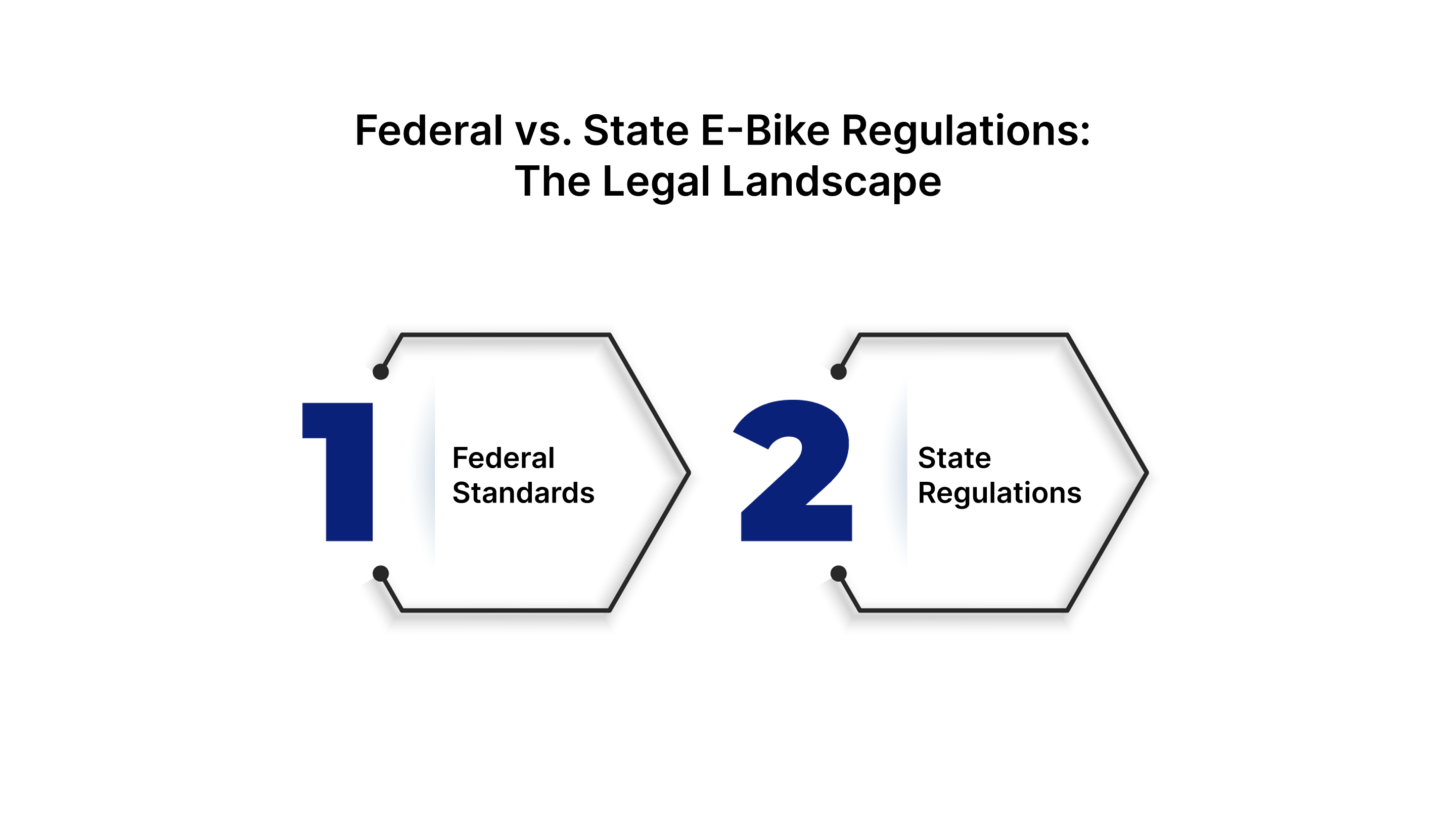
When you’re planning to launch or expand a shared e-bike service, understanding the legal framework is essential. In the U.S., e-bike regulations begin with federal guidelines but ultimately depend on the state and, in some cases, the city where you operate.
Federal Standards:
At the federal level, the Consumer Product Safety Commission (CPSC) defines a low-speed electric bicycle as one with fully operable pedals, a motor of no more than 750 watts, and a top speed of 20 mph when powered solely by the motor.
This classification means that, for manufacturing and sale, your e-bikes are treated like regular bicycles, not motor vehicles. However, these federal rules don’t determine where or how you can use e-bikes on public roads or bike paths.
State and Local Laws:
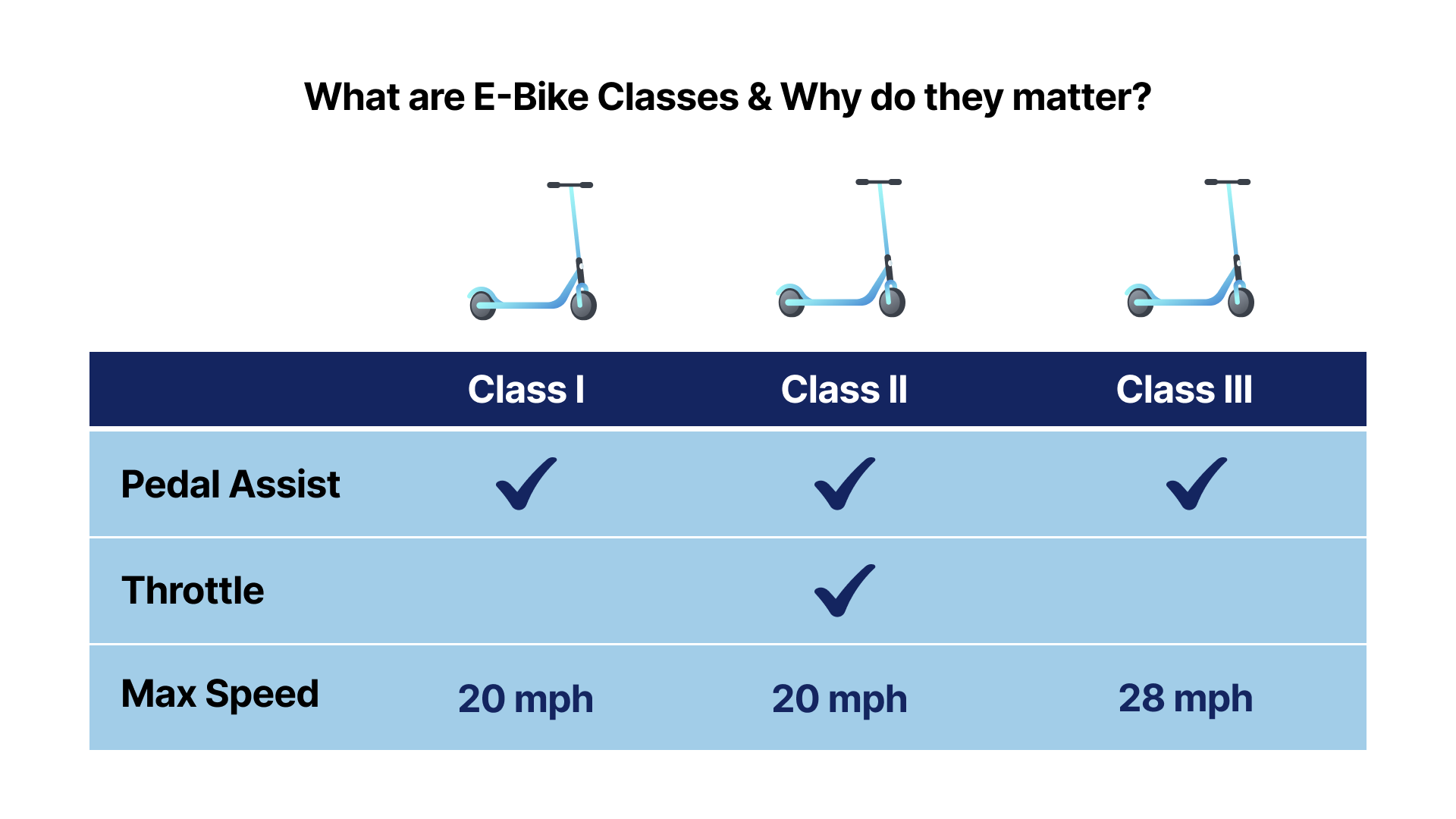
Once your e-bikes hit the streets, state and local laws take over. Most states now use a three-class system:
- Class 1: Pedal-assist only, up to 20 mph
- Class 2: Throttle-assist, up to 20 mph
- Class 3: Pedal-assist only, up to 28 mph
Each class comes with its own rules. For example, some states allow Class 1 and 2 e-bikes on bike paths but restrict Class 3 to roads and bike lanes.
- California: All three classes are allowed on streets and bike lanes. Class 3 e-bikes are restricted from multi-use paths unless a local ordinance allows them.
- New York: E-bikes are legal statewide; however, New York City has its own rules, including a 25 mph speed limit for Class 3 e-bikes and restrictions on certain greenways and park paths.
- Alabama & Alaska: Require e-bike registration and have additional licensing requirements.
- Local Rules: Many cities may establish their regulations for parking, fleet size, or geofencing, particularly in densely populated urban areas.
What This Means for Your Business:
You can’t assume that what works in one city will work in another. Some states or cities might require registration, special equipment, or restrict fleet sizes. If you don’t check the local laws, you risk fines, impoundments, or losing your permit to operate.
If you plan to operate a shared e-bike fleet in the U.S., understanding the three-class system is essential for both legal compliance and operational efficiency.
The Three-Class E-Bike System Explained
As of 2025, 37 states have formally adopted the three-class e-bike classification, and nearly all others use some variation of it to guide local rules and access. This system not only standardizes how e-bikes are defined but also directly impacts where your fleet can operate and what safety measures you must enforce.
Class 1 E-Bikes
Pedal-assist only, with no throttle. The motor assists only while the rider is pedaling and cuts off at 20 mph.
- Where Allowed: Generally permitted on city streets, bike lanes, and most multi-use paths.
- Typical Use: Popular for urban commuting and recreational riding due to their broad access and ease of use.
Class 2 E-Bikes
Throttle-assisted, allowing the motor to propel the bike up to 20 mph without pedaling.
- Where Allowed: Often allowed on the same infrastructure as Class 1, but some states and cities restrict throttle use on certain trails or paths.
- Typical Use: Favored for delivery services and riders who need flexibility, as they don’t require continuous pedaling.
Class 3 E-Bikes
Pedal-assist only, with assistance up to 28 mph. No throttle allowed (notably, California’s 2025 update now bans throttles on Class 3 e-bikes entirely).
- Where Allowed: Usually limited to roadways and bike lanes adjacent to traffic. Access to multi-use paths is often restricted unless specifically permitted by local authorities.
- Additional Requirements: Riders must be at least 16 years old, and helmets are mandatory for all Class 3 users, regardless of age, in many states.
- Typical Use: Suited for longer commutes and riders seeking higher speeds, but with stricter safety and access rules.
Key 2025 Updates
- Stricter Throttle Restrictions: California’s new law bans throttles on Class 3 e-bikes, reflecting a broader trend towards safety and speed management.
- Motor Power Limits: E-bike motors must not exceed 750 watts continuous power, a standard now clarified and enforced in leading states.
- Helmet Mandates: Helmets are required for all riders under 18 and for all Class 3 users, regardless of age, in most states.
These new developments underscore the importance of operators remaining vigilant; however, day-to-day compliance ultimately hinges on meeting certain fundamental requirements.
Key Street Legal Requirements for Shared E-Bike Fleets

Launching or managing a shared e-bike fleet in the U.S. means you must navigate a set of legal requirements that ensure safety, compliance, and smooth operations. These rules can vary by state and city, but several core standards are widely enforced, and understanding them is essential for your business.
1. Motor Power and Speed Limits
- E-bikes must have a motor rated at no more than 750 watts (1 horsepower).
- Class 1 and 2 e-bikes are limited to 20 mph, while Class 3 e-bikes can provide pedal-assist up to 28 mph, but never with a throttle.
2. Helmet and Age Requirements
- Most states require riders under 18 to wear helmets on any e-bike.
- For Class 3 e-bikes, helmets are mandatory for all riders, and operators must be at least 16 years old.
3. Equipment Standards
- E-bikes must be equipped with working front and rear lights for night riding, as well as reflectors.
- Functional brakes are required, and some states specify the minimum stopping distance.
- A bell or audible warning device is often required, especially in urban areas.
4. Parking and Geofencing Rules
- Cities may set specific rules for parking shared e-bikes to prevent sidewalk clutter.
- Geofencing technology is often required to control where bikes can be parked or ridden, particularly in high-traffic or restricted zones.
5. Rider Education and Safety
- Many municipalities expect operators to provide clear safety instructions and local law guidance to riders through apps or on-bike signage.
- Regular maintenance and safety checks are mandatory for shared fleets.
Staying compliant with these requirements is essential for uninterrupted operations and positive relationships with local authorities. Always verify the latest state and city-specific rules before expanding your fleet or launching in a new area.
Beyond these technical and safety standards, cities and states also impose a range of operational requirements that every fleet operator must address.
Permit, Insurance, and City Oversight Requirements for Shared E-Bike Fleets
When you operate a shared e-bike fleet in the U.S., compliance goes far beyond vehicle standards and rider rules. Cities and states impose a range of operational requirements designed to ensure public safety, manage public space, and protect municipal interests. Here’s what you need to know:
1. Permitting and Licensing
- City Permits Are Mandatory: In nearly all U.S. cities, you must secure a permit or license before launching a shared e-bike service. These permits are typically issued for a fixed period and require renewal. Cities may update permit terms at each renewal, reflecting evolving policy goals or lessons learned from previous operations.
- Operating Zones and Service Areas: Cities reserve the right to set and adjust operating zones. If bikes are found outside these areas, operators may face fines or have their fleets reduced.
- Permit Fees and Penalties: Cities charge permit fees to cover the costs of regulating and overseeing activities. Non-compliance with permit terms—such as failing to remove improperly parked bikes—can result in financial penalties or even permit suspension.
2. Insurance and Indemnification
- Insurance Requirements: Operators must carry liability insurance with minimum coverage amounts set by the city. This protects both the city and the public from potential claims related to accidents, injuries, or property damage involving shared e-bikes.
- Indemnification: Companies are typically required to indemnify the city, meaning they accept responsibility for legal claims or damages arising from their operations.
3. City Oversight and Operational Protocols
- Vehicle Removal and Maintenance: Cities require operators to remove damaged, abandoned, or improperly parked bikes within specific time frames—often as short as two to four hours after notification. Failure to comply can trigger fines or removal of operating privileges.
- Emergency and Event Coordination: Operators must coordinate with cities on protocols for extreme weather, emergencies, and special events (such as marathons or parades) to ensure public safety and minimize disruption.
- Local Staffing: Cities often require operators to provide 24/7 contact information for a local manager with decision-making authority who can respond to city requests or emergencies at any time.
- Public Communication: Operators must maintain a city-specific website or social media presence, provide clear user instructions, and display a 24/7 customer service phone number on all vehicles and equipment.
4. Data Reporting and Transparency
- Trip and Parking Data: Many cities require regular submission of anonymized trip, parking, and fleet distribution data to monitor compliance and inform transportation planning.
- Transparency: Operators must disclose all fees, penalties, and terms of service to users, often in multiple languages as required by the city.
Even with all these protocols in place, many operators find that staying compliant is easier said than done, thanks to a constantly shifting regulatory landscape.
Common Compliance Challenges for Shared E-Bike Operators
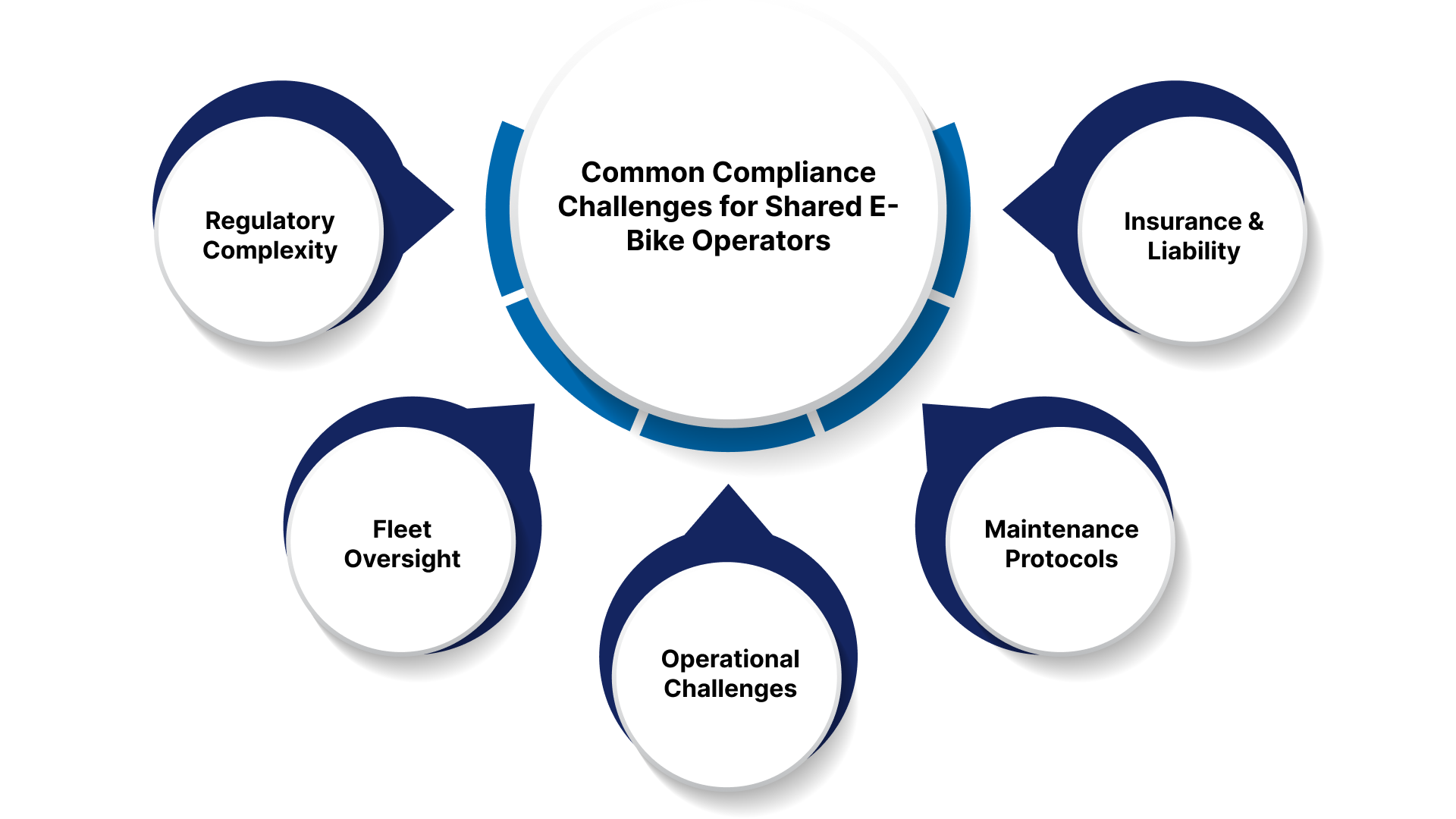
Despite growing standardization, shared e-bike operators in the U.S. continue to face several compliance challenges due to regulatory complexity, rapid policy changes, and local enforcement differences.
1. Navigating Patchwork Regulations
- State and Local Variations: Laws can differ not just from state to state, but even between neighboring cities. For example, a Class 2 e-bike may be allowed on multi-use trails in one city but banned in another.
- Frequent Updates: Regulations are evolving rapidly as cities respond to new mobility trends, so it is essential to monitor legal changes regularly to avoid accidental violations.
2. Fleet and Rider Management
- User Education: Ensuring riders understand local laws, helmet requirements, and proper parking is an ongoing challenge, especially for tourists or first-time users.
- Enforcement: Operators are often held responsible for improper parking, riding in restricted zones, or other user violations. Some cities impose fines or threaten to revoke permits for repeated infractions.
3. Technical and Operational Barriers
- Geofencing Accuracy: Implementing reliable geofencing to restrict riding or parking in sensitive areas requires investment in technology and constant updates as city rules change.
- Data Reporting: Many municipalities require operators to provide detailed trip and parking data. Inconsistent or incomplete reporting can lead to compliance issues or penalties.
4. Equipment and Maintenance Standards
- Safety Inspections: Regular maintenance and safety checks are mandatory, but managing this at scale can be resource-intensive. Failure to comply can result in the impounding of bikes or the revocation of permits.
- Equipment Upgrades: As standards evolve (e.g., new lighting or braking requirements), operators may need to retrofit or replace parts of their fleet to stay compliant.
5. Insurance and Liability
- Coverage Gaps: Some cities or states are beginning to require liability insurance for shared e-bike fleets. Finding affordable and adequate coverage for a large, distributed fleet can be challenging.
Fortunately, by learning from these challenges, operators can adopt proven strategies to not only stay compliant but also run more efficient and trusted fleets.
Best Practices for Ensuring Compliance and Smooth Operations
To thrive in the shared e-bike industry, it’s not enough to simply meet minimum legal requirements, you should aim to exceed them. Adopting best practices helps you avoid costly disruptions, build trust with regulators, and deliver a better experience for your riders. Here’s how leading operators stay compliant and efficient:
1. Stay Informed and Proactive
- Monitor Regulatory Changes: Assign a team member or use compliance software to track updates to state and local laws.
- Engage with Local Authorities: Build relationships with city officials and attend public meetings. Early engagement can help you anticipate regulatory shifts and influence policy discussions.
2. Invest in Technology
- Geofencing and GPS: Use advanced geofencing to enforce no-ride and no-parking zones, and to comply with city-specific operational boundaries.
- Automated Data Reporting: Implement systems that collect and transmit required trip, parking, and maintenance data to city dashboards in real time.
3. Prioritize Rider Education
- Clear In-App Instructions: Provide local rules, helmet requirements, and safe riding tips in your app and on your website.
- On-Vehicle Signage: Use clear, multilingual labels on bikes to communicate rules and customer service contacts.
4. Maintain High Safety and Maintenance Standards
- Routine Inspections: Schedule regular checks for brakes, lights, tires, and batteries. Document all maintenance activities to demonstrate compliance.
- Rapid Response Teams: Deploy local staff to quickly address improperly parked or damaged bikes, especially after city notifications.
5. Transparent Communication
- Disclose All Fees and Policies: Make sure users understand pricing, penalties for improper parking, and local riding rules before they unlock a bike.
- Responsive Customer Service: Offer 24/7 support and ensure users can easily report issues or ask questions.
6. Prepare for Emergencies and Special Events
- Event Coordination: Work with cities to develop protocols for large events, severe weather, or emergencies that may affect fleet operations.
- Contingency Planning: Have backup plans for rapid fleet removal or redeployment if required by city officials.
While adopting these best practices can set your operation up for success, having a clear and actionable checklist makes it even easier to ensure nothing falls through the cracks.
Compliance Checklist for Shared E-Bike Operators
To help you put best practices into action, here’s a practical compliance checklist. Use this as a reference before launching in a new city or as part of your routine operational reviews:
| Category | Checklist Item |
|---|---|
| Legal & Regulatory | Confirm e-bike class compatibility with local/state laws (Class 1, 2, or 3) |
| Verify motor power and speed limits (≤750W; 20 mph for Class 1/2, 28 mph for Class 3) | |
| Check for required city or state permits and ensure all are current | |
| Review helmet and age requirements for each jurisdiction | |
| Ensure compliance with registration, licensing, and insurance mandates (if any) | |
| Fleet & Equipment | Install required safety equipment: front/rear lights, reflectors, bell/horn, functional brakes |
| Ensure all bikes are labeled with contact info, permit numbers, and user instructions | |
| Schedule and document regular maintenance checks (brakes, tires, battery, frame integrity) | |
| Operations | Implement geofencing to enforce no-ride/no-parking zones as required by the city |
| Deploy rapid response teams for removal of damaged/improperly parked bikes within city timeframes | |
| Provide 24/7 local contact for city officials and emergency response | |
| Data & Reporting | Automate trip, parking, and maintenance data collection for city reporting |
| Submit required reports to city authorities on schedule | |
| Maintain transparent records of all compliance-related activities | |
| Rider Experience | Display clear in-app and on-bike rules (helmet laws, parking, local restrictions) |
| Offer multilingual support and easily accessible customer service | |
| Educate users on safe riding, parking, and local laws at sign-up and in-app | |
| Insurance & Risk | Maintain required liability insurance and update coverage as needed |
| Indemnify the city as specified in permit agreements | |
| Emergency & Events | Coordinate with city officials for special events, severe weather, or emergencies |
| Have a contingency plan for rapid fleet removal or redeployment |
To see how these principles come to life in a real-world setting, let’s look at how EazyRide puts compliance at the heart of its shared e-bike operations.
How EazyRide Ensures Shared E-Bike Compliance
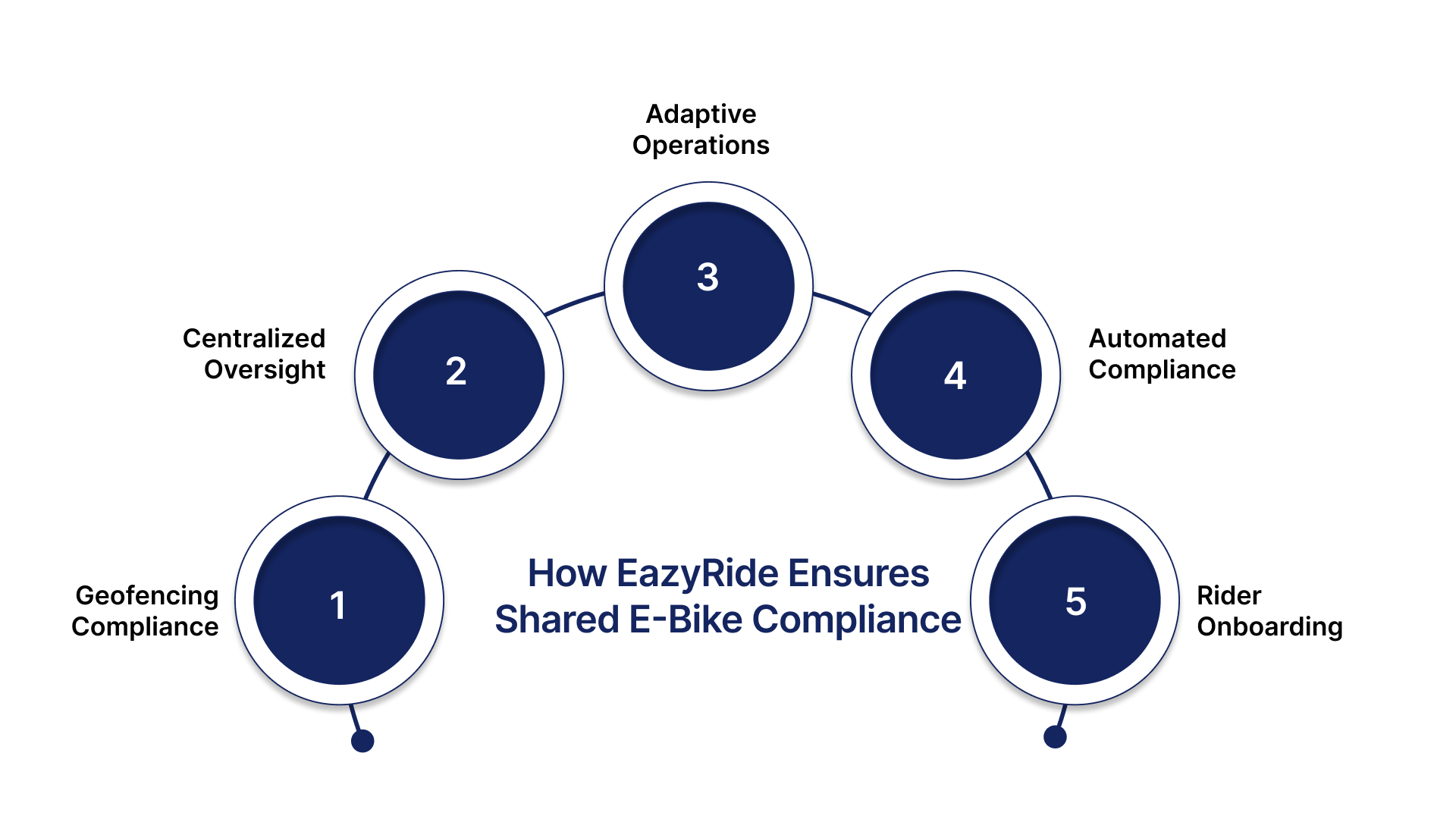
EazyRide is a leading white-label fleet management platform designed for entrepreneurs and organizations operating shared e-bike and e-scooter fleets. With advanced features for real-time fleet tracking, geofencing, and user experience, EazyRide empowers mobility operators to launch, manage, and scale their businesses while staying compliant with local and state e-bike regulations.
Here’s how EazyRide’s mobility software makes regulatory compliance simple and effective:
1. Geofencing for Local E-Bike Regulation Compliance
EazyRide’s geofencing tools allow operators to easily define, update, and enforce riding and parking zones for each city or service area. This ensures your shared e-bike fleet only operates in approved locations, helping you avoid regulatory fines and maintain positive relationships with city officials.
2. Centralized Multi-City Fleet Management
With EazyRide’s unified dashboard, operators can monitor and control their entire e-bike fleet across multiple cities and franchises from one platform. This centralized approach streamlines compliance with different local regulations and makes it easy to adapt to new city rules or service boundaries.
3. Customizable Operations for City-Specific E-Bike Laws
EazyRide offers flexible operational settings, allowing you to adjust pricing, fleet availability, and service zones to meet each city’s unique compliance requirements. While EazyRide does not manage permit documentation, its operational flexibility supports adherence to local and state e-bike policies.
4. Automated Data Reporting for Regulatory Transparency
EazyRide automatically tracks fleet usage, bookings, and vehicle status in real time. Operators can generate detailed reports to meet city-mandated data transparency requirements, demonstrating compliance with e-bike ridership, parking, and service area regulations.
5. In-App Rider Education on E-Bike Rules
EazyRide’s customizable rider app enables operators to communicate local e-bike laws, helmet requirements, and parking guidelines directly to users. This proactive rider education reduces the risk of violations and supports safer, more responsible riding in every community.
EazyRide is the ultimate fleet management platform for shared e-bike operators who want to ensure compliance with local and state regulations. By offering robust geofencing, centralized fleet oversight, flexible operations, automated reporting, and in-app rider education, EazyRide helps you deliver a safe, legal, and scalable shared mobility service.
Conclusion
Regulations on e-bikes in the U.S. are dynamic and highly localized, with federal guidelines providing a baseline but state and city regulations introducing significant variations. As new rules emerge such as stricter throttle and battery safety standards in states like California, mobility operators must remain vigilant and adaptable. By prioritizing regulatory awareness and operational best practices, you position your business to thrive in a rapidly changing environment and build lasting community trust.
EazyRide empowers you to meet these challenges head-on. With advanced tools for real-time fleet tracking, geofencing, multi-city management, and streamlined rider communication, EazyRide helps you maintain compliance and optimize your operations.
Ready to future-proof your shared mobility business? Book a personalized EazyRide demo today and see how effortless compliance and seamless operations can drive your long-term success.
FAQs
1. What are the main compliance requirements for operating a shared e-bike fleet?
Operators must adhere to local and state regulations, which often include obtaining permits, following e-bike classification rules, enforcing helmet and age requirements, maintaining proper insurance, and ensuring bikes meet safety standards such as lights, reflectors, and brakes.
2. How do cities typically regulate shared e-bike services?
Cities may set rules regarding where e-bikes can be ridden or parked, limit fleet sizes, require data sharing, and enforce specific operational zones through geofencing. Many cities also require regular reporting and community engagement from operators.
3. Why is geofencing important for shared e-bike compliance?
Geofencing allows operators to define virtual boundaries for riding and parking. This helps prevent e-bikes from being used or left in prohibited areas, reduces city complaints, and ensures the fleet operates within approved zones.
4. How can I educate riders about local e-bike rules?
Effective rider education can be achieved through in-app notifications, clear signage on bikes, multilingual instructions, and community outreach programs. Proactive communication helps reduce violations and promotes safer riding.
5. What are the penalties for non-compliance in shared e-bike operations?
Penalties can range from fines and permit suspension to impoundment of vehicles or even a ban on operations within the city. Maintaining compliance is crucial to avoid disruptions and protect your business reputation.


