
 AllSharing business

 26 December, 2025
 How to Integrate Payment Gateways in Scooter Sharing Apps?
You’ve secured funding, finalized your fleet design, and mapped out your service zones. But here’s the reality: 69.57% of users abandon a transaction if the payment process takes more than three steps. For scooter-sharing operators in 2025, payment integration isn’t just a technical checkbox; it’s the difference between a thriving mobility business and one that bleeds revenue with every failed transaction.
The payment gateway market reached $93.99 billion in 2025, driven by mobile-first consumers who expect seamless checkout experiences. Yet micromobility operators face unique challenges: micro-transactions averaging $3-8 per ride, split-second authorization requirements, and the need to process payments while users are literally on the move. One failed payment can mean a stranded rider and a damaged reputation.
This guide breaks down exactly how to integrate payment gateways into your scooter-sharing app, from selecting the right provider to implementing fraud protection without compromising the user experience. You’ll learn the specific technical requirements, cost structures, and security protocols that separate profitable operations from those drowning in chargebacks.
Key Takeaways
- Payment gateway integration complexity: Micromobility operators need solutions that handle micro-transactions, pre-authorization holds, and real-time processing while users are mobile
- Compliance requirements: PCI DSS compliance, data encryption, and regional payment regulations vary by market and directly impact your go-to-market timeline.
- EazyRide’s approach: White-label mobility platforms like EazyRide provide pre-integrated payment gateway solutions with built-in fraud detection, removing months of development time.
- Payments influence operational efficiency: Failed or delayed payments directly affect scooter availability, support workload, and peak-hour fleet utilization.
- Payment data is a growth signal: Authorization patterns, payment method choices, and retry behavior provide insights that help optimize pricing, subscriptions, and rider retention.
The Payment Processing Problem Operators Actually Face
You’re managing 200 scooters across a mid-sized city. Each generates 4-6 rides per day, with an average transaction value of $5.50. That’s 1,200 daily transactions totaling $6,600 in revenue. But here’s what’s happening behind the scenes:
Many payment attempts fail on the first try due to connectivity issues while riders are in motion. Another reason is getting declined because pre-authorization holds conflict with low card balances. By the time you factor in chargebacks from “I didn’t recognize this charge” disputes, you’re losing $950 per day, 14% of your gross revenue.
The operational impact compounds. Failed payments mean:
- Riders can’t unlock scooters, so they generate support tickets.
- Your fleet sits idle during peak demand hours.
- Negative reviews pile up about “payment issues.”
- You’re manually processing refunds instead of scaling operations.
Traditional payment gateway documentation assumes you’re processing $50- $500 e-commerce transactions with 24-hour settlement windows. Micromobility operates differently. You need instant authorization for $3-12 rides, given that users are often in areas with spotty connectivity, and you must release pre-authorization holds within hours, not days.
Why Payment Integration Can’t Be an Afterthought?
Payment systems shape far more than transactions; they influence trust, compliance, and long-term growth. For micromobility operators, payments sit at the intersection of user experience, regulation, and risk.
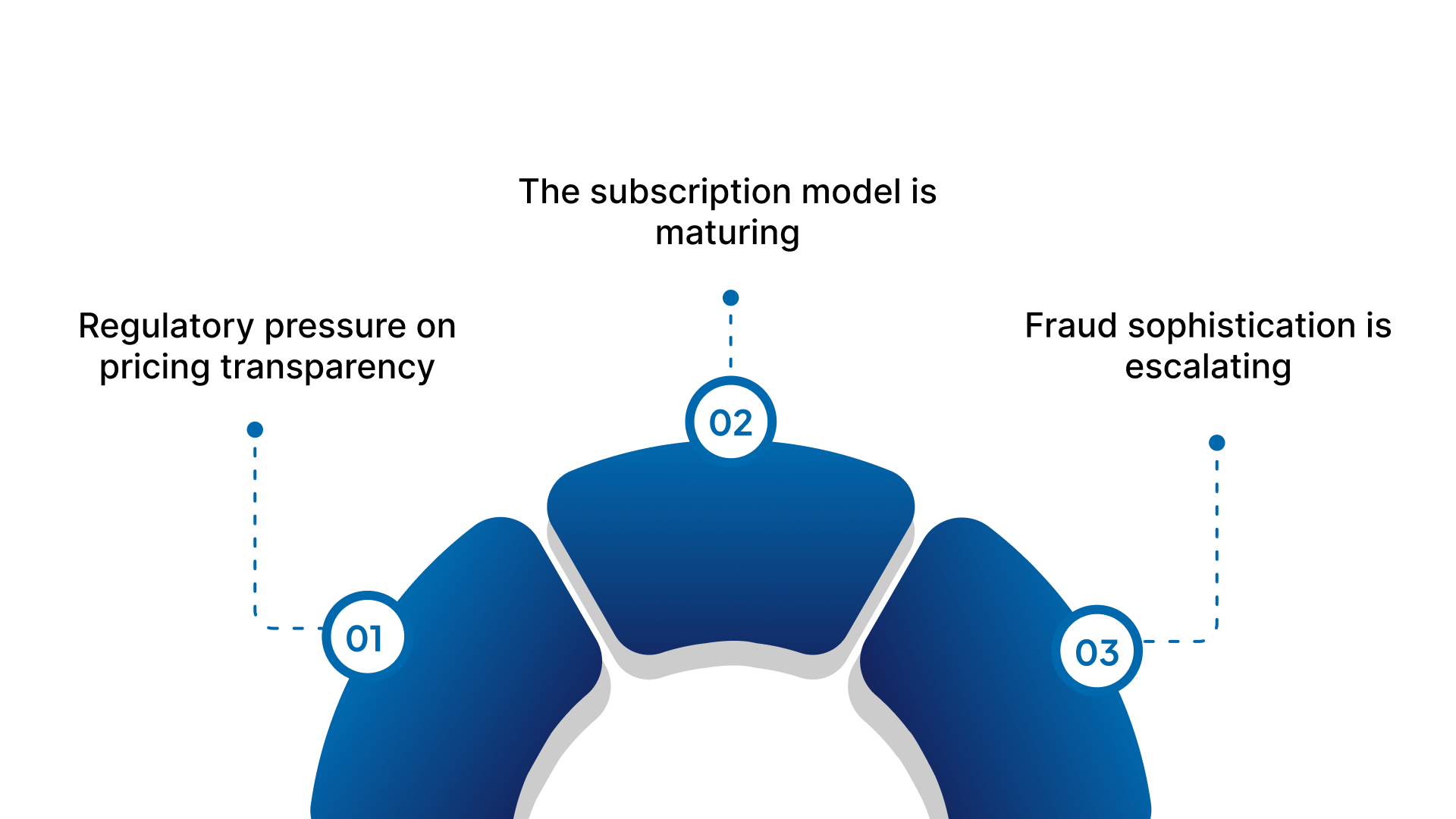
As the industry matures, treating payments as a last-step technical task is no longer sustainable. Three major shifts make payment infrastructure a strategic priority.
Regulatory pressure on pricing transparency
Hidden costs that users discover mid-transaction trigger abandonment rates above 60%.
Also Read: Understanding Scooter Sharing Systems in Major Cities
The subscription model is maturing
35% of Uber frequent riders now prefer subscription plans over pay-per-ride. This requires recurring billing infrastructure, failed payment retry logic, and dunning management capabilities, which most basic payment gateways don’t provide out of the box.
Fraud sophistication is escalating
In 2025, organized fraud rings specifically target mobility apps. The Lightning Shared Scooter Co. scam demonstrated how fake mobility platforms can steal millions. Legitimate operators need payment security that proves authenticity while maintaining sub-3-second checkout times.
As these pressures grow, payments become a foundation, not a feature. Learn how EazyRide helps operators build payment systems that are ready for regulation, subscriptions, and modern fraud threats.
Scooter Sharing Payment Gateway Integration Framework: 7-Step Implementation
Scooter sharing payment gateway integration isn’t just a technical checklist; it directly affects ride unlock speed, revenue reliability, and user trust. For micromobility operators, small decisions in payment design can create significant operational wins or costly failures.
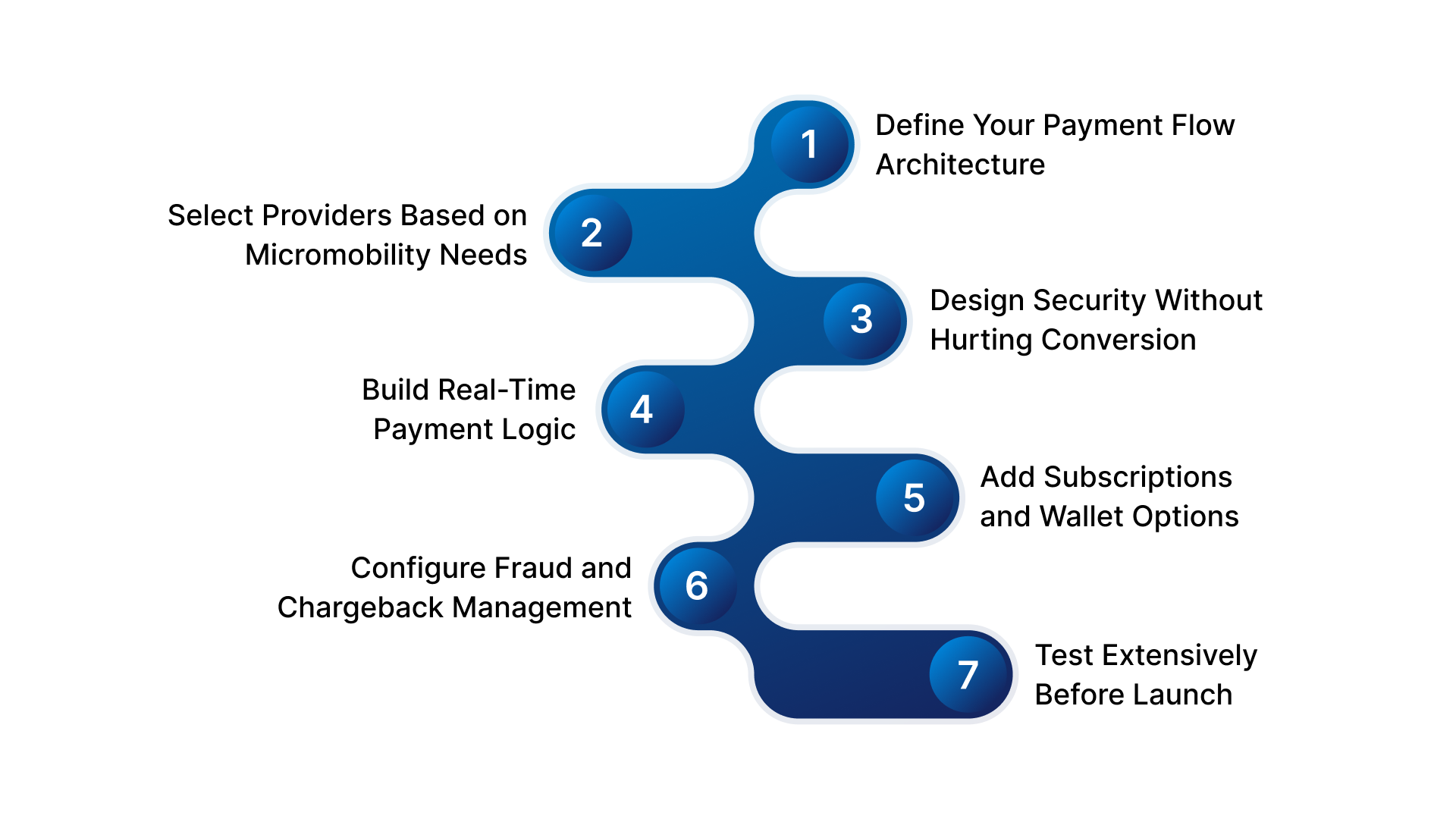
This framework breaks down the essentials into practical steps that balance user experience, security, and scalability. Whether you build in-house or use a platform, these principles apply.
Step 1: Define Your Payment Flow Architecture
Before choosing a gateway, map the whole payment journey.
- Pre-authorization strategy: Decide hold amounts ($5–25 typical), conversion timing, and release rules for canceled rides.
- Multi-payment scenarios: Plan for insufficient balances, partial corporate payments, and mid-ride failures.
- Settlement timing: Choose between daily payouts, instant payouts (with higher fees), or rolling reserves that protect against chargebacks.
Micromobility unlock decisioning flow: This is where scooter sharing differs from e-commerce. Your payment logic must answer: authorize first, then unlock? Or unlock immediately with post-ride capture? The standard flow:
- User initiates unlock
- Authorization request sent to gateway
- If approved, scooter unlocks instantly
- Ride completes, actual charge captured
- If authorization fails, unlock is denied
The fallback: If authorization succeeds but unlock fails mechanically, you must immediately void the authorization to prevent charging for a ride that never happened. Build this reversal logic into your unlock API response handling.
Step 2: Select Providers Based on Micromobility Needs
Not all gateways handle mobility use cases well.
- High transaction velocity: Must support thousands of rapid micro-transactions without slowing authorization.
- Pre-auth flexibility: Look for 24–48 hour holds with automated settlement or release.
- Mobile reliability: Authorization success must remain high on weak networks.
- Geographic readiness: Ensure support for cards and local methods in future markets.
- Transparent pricing: Understand base rates, volume discounts, international fees, and chargeback costs.
Step 3: Design Security Without Hurting Conversion
Security should stop fraud, not riders.
- Tokenization: Store tokens, not card data, to keep PCI scope minimal and reduce audit costs.
- Risk-Based 3D Secure Authentication: Risk-based authentication applies 3D Secure only when fraud signals are detected, not on every transaction. Forcing authentication on every unlock destroys conversion rates.
- Device fingerprinting: Flag new or suspicious devices using stored payment methods.
- Velocity limits: Detect abnormal ride or unlock frequency to prevent fraud escalation.
Step 4: Build Real-Time Payment Logic
Payment decisions must happen in seconds.
- Authorization flow: Pre-auth, network check, hold placement, and unlock should complete in 1–3 seconds.
- Retry strategy: Use staggered retries for network failures and soft declines before writing off revenue.
- Idempotency keys: Implementing idempotency keys and duplicate charges is a must for prevention to ensure users aren’t charged multiple times during retry attempts or network failures.
Step 5: Add Subscriptions and Wallet Options
Modern riders expect flexibility.
- Subscriptions: Support recurring billing, retries, proration, trials, and lifecycle changes.
- Digital wallets: Apple Pay, Google Pay, and PayPal improve success rates and reduce friction.
- Stored value: Prepaid ride credits improve cash flow and lower per-transaction fees.
Step 6: Configure Fraud and Chargeback Management
Fraud prevention doesn’t end at authorization.
- Real-time risk scoring: Auto-approve low-risk transactions and challenge high-risk ones.
- Chargeback automation: Collect ride data, submit evidence quickly, and flag accounts for review.
- Pattern detection: Watch for geographic or issuer anomalies that signal coordinated fraud.
Also Read: What Should You Know About Micro Mobility Payments in 2025?
Step 7: Test Extensively Before Launch
Payment bugs are expensive to fix post-launch.
- Test weak connectivity, partial payments, rapid unlocks, long rides, expired cards, refunds, and chargebacks.
- Run hundreds of test transactions across multiple scenarios using a small pilot fleet before going live.
- Descriptor strategy: Ensure your payment statement descriptor clearly shows your brand name to prevent “I didn’t recognize this charge” disputes from users.
Common Payment Integration Mistakes (and How to Avoid Them)
Payment issues rarely surface on day one; they emerge after launch, when real users, weak networks, and edge cases collide. For micromobility operators, minor oversights in payment setup can quickly lead to lost rides, increased fraud, or stalled expansion.
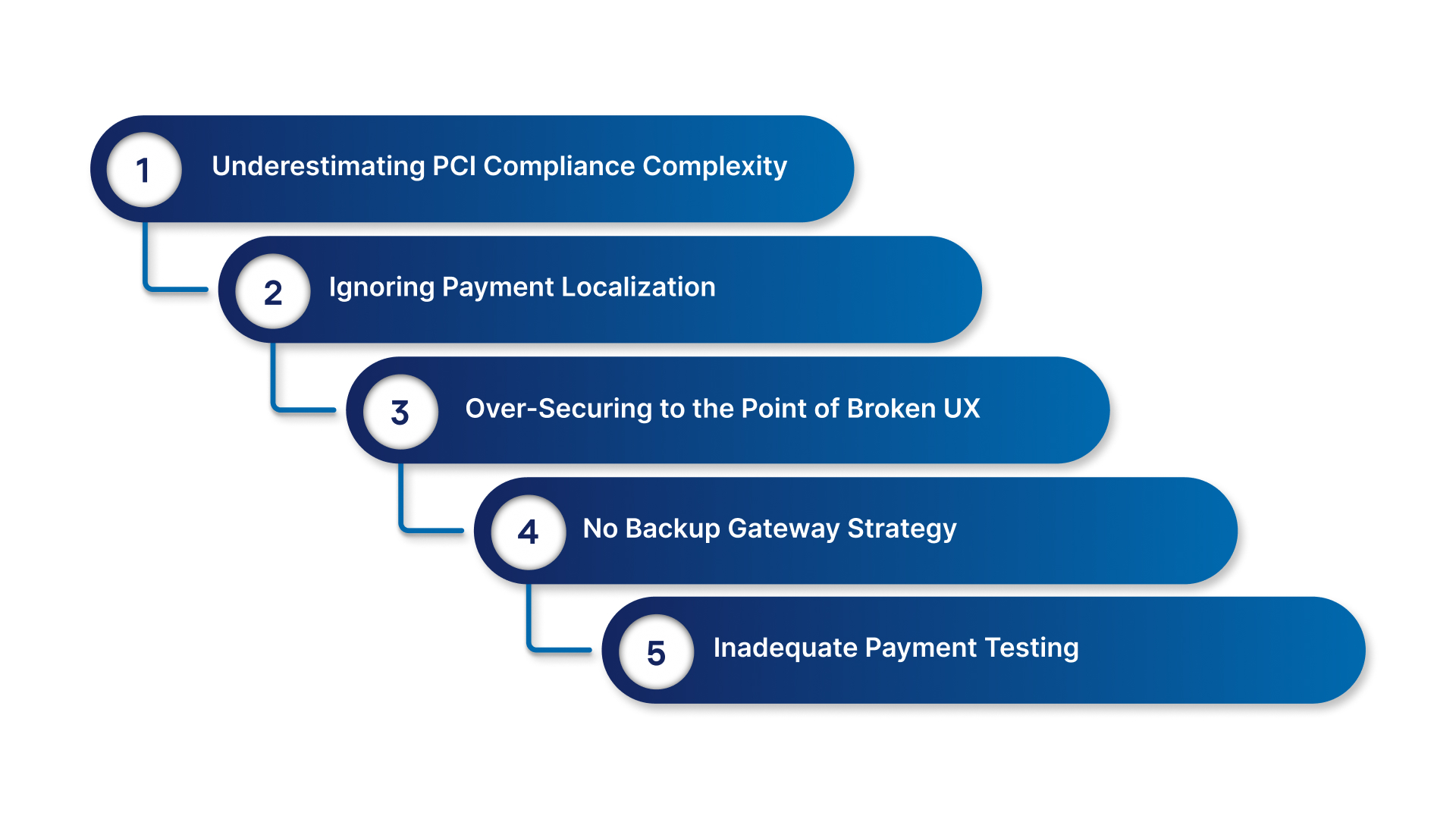
Understanding these common mistakes early helps you avoid costly rework and protect both revenue and user trust. Below are the most frequent payment integration pitfalls, and how to fix them.
Mistake 1: Underestimating PCI Compliance Complexity
The problem: Operators assume that “we’re just using Stripe” means no compliance work is required. Wrong. You still need security policies, vulnerability scanning, and annual compliance validation.
The fix: Use payment integration approaches that minimize your PCI scope. Never store card data, use hosted payment pages where possible, and ensure your gateway provider is PCI Level 1 certified.
Mistake 2: Ignoring Payment Localization
The problem: Launching in multiple cities but accepting only USD via US-based gateway infrastructure. This adds 2-3% currency conversion fees users shouldn’t pay.
The fix: Implement multi-currency support and local payment methods. Users in Canada expect Interac, UK users expect Faster Payments, and German users prefer SEPA direct debit.
Mistake 3: Over-Securing to the Point of Broken UX
The problem: Requiring 3D Secure, ZIP code verification, CVV codes, and email confirmation for every ride. Authorization success rates plummet to 60-70%.
The fix: Risk-based authentication. Use fraud scoring to apply friction only when needed, not universally.
Mistake 4: No Backup Gateway Strategy
The problem: Your sole payment provider experiences an outage (which happens 2-3 times per year, even for major providers). Your business will go to zero revenue until it is resolved.
The fix: Implement gateway failover. If primary authorization fails with a specific error, automatically route to the backup gateway. Adds complexity but ensures business continuity.
Mistake 5: Inadequate Payment Testing
The problem: Testing happy-path scenarios (successful ride, successful payment) but not edge cases. Discover bugs only when users report issues.
The fix: Create a testing matrix covering 50+ scenarios, including expired cards, insufficient funds, network timeouts, rapid unlock attempts, and refund processing. Run this suite before every release.
Avoiding these mistakes early can save months of rework and significant revenue loss. See how EazyRide helps operators sidestep these pitfalls with a payment system designed for real-world micromobility conditions.
How EazyRide Simplifies Payment Integration?
Instead of spending months building payment systems from scratch, EazyRide offers a pre-built, micromobility-ready payment infrastructure that lets operators launch faster and scale confidently.
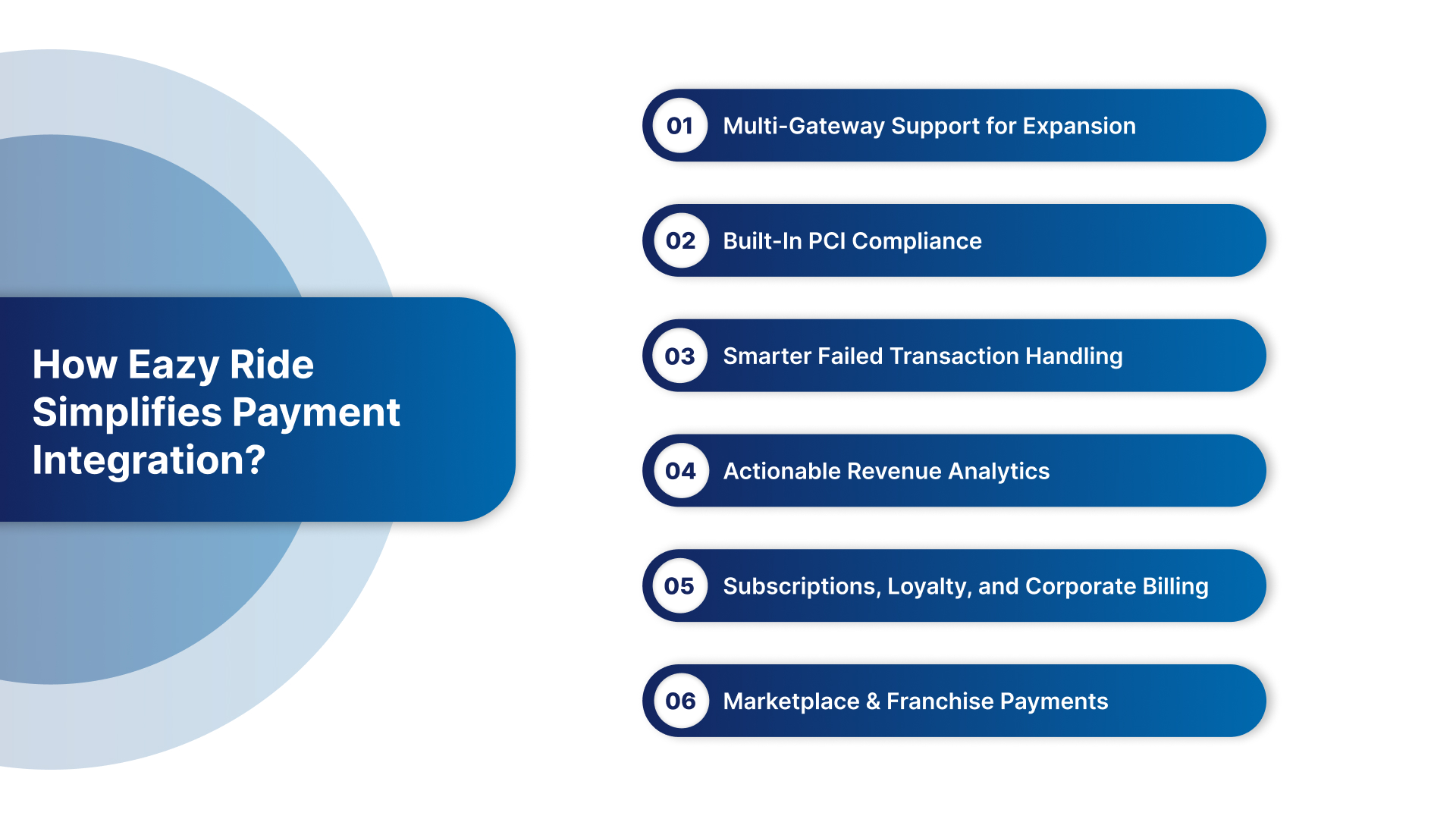
Multi-Gateway Support for Expansion
EazyRide integrates with major payment providers and supports configuration-based switching based on location, currency, or business rules, so you can expand into new regions without rebuilding checkout flows.
Built-In PCI Compliance
Payments are fully tokenized, keeping card data off your servers and reducing PCI compliance to SAQ-A. Operators avoid complex audits and save significantly on security and compliance costs.
Smarter Failed Transaction Handling
Automated retry logic adapts to failure types, while operator alerts flag users with repeated payment issues before revenue is lost.
Actionable Revenue Analytics
The admin dashboard shows authorization success rates, pre-auth optimization, payment mix, chargebacks, and gateway fees, helping operators increase completed rides and reduce declines.
Subscriptions, Loyalty, and Corporate Billing
EazyRide supports recurring plans, promotions, verified discounts, corporate accounts, and loyalty programs with complete lifecycle management built in.
Marketplace & Franchise Payments
For partner or franchise models, payments are automatically split, settled, reported, and tax-ready, enabling asset-light expansion without financial complexity.
Conclusion: Payment Integration as Competitive Advantage
Scooter sharing payment gateway integration can either strengthen your operations or quietly hold them back. Treating it as a simple technical task often leads to failed transactions, exposure to fraud, and compliance risks that grow over time.
Leading micromobility operators in 2025 see payments as strategic infrastructure. They focus on improving authorization rates, reducing fraud, and using payment insights to refine the rider experience.
The real decision isn’t whether to invest in payments, but how to invest. Building custom systems takes months and costly trial-and-error, while platforms like EazyRide deliver enterprise-grade payment infrastructure in weeks, not months.
Your payment gateway should fuel growth, not slow it down. Explore EazyRide’s complete payment solution and launch with confidence.
Frequently Asked Questions
1. How much does payment gateway integration typically cost for a scooter-sharing startup?
Costs typically include development effort (which can range from minimal with white-label platforms to higher investment for custom builds), transaction processing fees charged per payment, and ongoing PCI compliance and security expenses for operators managing their own systems. For early-stage scooter-sharing startups with smaller fleets and modest annual volume, payment processing costs usually constitute a noticeable but manageable portion of operating expenses and vary by region, provider, transaction mix, and growth pace.
2. What’s the difference between hosted payment pages and integrated checkout for mobility apps?
Hosted payment pages redirect users to the gateway, simplifying security and PCI compliance but adding friction. Integrated checkout keeps users inside the app for a smoother experience, but requires more security handling. For micromobility apps, integrated checkout is preferred to avoid breaking the unlock flow.
3. Can I change payment gateway providers after launch without disrupting users?
Yes, but users may need to re-enter card details due to re-tokenization. Migration typically takes 4–8 weeks and works best when both gateways are run in parallel for 30 days. Doing this during a low-usage period minimizes friction.
4. How do subscription payments differ from per-ride payments in integration complexity?
Subscriptions require recurring billing, retries for failed payments, proration, cancellations, and lifecycle management. This adds about 3–4 months of development compared to per-ride payments. However, subscription users usually deliver 3–4x higher lifetime value.
5. What payment security measures are necessary versus optional for micromobility?
Essential measures include PCI compliance, tokenization, SSL/TLS encryption, 3D Secure, and basic fraud checks. Optional but valuable additions are device fingerprinting, AVS checks, and automated chargeback handling. These become critical if fraud exceeds 0.5% or chargebacks cross 0.3%.


