
 Analytics and research

 20 August, 2026
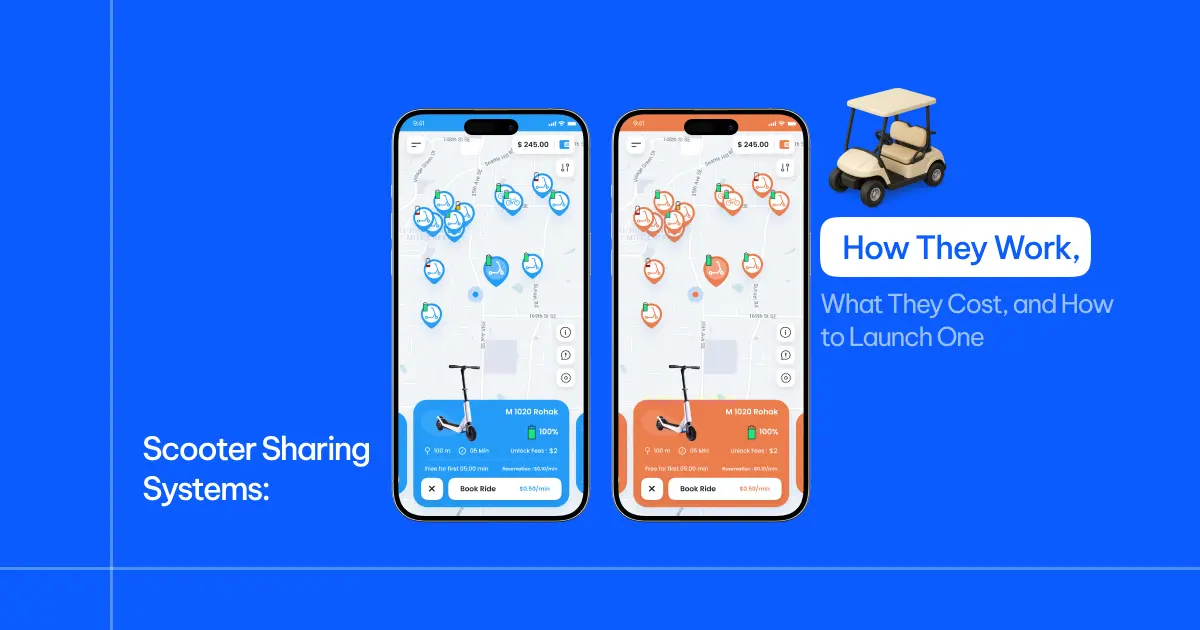
 Scooter Sharing Systems: How They Work, What They Cost, and How to Launch One
Scooter sharing systems let a rider unlock a shared electric scooter from a phone, ride it across a city, and end the trip almost anywhere inside a service zone, paying by the minute. In seven years they’ve gone from an unpermitted curiosity to a standing layer of urban transport in hundreds of cities, from Paris and Berlin to Austin and Washington, D.C. This guide covers how these systems actually work, how the dominant models differ, what the unit economics really look like, and what it takes to launch and run one profitably in 2026.
Key Takeaways
- Two models dominate: dockless free-floating and docked station-based.
- Regulation now defines the market: permits, caps, data sharing.
- Utilization decides survival: healthy fleets hit 3-6 daily rides.
- Launching is a software problem: EazyRide fleets go live in 14 days.
- Operations, not hardware, separate profitable fleets from failed ones.
What Is a Scooter Sharing System?
A scooter sharing system is a fleet of GPS-connected electric scooters offered to the public for short-term rental and managed entirely through a mobile app. The rider scans a QR code or taps “unlock,” the scooter’s onboard module verifies the account and payment, and the trip starts. When the rider parks and ends the trip, the system calculates the fare, usually an unlock fee near $1 plus roughly $0.15 to $0.45 per minute, and logs the vehicle’s location for the next user.
Shared scooters sit inside the wider category of micro-mobility: lightweight, low-speed vehicles built for short urban trips. Most shared e-scooter rides run between half a mile and two miles, exactly the “last mile” distances that are annoying to walk and wasteful to drive. That trip profile is why cities treat scooter sharing as a genuine complement to public transit rather than a toy.
How the technology actually works
Every shared scooter is a connected device. Four parts make the system run:
- An IoT controller with cellular connectivity, GPS, and an accelerometer, reporting location, battery level, and ride state in near real time.
- Geofencing, which lets operators and cities define zones where scooters can ride, must slow down, or cannot park. Cross a no-park boundary and the app won’t let you end the trip.
- A backend fleet-management platform that handles payments, user accounts, dynamic pricing, battery-swap routing, maintenance flags, and the data feeds cities require.
- Field operations, the crews who swap batteries, move vehicles into high-demand areas, and repair damage.
The scooter is the visible part. The rider-facing side of the system, from account creation to the end-of-trip parking check, lives in the app your riders download, and the whole operation is won or lost on the platform and the crews behind it. If you want to see how the pieces fit under the hood, this scooter sharing system design guide breaks down how geofencing, pricing, and IoT work together.
The Rise of the E-Scooter Industry
The shared e-scooter industry effectively began in 2017 and 2018, when a handful of venture-backed operators flooded US cities with dockless fleets, often overnight and without permits. The pitch was simple: drop scooters on sidewalks, let riders find them by app, and grow ridership faster than regulators could respond. It worked, briefly.
That “deploy first, ask permission later” era collapsed almost as fast as it arrived. Cities that woke up to hundreds of unpermitted scooters cleared them off the streets, then came back with permitting frameworks that put operators on a leash. What started as a growth-at-all-costs land grab turned into a permitted, capped, data-reporting business inside about three years.
The shift matters for anyone entering now. The messy early phase is over, and so is the cheap capital that funded it. The market that remains rewards operators who can run a compliant, well-behaved fleet at a profit, not the ones who deploy the most scooters the fastest. That’s a different game, and it favors disciplined regional operators over reckless expansion.
Dockless vs. Docked: The Defining Comparison
The single biggest design decision in any scooter sharing system is whether it’s dockless (free-floating) or docked (station-based). This choice shapes cost, rider convenience, and how easily you’ll win a city permit.
| Dimension | Dockless / Free-Floating | Docked / Station-Based |
|---|---|---|
| Where you park | Almost anywhere in the zone, within rules | Only at fixed stations or branded racks |
| Rider convenience | Highest, true point-to-point | Lower, you walk to and from a station |
| Sidewalk clutter | Higher risk, needs geofenced corrals | Very low, vehicles stay contained |
| Capital cost | Lower, no station hardware | Higher, stations and installation |
| Rebalancing cost | Higher, vehicles scatter | Lower, predictable locations |
| City approval | Harder, clutter concerns | Easier, orderly footprint |
| Best fit | Dense, app-fluent urban cores | Cities that prioritize public order |
In practice, most large US and European programs run hybrid systems: dockless freedom for the rider, plus mandatory geofenced parking corrals and small discounts for parking correctly. This hybrid came straight out of the early backlash against scooters dumped across sidewalks, a lesson the industry learned the hard way and now builds into every launch.
Types of Scooter Sharing Systems
Not every scooter sharing system is a city-wide public app. The main types:
- City-wide public programs, permitted, regulated, and open to anyone. This is the model most people picture.
- Campus and corporate systems, run by universities, business parks, and large worksites as closed or semi-closed fleets.
- Tourism and resort systems, where hotels, theme parks, and destination towns offer scooters to guests.
- Mobility-hub and transit-integrated systems, with scooters positioned at rail and bus stops to solve first and last-mile access, sometimes inside a transit agency’s own app.
Each type rewrites the rules. A closed campus fleet faces almost no regulatory friction and can launch in weeks. A city-wide public program lives or dies by its permit and spends real money staying compliant. Knowing which type you’re building is the first strategic decision, because it drives everything from your hardware budget to how much legal work sits ahead of you.
The Scooter-Sharing Industry and Market Today
The industry has settled into two tiers. At the top sits a small group of well-capitalized multinational operators competing for big-city permits, alongside national champions in individual European and Asian markets. Beneath them is a fast-growing layer of independent and white-label operators: campuses, resorts, tourism boards, and regional mobility companies running their own branded fleets on third-party software instead of fighting the giants head-to-head.
That second tier is where most new scooter sharing systems launch today. It’s also the more durable business. These operators pick markets the multinationals ignore, keep fleets small enough to hit healthy utilization, and avoid the permit wars that drain cash in tier-one cities.
The shakeout that reshaped the market. Rising interest rates in 2022 and 2023 ended the era of growth at any cost. Operators that couldn’t show a path to per-vehicle profitability lost funding, and several merged or pulled out of entire countries. The survivors share one trait: disciplined unit economics built on durable, purpose-built scooters rated for years of service rather than months, plus tighter operations. If you’re deciding whether to build your own stack or buy one, the trade-off is laid out in this breakdown of scooter sharing software development cost.
Effects on Cities and Riders
The effects of scooter sharing are genuinely mixed, and honest operators acknowledge both sides rather than pretending the downsides don’t exist.
Right-of-way obstruction and visual clutter. The most common complaint is scooters blocking sidewalks, curb ramps, and transit stops, which is a real accessibility problem for wheelchair users and people with visual impairments. The industry’s answer has been mandatory end-of-trip parking photos, geofenced no-park zones, designated corrals, and fines for misparking.
Injuries and safety. Shared e-scooters carry a non-trivial injury rate, concentrated among first-time riders, people riding on sidewalks, and riders without helmets. Head injuries are the most serious category, and there have been fatalities. Standard mitigations now include speed caps, often around 15 mph and lower in pedestrian zones, beginner-mode throttling, mandatory in-app safety tutorials, and sobriety prompts during late-night hours.
Net mobility effect. Studies split on how many car trips scooters truly replace versus walking or transit trips. The rough consensus is that well-run, transit-integrated programs meaningfully expand short-trip options without measurably worsening congestion. The keyword there is well-run. A sloppy fleet generates complaints; a disciplined one earns permit renewals.
Response and Regulations
Regulation is now the defining feature of the market. A typical major-city framework includes:
- Permits and operator caps, so only a fixed number of companies may operate.
- Fleet-size limits, often tied to demonstrated utilization and parking compliance.
- Parking rules: corrals, no-park geofences, and end-of-trip parking photos.
- Speed and zone controls: geofenced slow zones and no-ride areas.
- Data sharing, where operators feed anonymized trip data to the city, commonly via the MDS standard, for planning and enforcement.
- Equity requirements: low-income fare plans and mandated deployment in underserved neighborhoods.
For anyone launching a system, compliance isn’t a hurdle you clear once. It’s an ongoing operating requirement that has to live inside the platform. When a city tightens a speed cap or moves a no-ride boundary, you need that rule on every vehicle fast, not next firmware cycle. This is where scooter sharing software with built-in geofencing earns its place: operators pushing zone changes in real time report up to 40% fewer parking violations than crews doing manual enforcement.
Major Cities: A Snapshot Comparison
Exact rules change constantly, but the broad patterns across leading markets are clear:
- Paris banned shared e-scooters by public referendum in 2023, the sharpest example of a city reversing course over clutter and safety, even though private scooters stayed legal.
- US cities such as Austin, Washington, D.C., Denver, San Diego, and Atlanta generally run permitted, capped, dockless-with-corrals programs, with periodic curfews and parking crackdowns.
- German and Nordic cities lean toward strict parking enforcement and tight operator caps, favoring orderly hybrid systems.
- Asian and Middle Eastern markets are expanding quickly, often launching as tightly controlled, station-leaning systems from day one.
The throughline: cities increasingly want fewer operators running better-behaved fleets with full data transparency. For a closer look at how the rules differ market by market, see this guide on how e-scooter sharing works in major cities. The practical takeaway for a new operator is to read the local permit terms before buying a single scooter, because the city’s rules decide your fleet size, your parking model, and half your operating budget.
Jobs and Employment in Scooter Sharing
Most guides describe the technology and skip the people who keep it running. That’s a mistake, because labor is one of the largest lines in an operator’s budget and one of the biggest sources of local goodwill or friction.
A working fleet needs several roles. Field technicians swap batteries, move scooters into demand zones, and pull damaged vehicles for repair. Warehouse and repair staff rebuild brakes, replace tires, and refurbish battery packs. Remote operations watch the live map, respond to misparked vehicles, and handle rider support. In the early years, much of this ran on gig “juicers” who charged scooters at home overnight. Most serious operators have since moved to employed or contracted field crews, because reliability and vehicle care matter more than raw cost once you’re chasing profitable utilization.
The staffing math scales with your operating model. A dockless fleet scattered across a city needs more rebalancing labor than a docked one with predictable pickup points. Software cuts the load: demand-based deployment routing and automated maintenance alerts mean a smaller crew covers more vehicles. A field operator app that hands technicians a prioritized task list, turn-by-turn routing, and one-tap status updates is the difference between a crew that services 300 scooters a day and one that services 120. For a mid-sized operator, that labor efficiency often decides whether the fleet clears its operating costs at all.
The Unit Economics Most Guides Skip
Most articles on scooter sharing describe the market but never explain why operators win or lose. Here’s the math that actually matters, the part the incumbents’ overview pages leave out.
A shared scooter’s profitability is governed by three numbers:
- Vehicle lifespan. Early consumer-grade scooters lasted only a few months on the street. Purpose-built models now last several years, spreading the upfront cost of $400 to $1,000-plus per unit across thousands of rides.
- Rides per scooter per day (utilization). Healthy systems target roughly 3 to 6 rides per vehicle per day. Below about 2, most systems lose money.
- Operations cost per trip. Battery swapping, rebalancing, repairs, and charging are the dominant ongoing costs. Swappable batteries and demand-based deployment are the biggest levers here.
A simplified illustration: a scooter averaging 4 rides a day at about $3.50 net revenue per ride generates roughly $14 a day, or around $5,000 a year. If the vehicle costs $700 and lasts three years, hardware is roughly $230 a year, which leaves the entire profit question to operations efficiency. That’s why modern scooter sharing is a software-and-operations business, not a hardware one. The winners optimize routing, pricing, and maintenance through their platform. The losers buy cheap scooters and burn cash on manual work.
The pricing model matters as much as the fleet
Here’s a cost trap most first-time operators miss: the software pricing model you sign can cost more than the scooters themselves. Many platforms charge a percentage of every ride with no cap, which quietly scales your software bill with your success. A flat per-vehicle license does the opposite.
Run the numbers on a 200-scooter fleet doing 4 rides a day at $6 each. A 10% revenue share runs about $175,000 a year. A flat per-vehicle license near $14 a month runs about $33,600 a year for the same fleet. The math usually flips by year two, and it flips harder the busier your fleet gets.
The point isn’t that one model is always cheaper. It’s that you should model your own fleet’s ride volume before you sign, because a revenue share that looks cheap at launch becomes your biggest cost line once utilization climbs.
Developments and Innovations
The next phase of scooter sharing is being shaped by a handful of shifts:
- Swappable batteries that remove the need to collect and recharge whole vehicles, cutting the single largest operations cost.
- Sidewalk detection and computer-vision parking that verify correct parking automatically instead of relying on rider-submitted photos.
- AI-driven rebalancing that predicts demand and positions vehicles before peaks rather than chasing them after.
- Transit integration, with scooters appearing inside city transit apps and at mobility hubs.
- White-label expansion into smaller cities, campuses, and tourism markets the global giants ignore, which is the fastest-growing launch segment.
International expansion is no longer about flooding mega-cities. It’s about entering mid-sized markets with a compliant, profitable model from day one. The operators winning this phase treat scooters as durable infrastructure and treat software as the thing that keeps a small crew ahead of a scattered fleet.
How to Launch a Scooter Sharing System
If you’re an operator, municipal partner, campus, or mobility entrepreneur, launching a system comes down to five steps:
- Validate the market and secure permits. Confirm demand, pick your model, and align with local regulations before buying a single scooter. Dockless-with-corrals is the safe default in most cities.
- Choose durable, IoT-equipped hardware rated for multi-year street life, not the consumer-grade scooters that die in a season.
- Run on a real fleet-management platform with a rider app, payments, geofencing, dynamic pricing, maintenance routing, and the data feeds cities require.
- Stand up lean operations: battery swapping, rebalancing, and repairs, ideally routed by software so a small crew covers a large fleet.
- Launch a contained pilot, measure utilization, then scale the fleet only as your rides-per-vehicle numbers justify it.
The build-versus-buy decision at step three is where most launches stall. Building a compliant platform from scratch is a multi-year engineering project with an ongoing maintenance bill. Buying a white-label stack turns it into a go-to-market decision. Operators who take the buy path move fast: a typical e-scooter sharing app development engagement puts a branded, rule-ready system live in as little as 14 days from signing, with support for 10-plus IoT hardware brands out of the box so you’re not locked to one scooter vendor.
Barriers to adoption, and how to clear them
The real barriers are regulatory complexity, parking and clutter management, safety liability, and the operational discipline to hit profitable utilization. Each is solvable, but only with a platform that builds compliance, geofencing, and operations into the system instead of bolting them on later.
Scoping a 2026 launch and not sure whether to build or buy? A 30-minute fleet review will answer that faster than a week of vendor calls. The right platform manages e-scooters, e-bikes, and mopeds from one account, so if you add vehicle types later, you won’t be logging into a second system to do it.
Frequently Asked Questions
What is a scooter sharing system?
It’s a fleet of GPS-connected e-scooters rented by the public through a mobile app. Riders unlock, ride within a service zone, and pay by the minute, while the platform handles payments and tracking.
Are shared scooters profitable?
They can be. Profit depends on vehicle lifespan, utilization of about 3 to 6 rides per scooter daily, and operations cost per trip. Software-optimized fleets tend to profit; manual ones usually don’t.
Can anyone launch a scooter sharing system?
Most major cities require permits and cap operators and fleet size. Campus, resort, and private-property systems face far less regulation, so securing permits is the first step for public programs.
How long does it take to launch a fleet?
Building a platform from scratch takes many months. Using a white-label stack like EazyRide, operators go live in about 14 days once hardware and permits are in place.
What technology do I need to run one?
You need IoT-equipped scooters, a rider app, payments, geofencing, dynamic pricing, maintenance routing, and city data reporting. Fleet-management platforms bundle these so you don’t build each piece.
The Bottom Line
Scooter sharing systems have grown up. What was a chaotic 2018 land grab is now a regulated, software-driven layer of urban mobility in hundreds of cities. The model that wins is hybrid and compliant, built on durable hardware, and disciplined on the operations and unit economics most guides never mention. For operators ready to enter the market, the question is no longer whether scooter sharing works in cities. It’s whether you launch it on a platform that keeps a small crew ahead of a scattered fleet and a shifting permit.


