
 AllMicro Mobility Model

 29 January, 2026
 Missouri Electric Scooter Laws 2026: City Rules, Controls, and KPIs
Missouri scooter compliance is not a single “state law” answer. State code is clear on electric personal assistive mobility devices (EPAMDs) and, more importantly, for operators explicitly allows local authorities to regulate by ordinance.
That split is why online summaries conflict: the statute language maps cleanly to defined device categories, while stand-up rental scooters often get governed by how each city classifies and restricts them in practice.
This guide focuses on what you must verify before launch in Missouri, what changes city to city, and how to convert those constraints into enforceable controls and city-ready reporting.
Key Takeaways
- Missouri law is clear on EPAMDs. Stand-up rental scooters can still trigger classification and local-rule ambiguity that you must resolve before launch.
- City ordinances and permit terms control what is allowed for sidewalks, parking, speed limits, and rentals.
- Convert constraints into enforceable controls: zones, caps, no-ride areas, parking corrals, and response workflows.
- Cities judge outcomes: mis-parking, complaints per 1,000 rides, and obstruction clearance time.
- Verify primary sources first (statute + city ordinances). Avoid relying on secondary “state summaries” alone.
Missouri E-Scooter Law: What’s Clear, What’s Ambiguous
Missouri has a clean statutory lane for EPAMDs. It is much less explicit for the device most people mean by “electric scooter,” the stand-up kick-style scooter used in shared fleets.
That mismatch is why public summaries conflict and why local verification becomes non-optional for operators.
What The State Text Covers Cleanly (EPAMD)
Missouri defines an electric personal assistive mobility device (EPAMD) in a very specific way: self-balancing, two non-tandem wheels, one rider, 750 watts (1 hp) average power, and under 20 mph under the test conditions stated in the statute.
For devices that do meet that definition, the statute is also clear on operating posture:
- EPAMDs may be operated on a street, highway, sidewalk, or bicycle path.
- EPAMD operators get pedestrian rights and duties under the referenced traffic framework.
- EPAMDs are limited to roadways with posted speed limits of 45 mph or less (with an allowance to cross higher-speed roadways).
- Missouri explicitly gives cities and towns the authority to impose additional regulations on EPAMD operation within their limits.
This matters because many “state law” summaries stop at EPAMD rules, even though the statute itself anticipates local layering.
Where Ambiguity Starts For Stand-Up E-Scooters
Most stand-up rental scooters do not fit the EPAMD definition cleanly because they are typically not self-balancing, and their wheel configuration may not match the statutory language. That does not automatically make them “illegal.”
It does create classification ambiguity that operators need to resolve before launch.
The confusion increases when summaries try to force stand-up scooters into other traffic-code buckets that were not written with modern shared e-scooters in mind:
- Missouri’s definition of “bicycle” explicitly excludes several device types (including motorized bicycles and “similar wheeled devices”), which is one reason “treat it like a bike” summaries can be sloppy or incomplete.
- Missouri also defines “motorized bicycle” using criteria tied to engine displacement (cc) and other characteristics that do not map cleanly to electric stand-up scooters.
Net effect: secondary sources often blend EPAMD, bicycle, and moped/motorized-bicycle concepts into a single “scooter law.”
The blending is the signal. It usually means the author is simplifying a classification question that the statutes do not answer in one clean sentence.
Classification Risk
Treat classification as an internal compliance artifact, not a marketing label.
Maintain a “classification file” for the device you plan to deploy:
- Device specs that drive classification: self-balancing yes/no, wheel configuration, governed top speed, motor rating (watts), and any limiter behavior.
- Your rationale: why you believe the device aligns (or does not align) with EPAMD criteria, and what alternate category you are using if it does not. Anchor the rationale to the primary statutory text, not third-party summaries.
- Local override note: record that cities and towns can add requirements that effectively become the operating contract for your program.
This file is not legal advice. It is a practical control for preventing “we assumed” failures during city review, incident response, or permit negotiations.
With the statewide baseline documented, the real operating posture is set locally by ordinances and permit terms that define sidewalks, parking, speed limits, and enforcement.
Which Missouri City Rules Change What Riders Can Do In Practice?
Missouri’s statewide baseline does not decide how a shared scooter program operates day to day. Cities do. Ordinances, agency policies, and permit terms shape what riders can do, what operators must enforce, and what the city can remove or impound.
Rule Categories That Commonly Differ By City
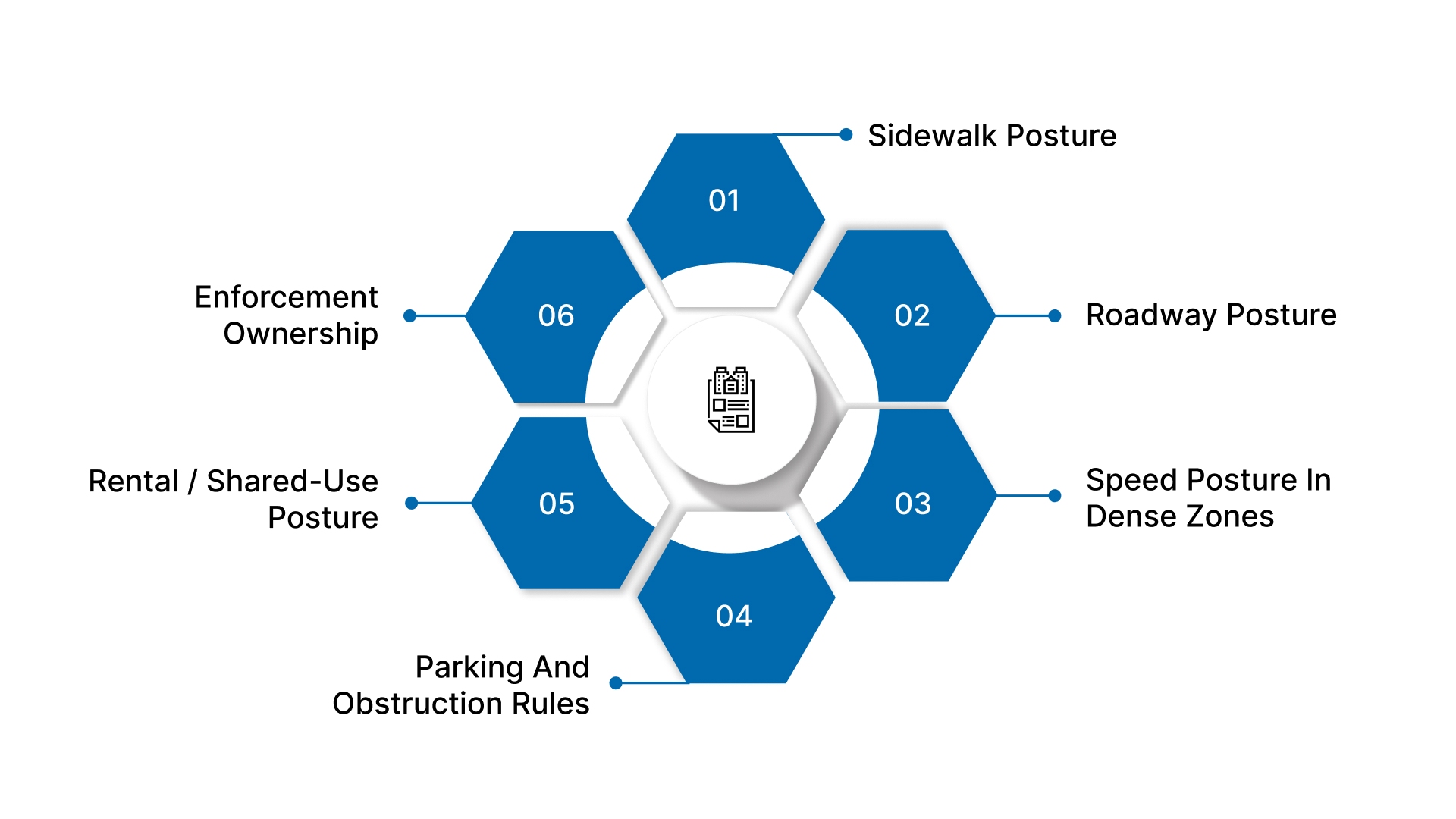
These are the buckets that most often change the operating reality:
- Sidewalk Posture: Full allowance, full prohibition, or restrictions by district (downtown cores, riverfronts, parks, business corridors).
- Roadway Posture: Rules tied to posted speed limits, lane requirements, or “where devices are treated as vehicles.”
- Speed Posture In Dense Zones: Location-specific limits in high-conflict areas, sometimes framed for micromobility broadly (not scooters only).
- Parking And Obstruction Rules: “No obstruction” standards, required placement (furniture zone), and authority to remove unattended devices.
- Rental / Shared-Use Posture: Whether rentals are allowed on public right-of-way at all, and if allowed, under what permit or pilot terms.
- Enforcement Ownership: Which agency enforces what (police vs parking enforcement vs transportation/public works) and what the escalation path looks like.
High-Signal Markets To Verify First
These are not the only cities that matter. They are high-signal because they tend to set expectations for how shared fleets are governed and reviewed.
St. Louis
St. Louis treats shared fleets as a managed program with a defined permitting pathway. Use the City’s shared bike and scooter permit process as your cue to treat local requirements as operational inputs, not background context.
Kansas City
“Kansas City has used program terms to govern shared scooter operations, including time-bound cooperative agreements approved through the city’s public meeting records. Treat this as a reminder that the enforceable requirements may sit in current program documents as much as in ordinance text.”
Other Missouri Cities
Do not assume a St. Louis or Kansas City approach carries over. Treat each launch city as its own verification file, and re-check effective dates, district overlays, and any permit/pilot terms before you publish rider policy or deploy hardware.
“Verify Before Launch” Micro-Checklist Per City
Use this method to prevent “state-law compliant” programs from failing under municipal rules.
- Pull the Current Ordinance and Overlays: Record the effective date, last amendment date, and any geographic overlays that change constraints (downtown districts, parks, trails, waterfronts).
- Confirm Where the Binding Requirements Live: Determine whether constraints are set by ordinance alone or whether a permit/pilot program adds enforceable conditions that function as the operating contract.
- Lock the City’s Operating Posture Snapshot: Capture a one-page view of what the city allows or restricts: sidewalk stance, roadway stance, speed stance (by district if applicable), parking/obstruction stance, and rental/shared-use stance.
A city map of what varies is only useful when constraints become enforceable operating behavior. That translation sits in the controls section that follows.
How Do Operators Translate Missouri Constraints Into Enforceable Fleet Controls?
City rules only scale when constraints become system behavior. The goal is simple: make compliant riding and parking the default outcome, then contain edge cases without adding headcount every time volume grows.
Missouri Scooter Compliance: Constraint → Control → Evidence Map
| Constraint Type | Typical Trigger | Operator Control | Evidence Signal | KPI To Monitor |
|---|---|---|---|---|
| Sidewalk Posture | Pedestrian conflict, downtown complaints | No-ride or slow-zone boundaries (severity set by local posture) | Zone-entry events + complaint tickets | Sidewalk-conflict proxy; complaints per 1,000 rides |
| Downtown Speed Posture | Near-miss reports, enforcement pressure | Slow zones + zone-based speed caps | Speed-cap breach events | Speed-cap breach rate; incident rate |
| Tourist Corridor Friction | Weekend surges, clustered foot traffic | Corridor controls around high-friction blocks | Zone-entry events | Complaint concentration: corridor incidents |
| Campus Boundary Posture | Shared paths, institutional restrictions | Boundary controls aligned to campus edges | Zone-entry + end-ride validation failures | Incidents near the boundary; improper end-ride rate |
| Parking Obstruction Risk | ADA complaints, blocked walkways | Corrals + end-ride validation | Mis-park reports + validation failures | Mis-parking rate; obstruction clearance time |
| After-Hours Riding Limits (If Used Locally) | Visibility risk, late-night complaints | Time-based restrictions or stricter night policies | Trips in restricted hours | After-hours trip rate; night incident |

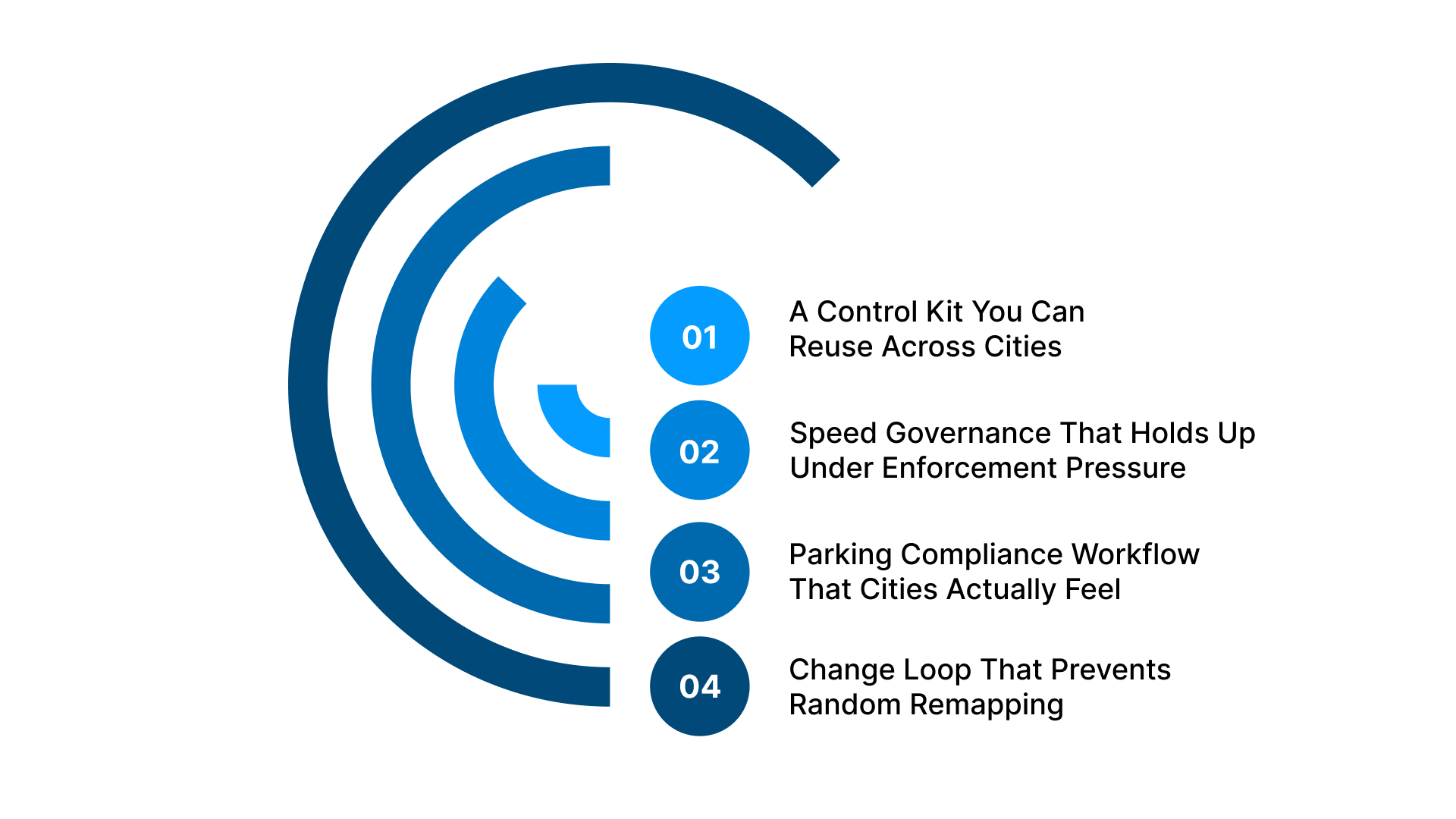
A Control Kit You Can Reuse Across Cities
Keep the architecture fixed and change parameters per market:
- Ride zones for where trips are allowed.
- No-ride areas for exclusions.
- Slow zones for conflict-prone environments.
- Parking corrals for end-ride control.
Assign one owner for edits. Log every change with the evidence that triggered it.
Keep the control kit fixed. Change parameters by market. That is how you prevent ops drift.
Speed Governance That Holds Up Under Enforcement Pressure
- Use zone-based caps, not a single fleet-wide rule.
- Treat dense cores, campuses, and tourist corridors as “sensitive areas” with stricter defaults.
- Allow speed-policy changes only with a simple internal standard: what evidence qualifies, who approves, and what rollback looks like.
Speed posture becomes a political issue when parking and obstructions are unmanaged.
Parking Compliance Workflow That Cities Actually Feel
- Set an end-ride standard your team can enforce: acceptable placement, correction trigger, and removal trigger.
- Run a simple response motion: intake → triage → dispatch → confirm resolution.
- Handle repeat issues by pattern: repeat locations, repeat users/devices, repeat time windows.
Controls drift unless updates are governed and checked after each change.
Change Loop That Prevents Random Remapping
- Cluster incidents into hotspots.
- Make small boundary/severity edits.
- Update rider guidance only when controls change.
- Monitor post-change performance before the next adjustment.
Controls become defensible when you can prove they work. The next section defines the KPIs cities and stakeholders use to judge program maturity.
What KPIs Prove Control to Missouri Cities and Stakeholders?
Cities do not renew programs because an operator “has policies.” They renew when the operator can show fewer repeat issues, faster resolution, and a clear corrective-action trail.
This section defines the measurement layer that makes your compliance posture defensible in stakeholder reviews.
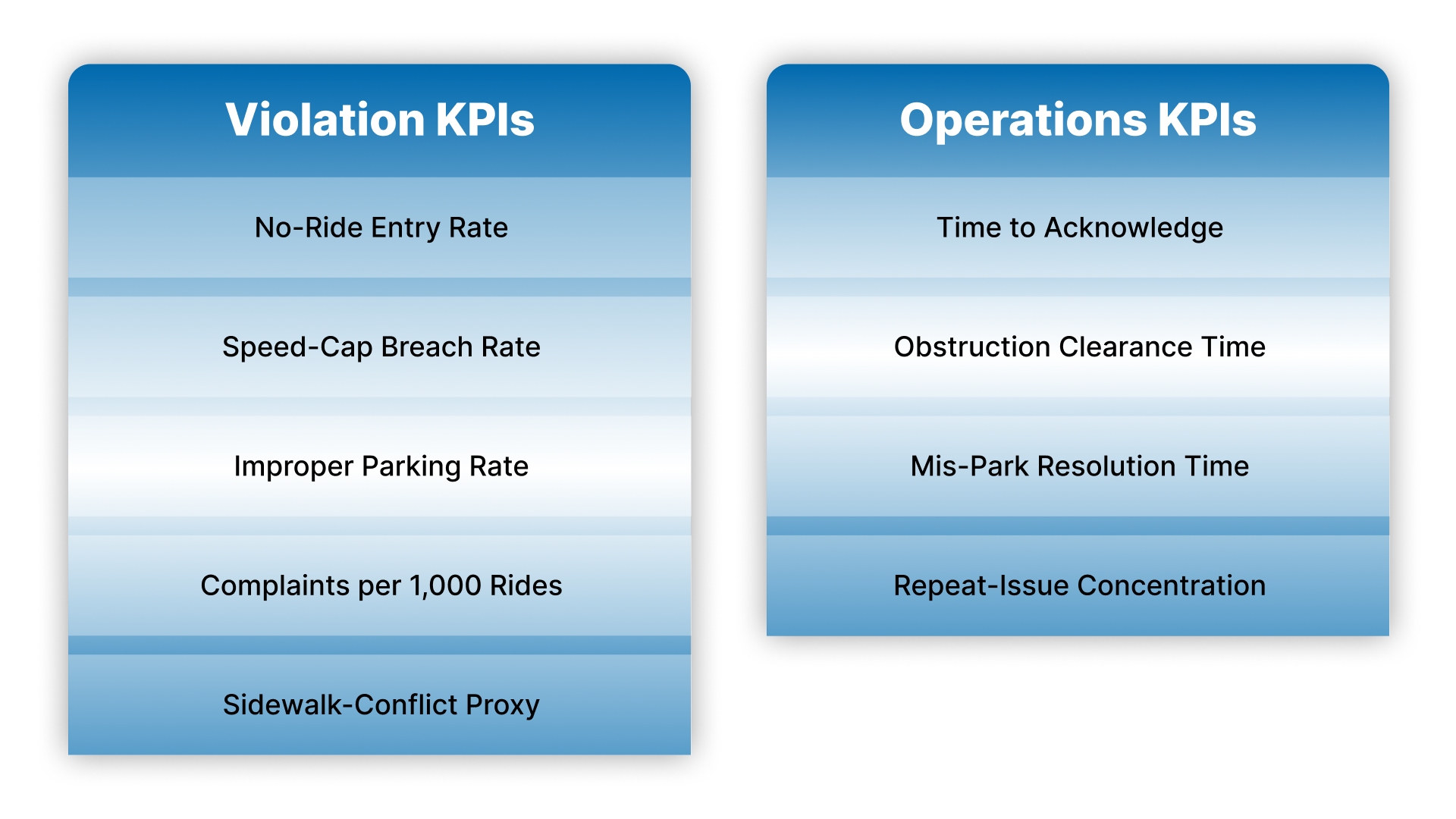
Violation KPIs
Use these to prove whether your controls are working in the field. Keep them normalized so they stay comparable across seasons and growth.
- No-Ride Entry Rate: Track entries per 1,000 rides and segment by hotspot. This is the cleanest signal that boundary design is being respected.
- Speed-Cap Breach Rate: Track breaches per 1,000 rides and segment by zone type (dense core vs corridor vs edge zones).
- Improper Parking Rate: Measure mis-parks per 1,000 trip ends and split into severity buckets if your intake allows it (minor placement vs obstruction-class issues).
- Complaints per 1,000 Rides: Track total complaints and complaint types (parking, riding location, speed). Mix shift matters as much as volume.
- Sidewalk-Conflict Proxy: Use one consistent proxy (complaint-tagged incidents, flagged segments, or patrol reports). Do not improvise definitions month to month.
Operations KPIs
These prove whether you can contain friction when something goes wrong. Cities often judge these more harshly than “rule adherence” metrics.
- Time to Acknowledge: Intake-to-assignment. This is your responsiveness signal.
- Obstruction Clearance Time: Time to clear devices that block curb cuts, ramps, entrances, or walkways. Treat this as a priority metric.
- Mis-Park Resolution Time: Report-to-correction time. Segment by zone so you can show targeted improvement.
- Repeat-Issue Concentration: The share of incidents coming from the top hotspots (top 5–10 locations). Concentration guides where you adjust operations first.
Package these KPIs into a two-page monthly city pack and run trigger-based corrective actions tied to zone class.
KPIs only work when launch readiness includes verified requirements, named owners, and escalation paths.
What Must Be Verified Before Launching a Shared Scooter Program in Missouri?
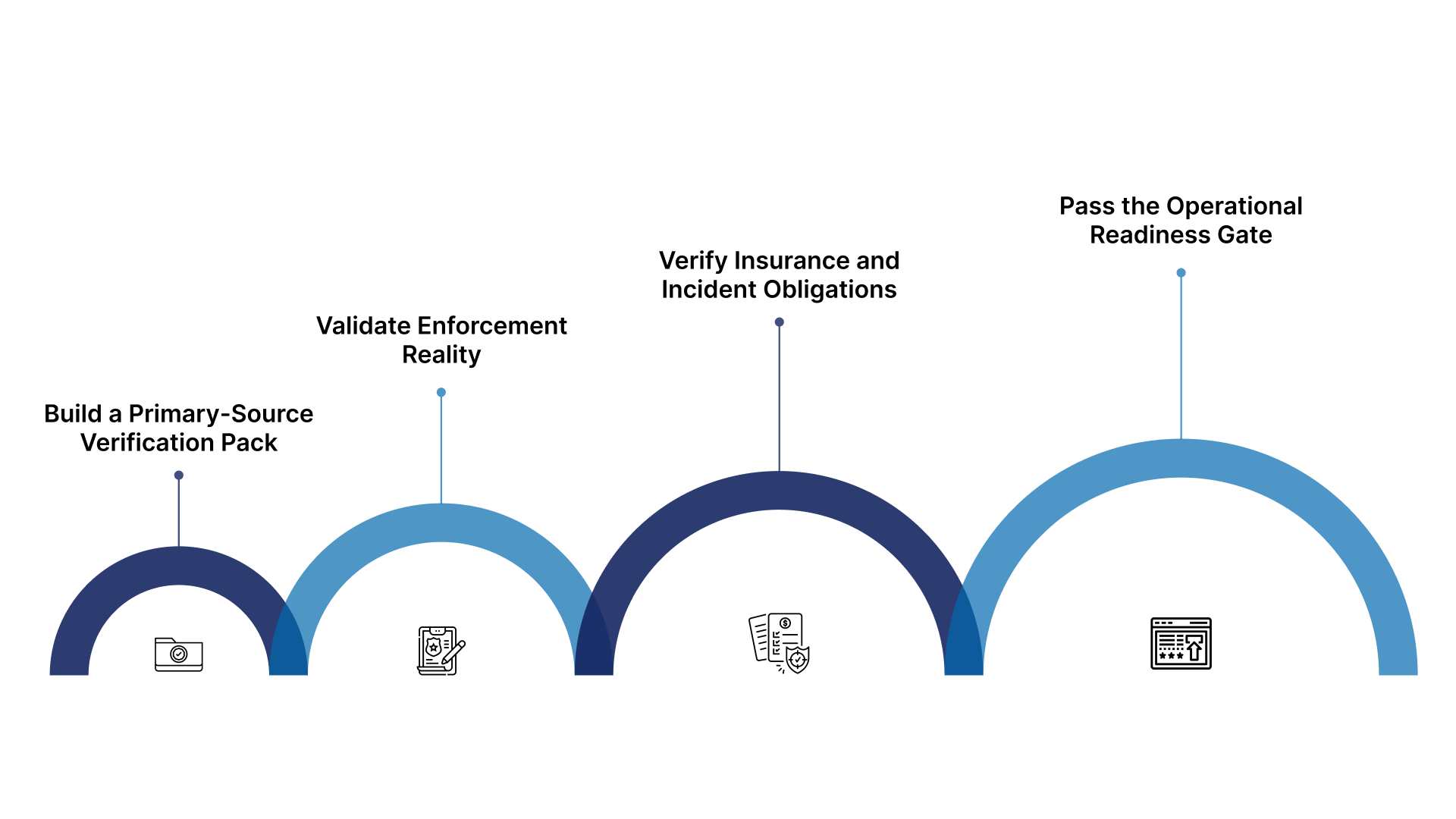
A Missouri launch usually fails for predictable reasons: teams rely on outdated city text, miss permit/pilot terms that function as the real operating contract, do not know who enforces what, or cannot clear obstructions fast enough once volume spikes.
This section is the readiness gate that prevents those failures.
1. Build a Primary-Source Verification Pack for Each Launch City
- Pull the current ordinance text and record the effective date and last amendment date.
- Identify any geographic overlays that change posture (downtown districts, parks, trails, campuses, special event zones).
- Confirm whether constraints come from ordinance, permit program, or pilot terms, then record which one controls each requirement.
- Capture the renewal owner and renewal timing if the city uses permits or pilots.
2. Validate Enforcement Reality
- Document which agency owns enforcement (police, parking, transportation/public works) and what each agency actually handles.
- Confirm the complaint intake channel used by the city (311, email, portal, hotline) and where escalations go.
- Verify the device removal or impound process: who can remove, where devices go, how retrieval works, and what triggers removal.
- Define one escalation path for high-visibility incidents (ADA obstruction, injury event, media attention, city council complaints).
3. Verify Insurance and Incident Obligations
- Confirm the minimum insurance requirements and the required documentation format (COI, certificate holder, additional insured language).
- Check whether the city specifies incident reporting timelines or required submission elements.
- Record any reporting or documentation obligations tied to permits or pilots (frequency, format, required fields).
4. Pass the Operational Readiness Gate
- Confirm staffing coverage for mis-parks, obstructions, and incident intake, including weekends and peak demand windows.
- Set internal service levels for acknowledgment and clearance that match city tolerance, then stress-test them during peak hours.
- Start with a footprint you can control (bounded geography + manageable device count).
- Set expansion gates tied to outcomes cities care about (mis-parking, complaints per 1,000 rides, obstruction clearance performance, hotspot concentration).
Tooling becomes a risk decision when Missouri compliance depends on city-by-city overlays (especially trails and districts), fast obstruction response, and reporting that can stand up in renewal conversations.
How EazyRide Turns Missouri City Rules Into Enforceable Operations
If your Missouri launch depends on enforcing city-specific zones, caps, and parking posture, manual workflows break as ride volume increases.
EazyRide reduces that execution risk by giving operators a white-label stack built for controlled operations: a branded rider app, an operator app for field teams, and an admin dashboard that acts as the control and reporting layer.
Use The Admin Dashboard as the Control System
- Run each city as its own configuration. Treat the dashboard as the single source of truth for operating areas, policy settings, and updates.
- Apply city-specific operating posture through centralized settings so changes do not depend on ad hoc ops instructions.
- Push updates fast when a city changes posture or when hotspot data forces boundary refinements.
Use The Operator App to Meet Field Expectations
- Assign and track tasks for mis-parks, obstructions, rebalancing, charging, and maintenance from one workflow.
- Create a repeatable response motion that holds during peak windows, not only during low-demand periods.
- Improve accountability by making ownership and status visible across the team for every field action.
Use Reporting Outputs for Stakeholder Reviews
- Pull trend views that show whether corrective actions reduced repeat issues over time.
- Use hotspot analysis to explain where friction concentrates and what was changed in response.
- Share resolution timelines that support credibility in permit conversations without rebuilding spreadsheets from raw logs.
If you are preparing a Missouri launch and need enforceable controls and stakeholder-ready reporting at scale, book a demo with EazyRide to map one target city into operating areas, speed posture, and parking rules, then review the outputs you can use for city check-ins and renewals.
Conclusion
Missouri is not a “state-law-only” market for shared scooters. The program that survives scrutiny is the one that treats local requirements as operating inputs, not background context.
That means your team can point to current primary sources, show who owns enforcement and response, and demonstrate that the fleet behaves predictably in the highest-friction zones.
The operational bar is practical. Keep the footprint controllable, react to hotspot signals fast, and maintain documentation that stands up in city check-ins.
EazyRide supports that approach by centralizing city-specific configurations, coordinating field response through the operator workflow, and producing reporting outputs that match how stakeholders evaluate program maturity.
FAQs
1. Are electric scooters legal in Missouri?
Often yes, but legality depends on how the device maps to Missouri definitions and what your launch city permits. Use the state statute as the baseline, then confirm the current municipal posture before you deploy.
2. Are electric scooters allowed on sidewalks in Missouri?
Sidewalk posture is usually set by city ordinance and can change by district. Treat sidewalks as a city-level verification item and align rider policy to the most restrictive zones you operate.
3. Do you need a license to ride an electric scooter in Missouri?
Requirements depend on device classification and the city’s enforcement posture. For shared fleets, confirm how the device is treated before publishing rider-facing rules or FAQs.
4. What is the speed limit for electric scooters in Missouri?
There is rarely one statewide number that applies cleanly to shared scooters. Cities and districts often drive practical limits, which operators typically enforce through zone-based speed policies.
5. Are rental scooters allowed in Kansas City or St. Louis?
It depends on the latest ordinance language and any active permit or pilot terms. Validate current documents and operating conditions before assuming rentals are permitted on public right-of-way.
6. Can Missouri cities ban or restrict scooter rentals even if state law allows certain devices?
Yes. Cities can restrict operations through ordinances, permits, and pilot program terms. Treat municipal requirements as binding conditions for launch and scaling.


